

Two agentic coding tools launched within two months of each other last year.
Both run locally in your terminal. Both support MCP servers and maintain persistent project context. The difference:
OpenAI’s Codex CLI is open-source under Apache-2.0.
Claude Code is not. At the foundation layer, they are otherwise functionally similar.
But here is where it gets interesting for B2B founders: Your GTM motion defines which one you pick.
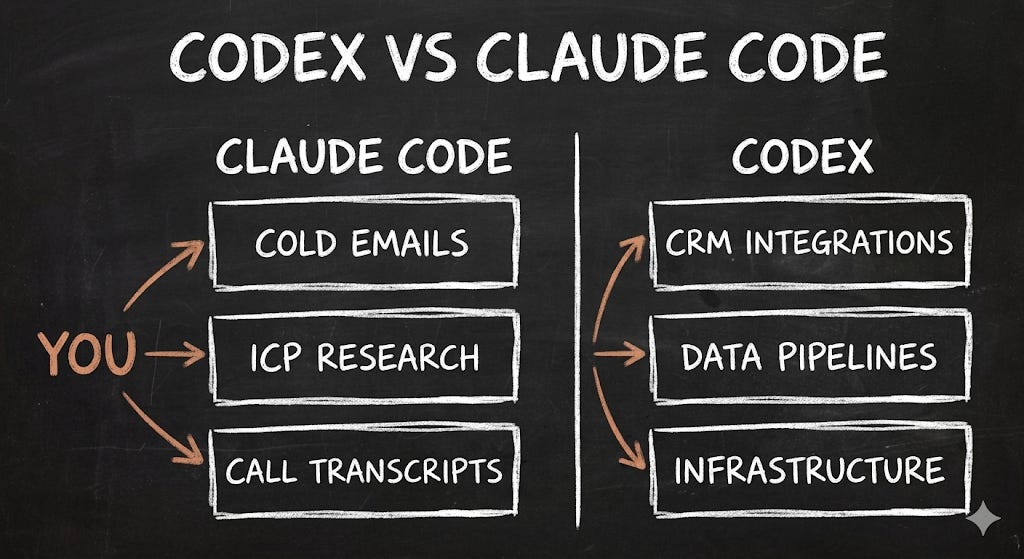
The short version: Codex builds your product. Claude Code sells it.
Let’s dive in.
Tribalism
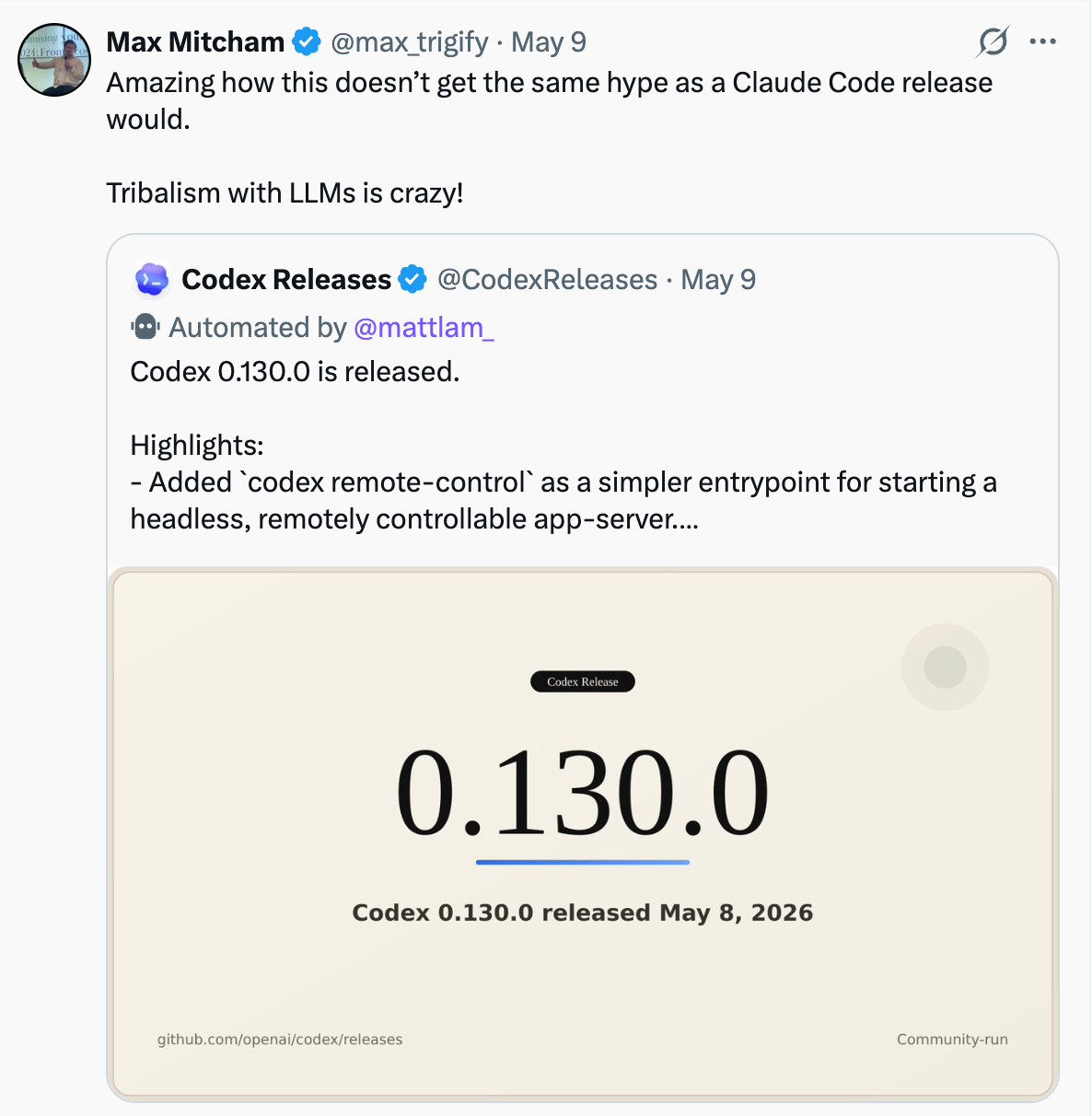
Max Mitcham, founder of Trigify, recently moved toward Codex and away from Claude Code, calling the community loyalty around the two tools irrational.
Codex CLI has over 700 releases on GitHub, around 74,000 stars, and a release cadence most open-source projects would be embarrassed to match.
For context, Claude Code sits at over 112,000 GitHub stars, and Gemini CLI has entered the race too.
All three are moving fast. In my read of the market, a comparable Claude Code release produces significantly more noise outside engineering circles.
But Max is running a heavy engineering operation where parallel agent workflows and complex codebases matter. His context is not yours if you are a B2B founder trying to build pipeline.
The tribalism exists because the two tools serve different work, and the communities that formed around each one reflect that split.
Claude Code went viral in the 2025 winter holidays when non-developers discovered it, including many non-programmers who used it for vibe coding.
By January 2026 the GTM community was fully inside it. Founders, operators, and GTM teams adopted it to build outbound systems, research ICPs, and draft sequences without writing code.
Codex stayed with engineers. Different work for different people, and different patterns.

Claude Code for GTM. Codex for the plumbing.
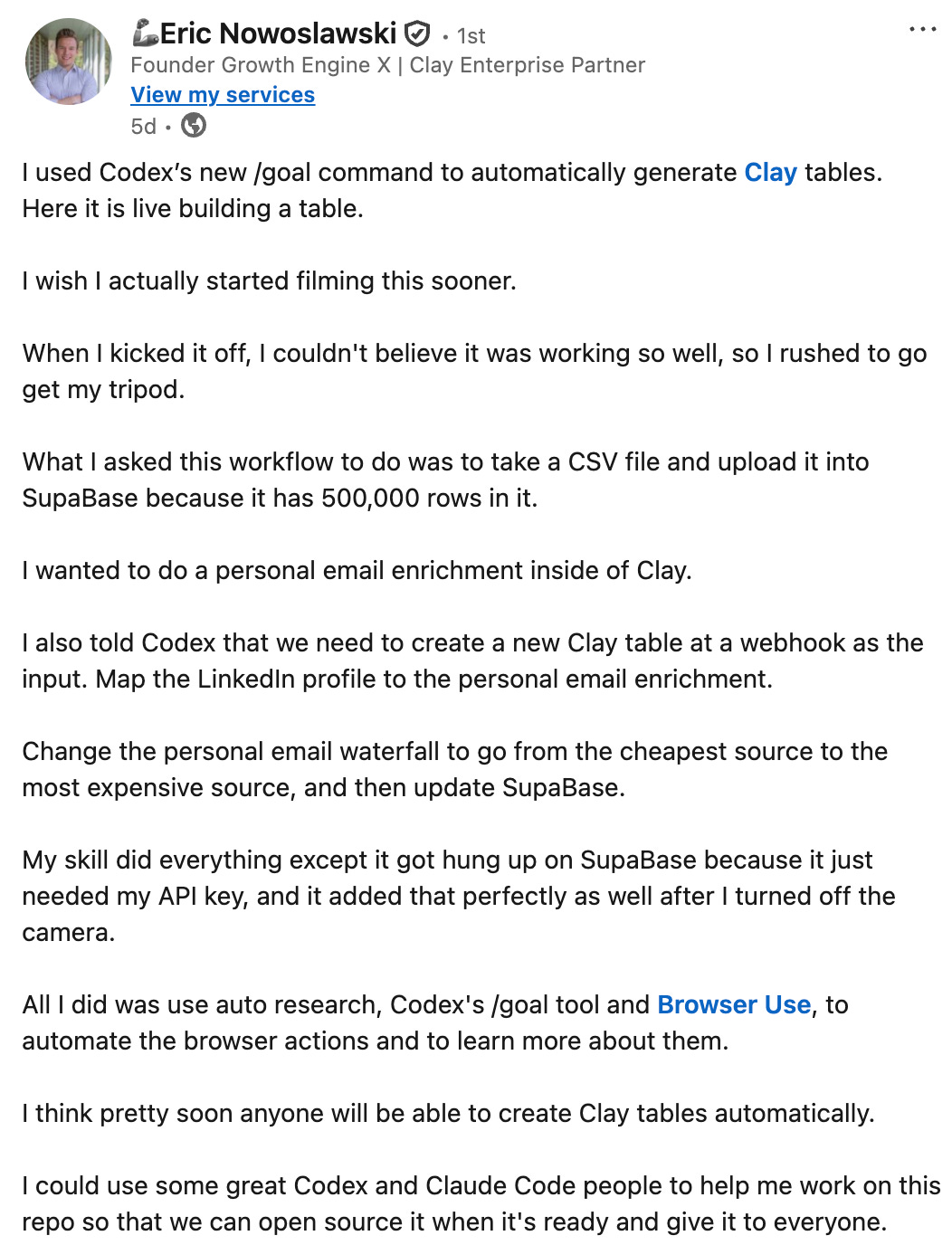
Eric Nowoslawski shared a session that made the split clearer than anything I have seen.
He used Codex’s /goal command to take a 500,000-row CSV, upload it to Supabase, create a Clay table via webhook, map LinkedIn profiles to personal email enrichment, configure a multi-provider waterfall from cheapest to most expensive source, and update Supabase with the results. All in one session.
His reaction: “I couldn’t believe it was working so well.”
That’s Codex doing what Codex does: complex, multi-step, production-grade infrastructure that would have taken a developer a full day to wire by hand.
This isn’t a threat to Claude Code, but proof of exactly why the two tools belong in different parts of your stack.
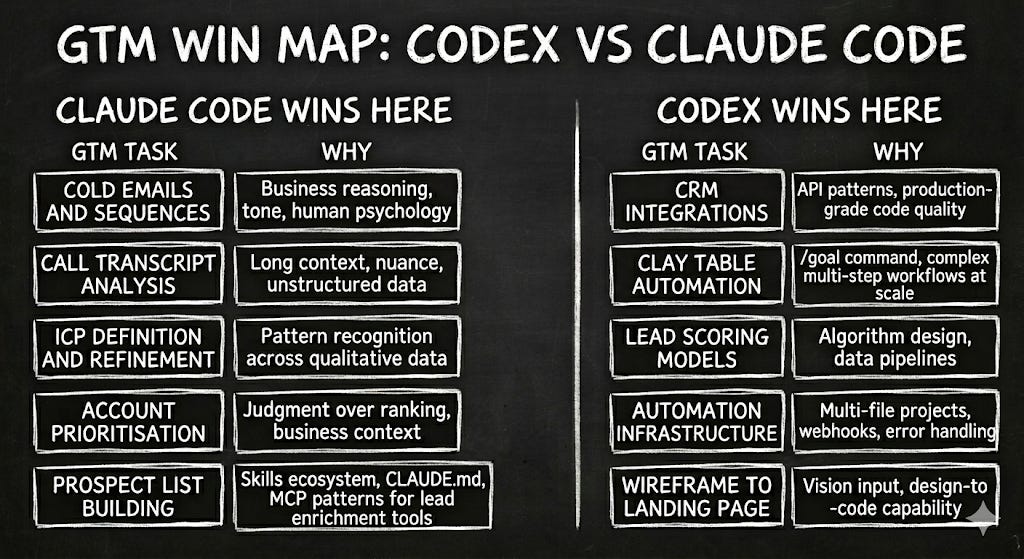
Where Claude Code wins for GTM:
Writing cold emails that sound like a person who understands their buyer’s situation
Analysing call transcripts and catching the moment a prospect went quiet because their champion left
Defining a sharp ICP by pattern-matching across customer interviews and win/loss notes
Prioritising accounts based on judgment rather than just a score
The list-building and enrichment workflows solving the same GTM problems
Where Codex wins:
CRM integrations
Lead scoring models
Webhook setup
Data pipelines, automation infrastructure, and design-to-code workflows from screenshots or wireframes.
Claude Code wins where the work requires more judgment, language, and an understanding of human context.
Codex wins where the work requires more precision, structure, and production-grade reliability. Shipping the infrastructure that will eventually run the motion Claude Code is designed to execute.
The founder who stopped guessing
A startup running an HR tech platform had twelve closed deals in the previous year, all from referrals and one conference. No outbound or system, and no way to repeat it.
I asked them what those twelve customers had in common. They all had HR teams and were mid-size companies. But beyond that they couldn’t tell why they bought and the others didn’t.
That’s the most expensive kind of not knowing.
We spent the first session loading closed-won notes into Claude Code. Call transcripts, CRM fields, email threads. Every one of their twelve customers had posted a People Operations or HR Systems role in the sixty days before first contact. Not a Head of HR. Specifically an operational or systems-focused hire, which meant they were trying to build process.
The second session built a scored list of thirty-eight companies showing the same signal right now.
The third session wrote the first three-email sequence using his exact proof points and a specific hook for each account based on what the job posting said.
They didn’t need Codex for any of that. Just a system that could read their own data, find the pattern, and turn it into outreach.
Takeaway
If you’re a B2B founder doing outbound, building prospect lists, writing sequences, and managing a lean GTM motion without a technical co-founder, stick with Claude Code.
The ecosystem was built for you. The Skills, the CLAUDE.md patterns, the MCP integrations for enrichment and list building, all of it compounds the longer you use it.
If you’re a GTM engineer or technical founder shipping production infrastructure alongside your sales motion, running complex data pipelines, or managing parallel agent workflows across a real codebase, Codex earns its place.
Pick the one that matches your motion, and don’t switch because of hype.
The best GTM system is the one you actually understand well enough to improve every week.
Sincerely,
Jasper
PS: Every week you run outbound without a signal-based list is a week you are reaching the wrong companies.
Join the founders who built their first signal-based list in a single Claude Code session.
—> The Claude GTM Starter Guide shows you exactly how: the setup, the CLAUDE.md, and the first session from scratch. One hour. Your first scored list by end of week.