


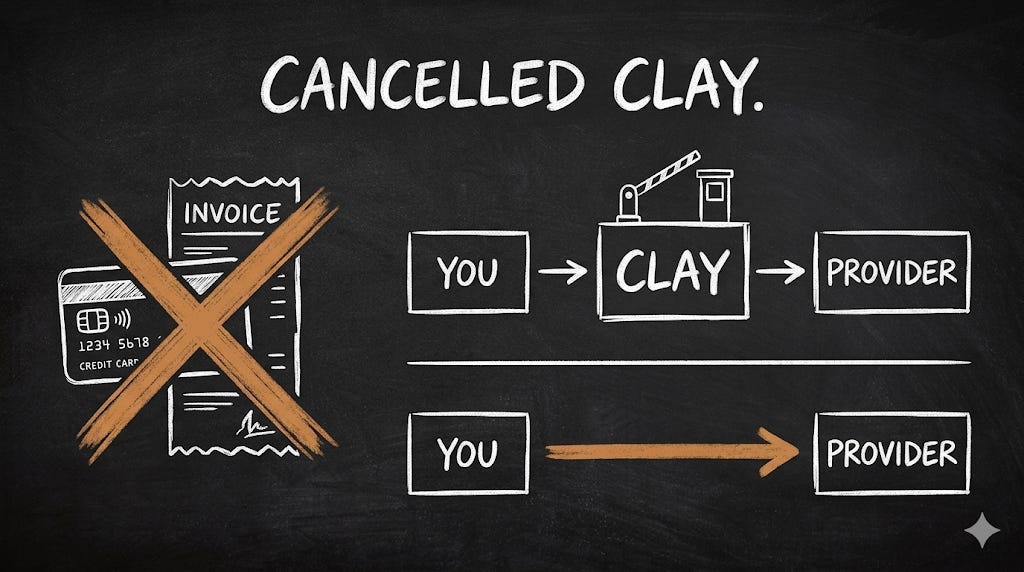
I cancelled my Clay subscription three months ago. My verified email hit rate barely moved.
That surprised me, because Clay had always felt essential. Then MCP came along and the thing Clay was doing for me turned out to be a single command.
Here’s what changed and how to run the same test yourself.
What MCP actually did
MCP, the Model Context Protocol, turns every data provider into a direct connection inside Claude. Lead enrichment providers like Apollo, Prospeo, Findymail, and a growing list of others can now be queried in plain English from a single terminal session, without Clay sitting in the middle.
Before MCP, the enrichment flow looked like this:
You → Clay → Data Provider → Clay → You
You paid Clay at every point in that chain. Their platform fee, their credit markup on top of the underlying data, and your time managing a visual interface that required attention at every step.
After MCP, the flow looks like this:
You → Claude Code → Data Provider → Claude Code → You
No intermediary, no platform to log into. The provider charges their standard API rate. Claude Code does the orchestration that Clay used to do, autonomously.
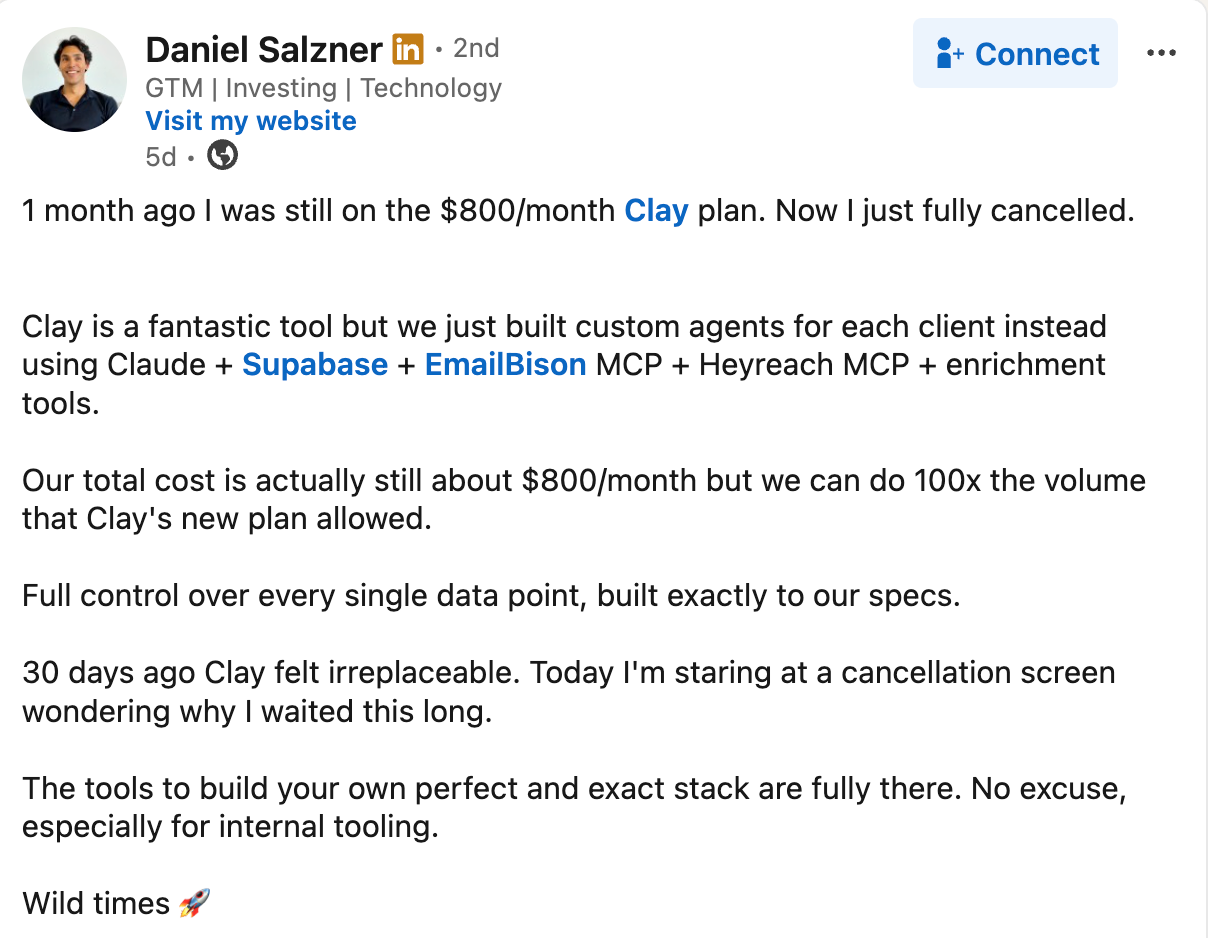
What this costs at founding team scale
The direct stack has three components:
Claude Pro ($20/month) or Max ($100/month if you are running heavy sessions across multiple workflows)
Lead enrichment: Apollo Basic ($49/month, 1,000 credits)/ Prospeo as a fallback ($39/month)
Total: $108/month on Pro, $188/month on Max
Clay’s pricing depends on your plan and how many providers your waterfall hits per contact.
Pull your last invoice and divide it by the number of verified contacts you actually got out of it. That number is what you are comparing against.
The more significant saving is not the money. Running an enrichment session with a Claude Code Skill file takes approximately 15 minutes of active time. The session runs autonomously while you work on something else.
Clay requires you to log in, configure a table, monitor the run, and export the results. For a team running enrichment weekly, that adds up to two to three hours a month spent managing the tool rather than using the output.
Where Clay still wins
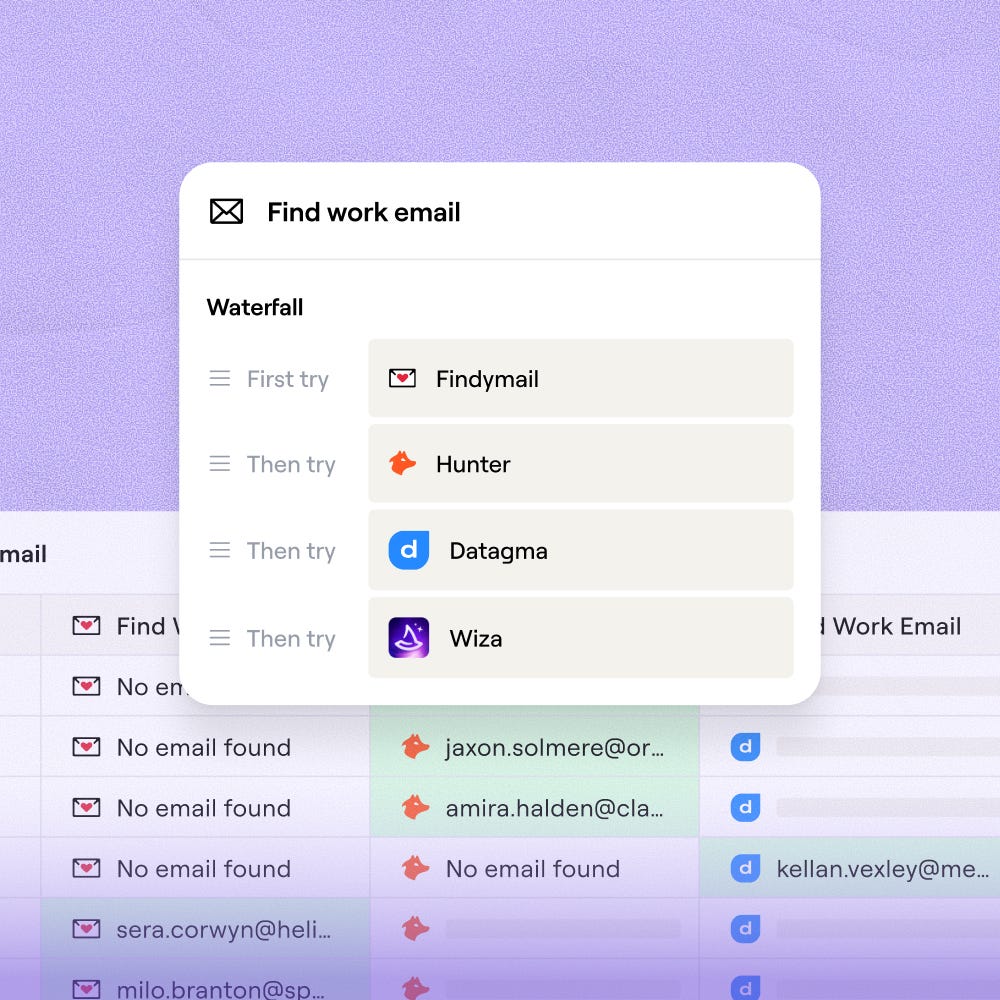
Clay’s waterfall across multiple providers produces higher verified email rates than a single direct connection for most ICPs.
If your coverage test comes back consistently low with one provider and adding a second does not move it, Clay’s multi-provider orchestration is doing a job the direct stack cannot replicate at the same hit rate.
The test that tells you which side of the line you are on is specific.
Take 20 companies from your actual account list. Run a contact enrichment session with your lead enrichment provider and count how many Champion contacts return a verified email.
Above 80%: one provider covers your ICP well. Send with confidence after a final real-time verification pass through NeverBounce or ZeroBounce.
60% to 80%: add Apollo/Prospeo as a fallback and re-run the test. If the combined hit rate clears 80%, the direct stack covers you. If not, Clay’s waterfall earns its cost for your specific buyer type.
Below 60%: the direct stack has a coverage problem for your ICP. Clay is worth keeping.
One important distinction worth making: a provider marking an email as verified is not the same as that address being deliverable today.
Provider databases update on their own schedule. Always run your final list through a real-time verification tool before any sequence starts, regardless of your hit rate.
Sending to stale addresses burns your sender domain faster than almost anything else you can do wrong in outbound.
The question worth asking
Most founders who run this exercise land in one of three places:
Clay is doing one job they are paying for three. They signed up to enrich contact data but are paying for a full platform including AI features, table logic, and integrations they never use. A single enrichment provider connected directly to Claude Code does the one job they actually need.
Clay is doing exactly what they need. Complex waterfall enrichment at scale with a non-technical team that depends on the visual interface. In that case, the direct MCP stack handles research and targeting while Clay handles enrichment.
Clay was solving a problem that no longer exists. They set it up when list building was manual. Now that Claude Code handles the research and targeting, the workflow Clay was managing runs through the agent. Clay became an expensive habit.
Which one applies to you depends on one number: your verified email hit rate on your actual ICP using a single direct provider. Run the test before drawing any conclusions.
Takeaway
MCP made Clay optional for one specific reason: if your Ideal Customer Profile is well-covered by one or two direct providers, the waterfall Clay runs across five or six providers produces marginal additional value at a meaningful additional cost.
Whether that applies to you comes down to the coverage test, and not your monthly contact volume.
The teams getting the most from their enrichment stack ran the coverage test, found out what they actually needed, and stopped paying for what they did not.
Three things to do before this disappears from your inbox:
Pull your last Clay invoice and calculate your cost per verified enriched contact
Run the 20-company coverage test with your lead enrichment tool directly
Compare the hit rate against what Clay produces for the same companies
If the numbers are close, you already know what to do.
Sincerely,
PS: The Claude Code Lead Enrichment Guide takes you from raw account list to a fully enriched CSV in one session. By the end you have:
verified emails and direct dials for every HOT and WARM account
a buying signal score with documented evidence for every row
a reusable/enrich Skill that runs the same process identically every time, without logging into Clay, exporting a CSV, or managing a waterfall manually.
Get instant access by upgrading to paid.