
A few months back, a founding team asked me for feedback on their email campaigns.
Six replies from ~ 2000 emails.
They had already rewritten the subject line three times, swapped the hook, tried a shorter version, tried a longer version, and run the whole thing through Claude twice to make it sound less salesy.
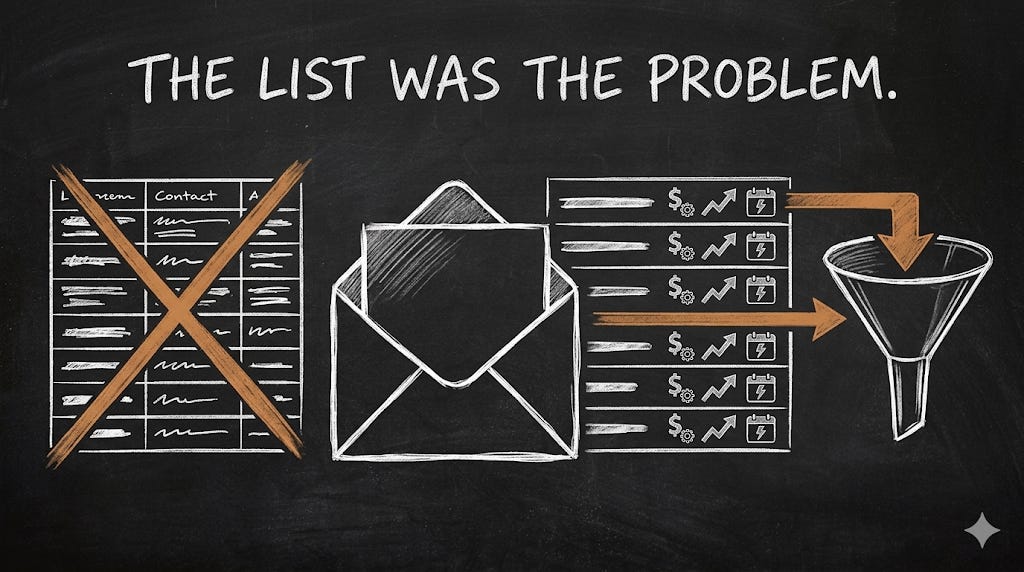
They thought the copy was the problem. I asked to see the list first.
The accounts were fine on paper: right industry, right company size, right job titles.
But there was nothing behind any of them.
No signal that any of those companies were actively dealing with the problem they solve.
They would pull filtered lists from Sales Navigator and start sending.
The copy wasn’t the problem.
Why the Copy Gets the Blame
Copy is visible and easy to change.
You can open a doc and rewrite a subject line in ten minutes, or add some fluffy personalisation.
Rebuilding the logic of your targeting however, finding better signals, questioning whether you are actually reaching the right accounts at the right moment, that takes longer and feels less like progress while you are in it.
So teams often skip it and keep iterating on the words while the real problem sits untouched underneath.
Static data tells you that a CFO at a 100-person SaaS company could theoretically need your product.
They tell you nothing about whether that specific CFO is thinking about that problem right now:
Whether they are three weeks into a new role and actively evaluating vendors.
Whether they just expanded to three new countries and their existing process is already breaking.
Whether a G2 review from last week suggests their current tool is causing them pain.
That gap, between who might care and who cares right now, is where most cold email campaigns go to die.

What A Signal Actually Looks Like
Say you sell finance automation. Your ICP is CFOs at Series B SaaS companies.
A static list gives you: CFO, Series B, SaaS, 50 to 150 employees.
That describes a few thousand companies. Most of them are not actively thinking about your problem today.
A signal-based list filters that down to: CFO at a Series B SaaS company that raised in the last 90 days, posted a Head of Finance role two weeks ago, and has two G2 reviews from the past month mentioning slow month-end close.

That describes maybe 40 companies, but every single one of them has a reason to care about your email today.
The first line of your email practically writes itself: “Raising a Series B usually means the finance team doubles before the systems do.”
That is not a clever copywriting trick, but a direct consequence of knowing what is most likely happening inside that company right now.
The signal is doing the work, and the copy is just the delivery mechanism.
3 Questions Every Email Must Answer
Once you have the signal, the email structure is straightforward.
Every first email needs to answer three questions, in this order.
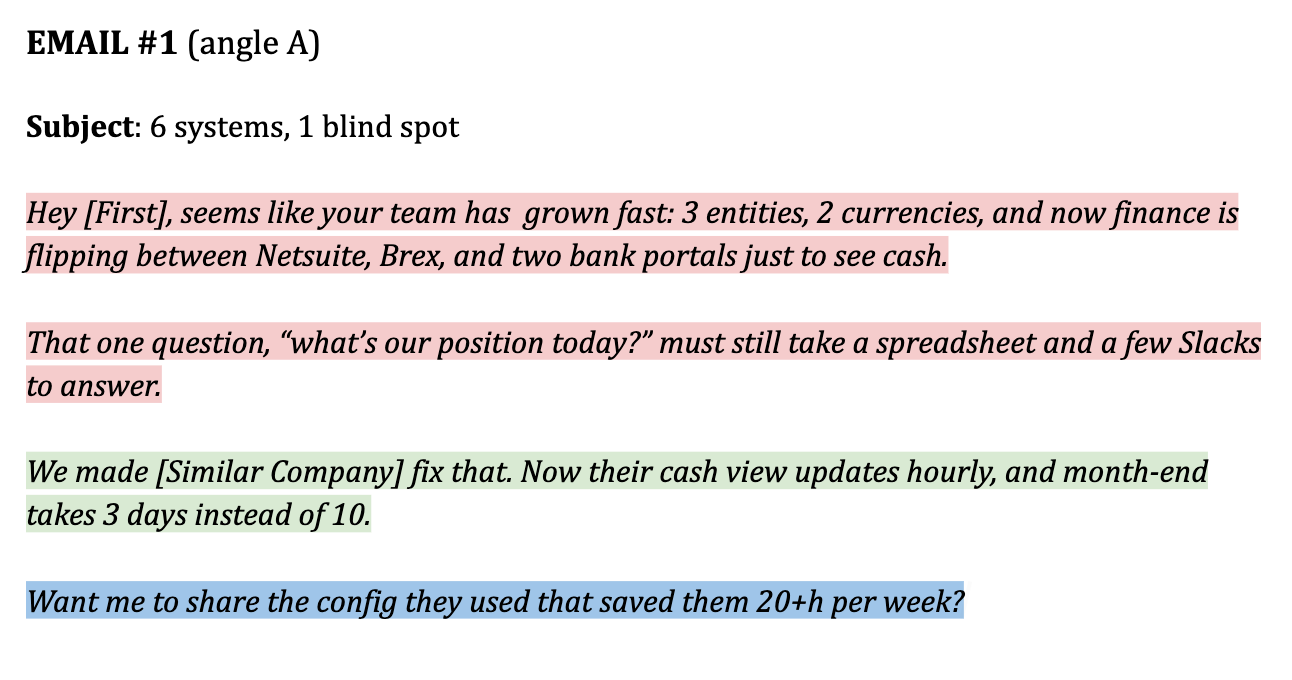
Why ME? A direct observation about what the signal implies for their business (a business problem). This is the RELEVANCE piece.
“Raising a Series B usually means the finance team doubles before the systems do” is relevance. “
Saw your post about hiring, congrats on the growth” is personalisation.
They sound similar, but they perform very differently.Why YOU? One proof point of how you solve that problem, ideally from a real client, with a real number. This is the CREDIBILITY piece.
Not “We help companies like yours improve efficiency.” That could describe anyone.
“We made [vertical] teams cut reporting time from 5 days to 2” is specific enough to be believed.Why ACT? Not a meeting request. Something they would actually want even if they had never heard of you.
A short video, a template, a framework. Something that delivers value before asking for anything in return.
“Made a video showing exactly how they set this up. Worth 2 minutes?” is an offer.
“Would you be open to a quick call?” is a tax.
When all three land together, your email does not feel like outreach, but something the prospect could have wished to receive.