

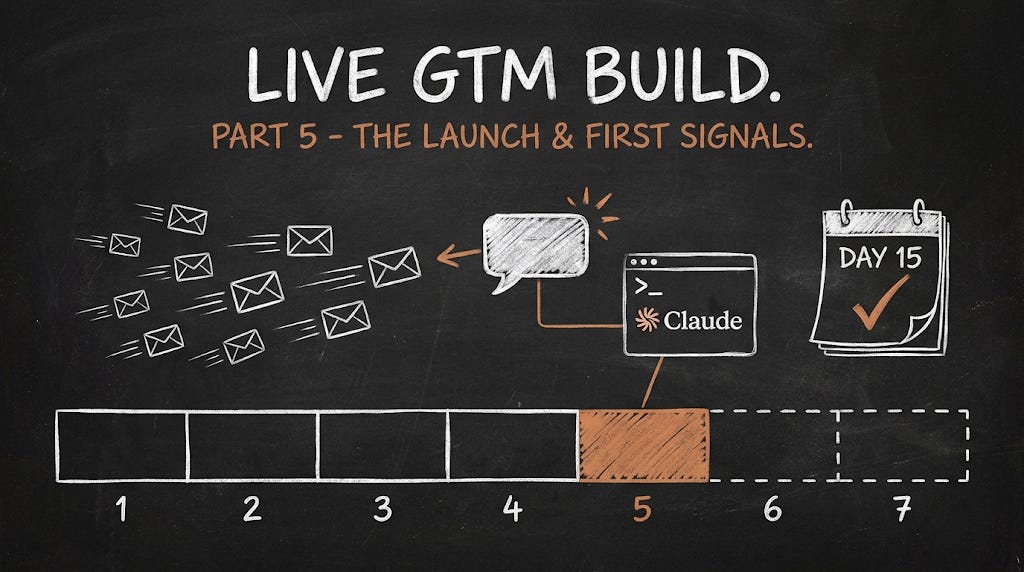
In part 4 of this GTM build report, we wrote the copy: 2 versions of Email 1, and a free page behind Emails 2 and 3.
Now everything goes live.
In part 1, I promised you the story behind one number: the first meeting came 15 days after the first email.
This is that story, along with the lead we lost by being too generous.
This is part 5 of the build. Each phase gets its own part, with the numbers, good or bad.
🗺️ The build in 7 phases
Phase 5: LAUNCH AND FIRST SIGNALS
Phase 6: RUN AND FIX
Phase 7: RESULTS AND THE VERDICT
This part covers phase 5.
Quick recap: the client
The client is a remote ecommerce marketing agency of around 60 people. It sells retention services to Shopify brands.
They had switched cold email off for a year after 2 expensive tries that didn’t work.
The founder’s brief: “I just want to avoid very expensive tests.”
The market: Shopify brands are one of the most pitched audiences in B2B, and agencies send them the same offer every week.
As I wrote in part 1, I almost said no for that reason. That’s also what makes it a good test.
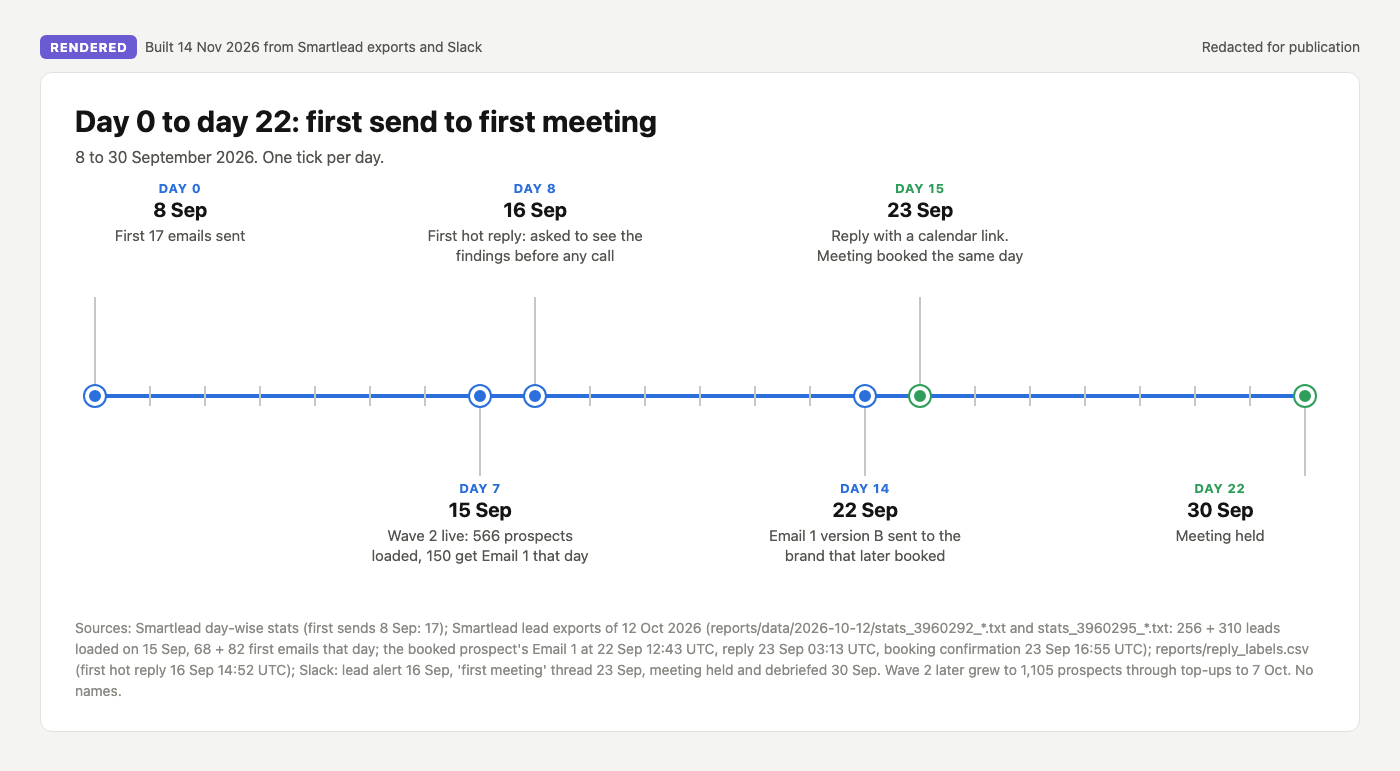
📅 Day 0 to day 22
Here’s the launch as it happened:
8 September, day 0: the first 17 emails go out
15 September, day 7: the second wave launches, with 1,105 prospects
16 September, day 8: the first hot reply comes in from the president of a skincare group. He wants the findings before any call
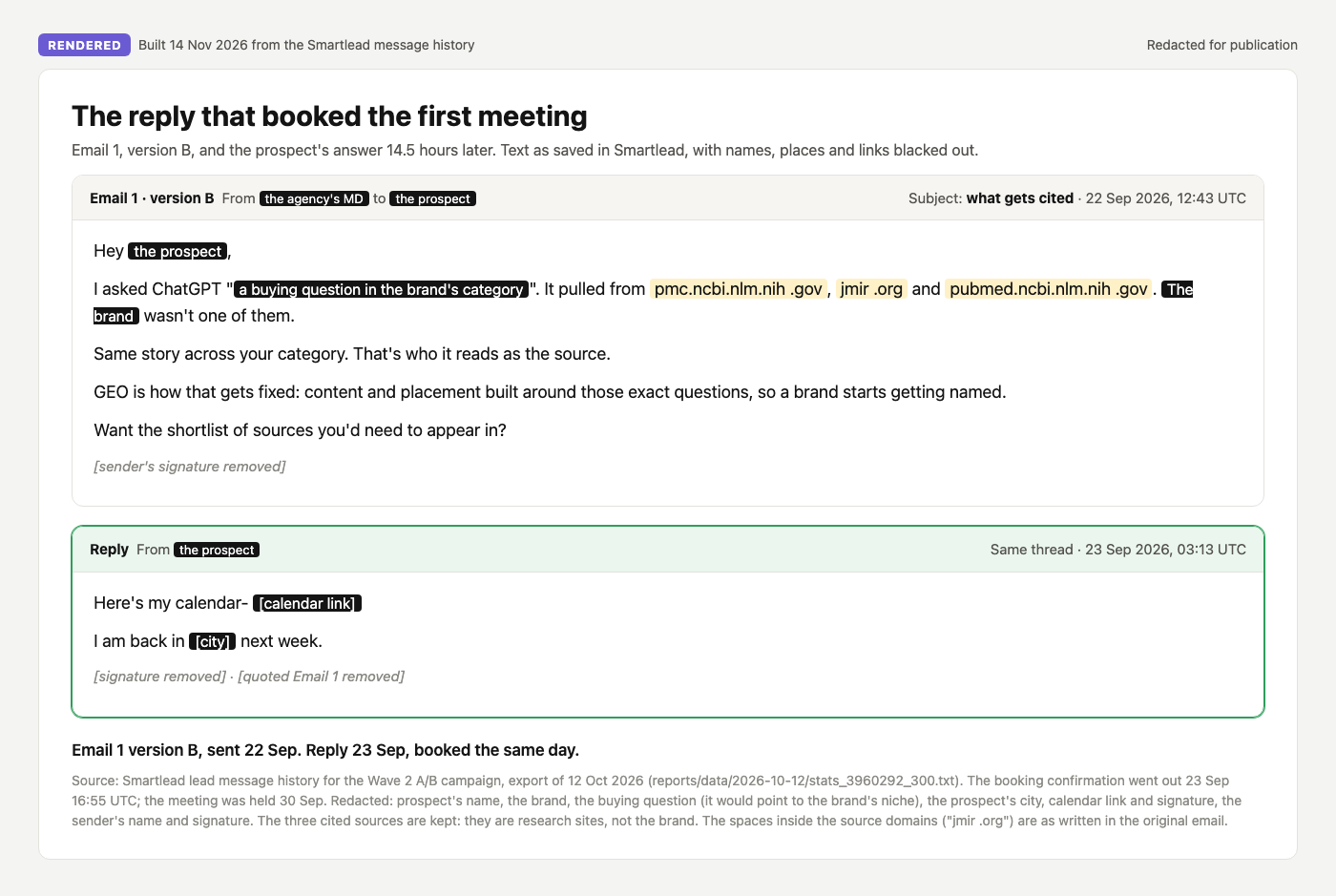
22 September, day 14: a brand gets version B of Email 1, the one that names three sources
23 September, day 15: the prospect replies overnight with their own calendar link, and the agency books the meeting the same day
30 September, day 22: the meeting takes place
After the call, the agency’s MD wrote in our Slack channel:
“Interesting call, there is definite interest. They are leaning towards a performance based fee. We will send an offer. Not an easy niche.”
The CEO answered a few minutes later:
“WOW !!!!! This made my evening seriously.”
I’ll report the outcome in part 7.
🎁 The lead who got too much for free
That first hot reply on day 8 taught us more than the meeting did.
He asked to see the findings before agreeing to a call.
The team wanted to impress him, so we sent a teaser, then a full analysis of 72 AI answers, then a paid offer.
He read the analysis carefully and found a data error in it. He never booked a call.
That’s the risk of sending everything by email. A long analysis gives the prospect a long list of things to pick apart, and no reason left to talk to you.
From 29 September, we followed one rule: anyone who replies gets a teaser of their own result by email, and the full breakdown only on a 20-minute call.
📊 The first numbers
Here are the first two waves, counted on 12 October:
1,195 prospects contacted
10 human replies
3 positive replies
1 meeting booked
That’s a positive reply rate of 0.25%. It’s low, and it’s in one of the toughest markets for cold email, so I won’t dress it up.
Part 7 holds the full verdict.
Take this to your own campaign
Strip away the AI search angle, and 1 rule from this launch works for any outbound:
Decide who answers a hot reply, how fast, and what you give away, before the first email goes out.
Before you launch, write down three things:
Who replies: the one person who answers hot replies, and who covers when they’re away
How fast: same day, next day at the latest. Our slowest hot reply took three days because we kept passing the draft back and forth
What stays for the call: one teaser number goes by email, and the full answer waits for the call
This works the same on LinkedIn as in email.
I wrote the full version for LinkedIn, from first reply to booked meeting, in Booking Meetings on LinkedIn with Claude in Chrome.

🧰 Tech stack for this phase
Sending and inbox: Smartlead, where every reply lands in one master inbox
Reply check: a scheduled Claude Code task that runs every evening, Monday to Saturday
Team chat: Slack, where every hot reply gets posted for the agency to see
Landing pages: Send.co, where visits are tracked through the lead’s email in the link
Calling: Claude in Chrome, which adds page visitors to a call list
📍 Phase 5: Launch and first signals
Seven steps, from the first send to the first meeting:
Launch small, with a first wave you can read by hand
Read your own first sends
Catch every human reply, every evening
Answer the same day
Give a teaser, and sell the call
Follow up the people who clicked
Count meetings instead of replies
Below you’ll find every step in full, with what we did, what I’d do differently, and the prompts.
Inside:
The bug that sent 13 prospects the same first email twice, and the rule that stopped it
The reply-check prompt that runs every evening while you sleep
The teaser reply that asks for a call without giving the work away
What happened when we called 8 page visitors
The two numbers worth tracking at launch
Download: the reply-handler skill, which catches, labels and drafts an answer to every reply