

In part 3 of this GTM build report, we found the signal: each brand’s own ChatGPT result.
Today we look at the step most people start with, and that we left until fourth: turning that signal into emails a stranger engages with.
This is part 4 of the build. A new part at each phase, with the numbers, good or bad.
👷🏼 The build in 7 phases
Phase 4: THE COPY AND THE PAGES
Phase 5: LAUNCH AND FIRST SIGNALS
Phase 6: RUN AND FIX
Phase 7: RESULTS AND THE VERDICT
Quick recap: the client
A remote ecommerce marketing agency, around 60 people, selling retention services to Shopify brands.
Cold email had been switched off for a year, after 2 expensive tries that didn’t work.
The founder’s brief: “I just want to avoid very expensive tests.”
The market: Shopify brands, one of the most pitched audiences in B2B. Agencies pitch them the same offer every week.
✍️ Why the copy came 4th
Plenty of teams start with the copy.
We wrote it after the infrastructure, the list and the signal, for one reason: by then, the email had something true to say.
Every first email opened with a fact about the prospect’s own brand:
A question we asked ChatGPT
The sources it named
The fact that their brand wasn’t one of them.
The copy didn’t have to persuade anyone. It just had to report what we found, in plain words.
🏆 The email that booked the 1st meeting
We wrote two versions of Email 1, around the same scan:
Version A, the absence angle: “we asked ChatGPT five buying questions, and your brand didn’t come up in any of them”
Version B, the sources angle: “we asked ChatGPT one question, here are the three sites it named, and your brand wasn’t one of them”
Version B booked the first meeting. Its subject line: “what gets cited”.
Now the numbers, from the report three weeks in:
Version A: 987 leads, 6 human replies, 2 positive (0.20%)
Version B: 568 leads, 8 human replies, 2 positive (0.35%)
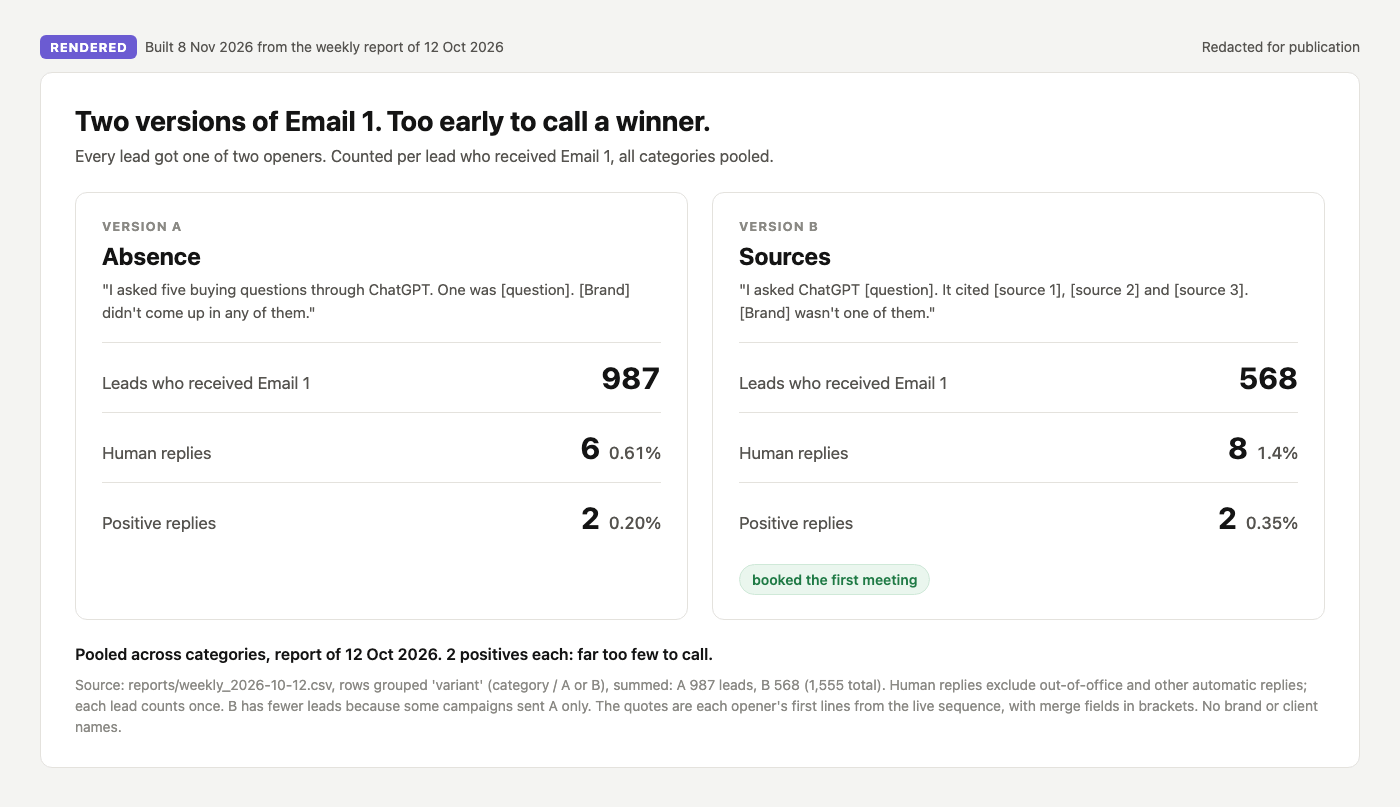
Two positive replies each. That’s far too few to call a winner, so I won’t.
Version B also got more “no thanks” replies, which tells you it got read more. That’s all it tells you.
Part 5 (next week) has the story of the meeting itself.
🧑🏻💻 How to take this to your own campaign
Strip away the AI search angle, and one rule from this build works for any outbound:
Open with a fact the prospect can check in ten seconds.
Version B didn’t win on clever wording. It named three real websites.
Anyone could type the question into ChatGPT and see the same answer. That’s what made the email believable before it asked for anything.
Before your next campaign, test your first line against three questions:
Is it about them, or could it go to 500 companies unchanged?
Can they check it, in a job post, their own website, a public list?
Did you find it, or is it their own news read back to them?
Three yeses, and the copy can stay plain.
A no on any of them, and better wording won’t save it: instead of the email, it’s the research that needs work.
I wrote about why this matters, and how to research every prospect in 2 minutes instead of 10 in This Claude Skill Writes Emails That Book Meetings.

🧰 Tech stack for this phase
Writing: Claude, with the YYY email prompts
Sending: Smartlead, for the sequence, the spintax and the two versions of Email 1
Landing pages: Send.co, one page per category
Claude Code: building the sequences in Smartlead, and checking every merge field against the list
📍 Phase 4: The copy and the pages
Eight steps, from a scan result to a sequence that’s ready to send:
Pick the frame: YYY-email inside a 3-step sequence
Write Email 1 around the signal, in two versions
Write the subject lines
Add spintax, so no two emails go out the same
Write Emails 2 and 3 around a free resource
Build the pages
Decide what stays free
Test before anything sends
Below: every step in full, with what we did, what I’d do differently, and the prompts.
Inside:
The full sequence: both versions of Email 1, Emails 2 and 3, word for word
The 16 subject lines from both versions, and the one that booked the meeting
How much spintax is enough, and where never to use it
How we tracked page visits with a tool that can’t build pages in bulk
The rule for what you give away, and what you save for the call
Download: the sequence-builder skill, which turns any signal into a 3-email sequence