

You post three times a week. 5 likes, mostly from peers.
Or you send connection requests every day.
More than half get ignored, because nobody knows who you are.
Two different problems, with the same cause.
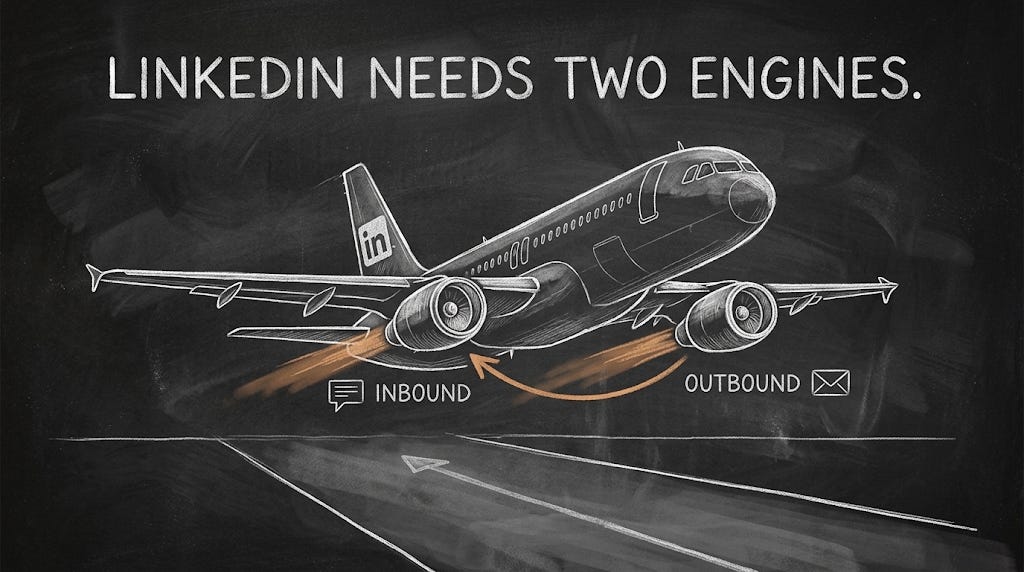
You’re flying on one engine and wondering why you can’t get off the ground.
✈️ Two engines
Think of LinkedIn like a plane.
It needs traction to take off, and it has two engines to get it:
The inbound engine: people see your posts, check your profile, and come to you
The outbound engine: you find the right people and start the conversation yourself
Run one engine and you’ll crawl down the runway.

Run both and each one feeds the other, until the whole thing lifts off.
📥 How the inbound engine powers outbound
When your request lands, the other person looks at your name, your face and your headline.
They decide in about 2 seconds.
If they’ve seen your posts, your name rings a bell. That familiar feeling gets requests accepted and DMs answered.
Your posts also sit on your profile. When a prospect checks you out before replying, they find proof instead of a sales pitch.
📤 How the outbound engine powers inbound
Every buyer you connect with starts seeing your posts. So outbound builds the audience you want: buyers, not only peers.
Then the DMs push it further: LinkedIn’s feed favours people you interact with.
Start a conversation with a buyer, and your next posts show up in their feed more often.
So every DM warms up your content, and your content warms up your next DM.
And every conversation tells you what your buyers care about: Their questions, their objections, and their words.
That’s your next post, written by your market.

🎟️ Want the inbound engine running properly?
The Reply io team is running a free livestream this Thursday.

They’ll cover:
How to grow your presence on LinkedIn
How to post in a way that pulls your audience in
How to turn that audience into warm leads.
Thursday 1 October · 5 PM UK / 6 PM Central Europe / 12 PM ET
You’ll also walk away with:
The hooks that got Reply io 3M+ impressions on LinkedIn, with why each one worked
A cheat sheet for never running out of post ideas
The checklist the Reply team runs before every post
And the outbound engine?
That’s what I’ve been building on Founder’s GTM. The full system, in the order you’d set it up:
1. Find buyers showing intent.

2. Get your requests accepted.

3. Turn connections into replies.

4. Turn replies into meetings.

Each one comes with the Claude prompts to run it.
BONUS: Turn your DMs into posts
Here’s where the two engines connect.
First, get your conversations. There are two ways:
Quick: open your LinkedIn inbox with Claude in Chrome and let it read your recent threads
Complete: export your data from LinkedIn (Settings → Data privacy → Get a copy of your data → Messages), then upload the file to Claude
Then run this prompt:
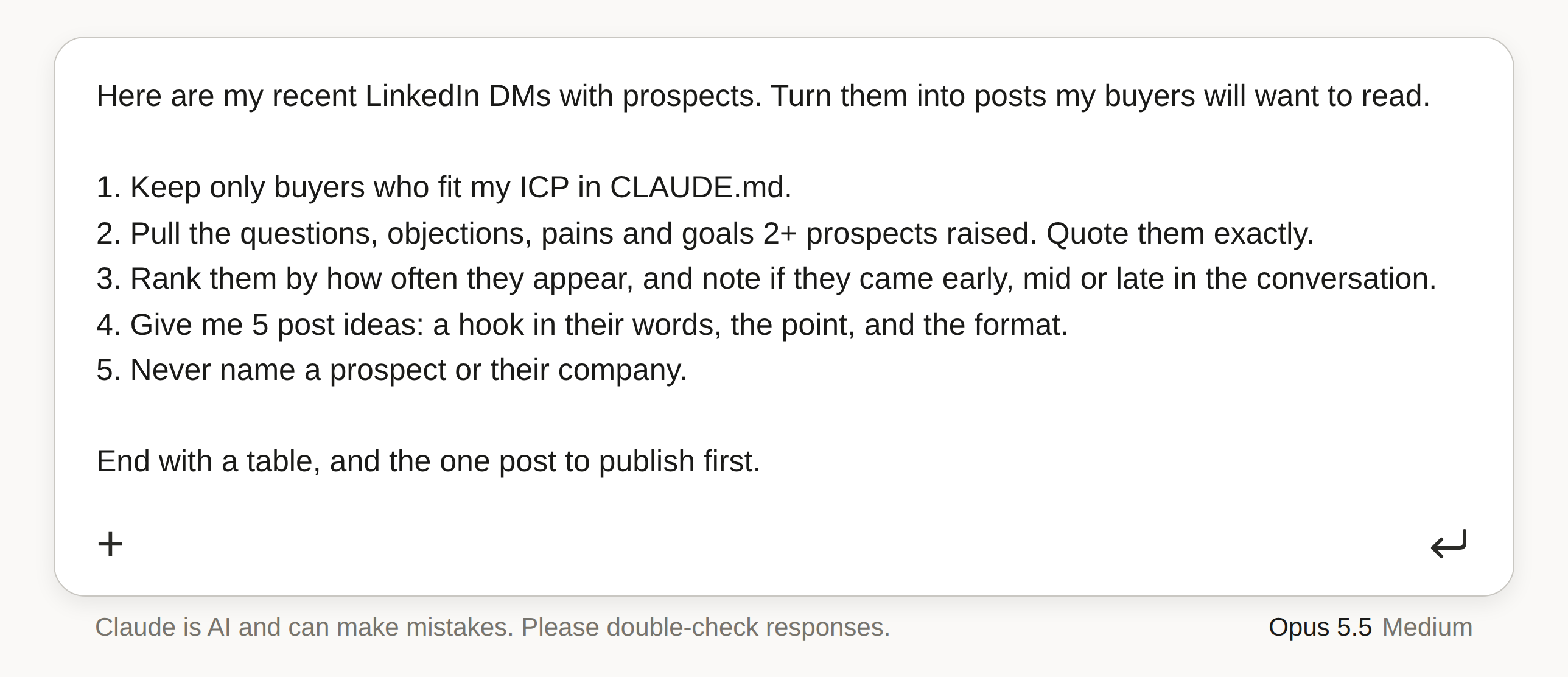
Your buyers wrote those posts already. You’re just publishing them.
Takeaway
Posting alone builds an audience slowly.
Outbound alone knocks on the doors of people who’ve never heard of you.
Two engines, and each one feeds the other.
Posts make your name familiar before the request lands.
Conversations put your posts in front of buyers, and hand you the posts worth writing.
That’s the traction that gets the plane off the ground.