



0.2%. That’s the meeting rate inside a normal, well-run outbound team.
In one case, 15 salespeople with good process, covering the whole country.
2 meetings for every thousand people they contacted.
Now here’s what a founder gets, working alone, no team, no tools, squeezing outbound in between everything else: 0.5% to 1%.
That’s 2.5 to 5 times better than the professionals.
This article came out of multiple conversations between Jasper Vanu and Doug Bell.
Jasper writes Founder’s GTM, on building Claude-based GTM systems for founder-led teams.
Doug writes Cannonball GTM, on pain-based segmentation and finding buyers before they start shopping.
Clips from these conversations are coming to Notes and LinkedIn over the next few weeks.
Subscribe to stay tuned.
We see this from opposite ends.
Jasper Vanu | Claude for GTM works with founders starting outbound, one to ten million in revenue.
Doug Bell works with growth teams further along, ten and twenty million and up.
Doug: “I get them after Jasper’s done with them, a few years later.”
Same companies, different years. The number keeps falling as they grow.
The question very few can answer
Ask a founder how many meetings outbound booked last month and you’ll get an open rate back.
Jasper:“Usually there is no answer to the question, so then we know where we are.”
Some weeks it’s LinkedIn, some weeks nothing.
The email tool shows opens and replies, so opens and replies become the scoreboard.
Ask a growth team and you get the same problem wearing better clothes.
Dashboards everywhere: CAC, pipeline, reply rate, sequence completion.
Doug’s sat in reviews where the reply rate looked great and nobody could say how many meetings it produced.
Here’s the number that matters:
Meetings booked ÷ people contacted
Why that one:
Opens tell you your subject line or headline worked
Replies tell you someone was curious, and curiosity is free
A meeting costs them something, which is why it’s the first honest sign they care
Doug’s written the longer version: why everyone tracks activity instead of need.

Two doors, one question:
Founder? Can you say how many meetings outbound made last month?
Running a team? What’s your rate, and what should it be?
Which brings up the obvious thing. What should it be?
🪜 The ladder
Here are 4 numbers from our combined client work.
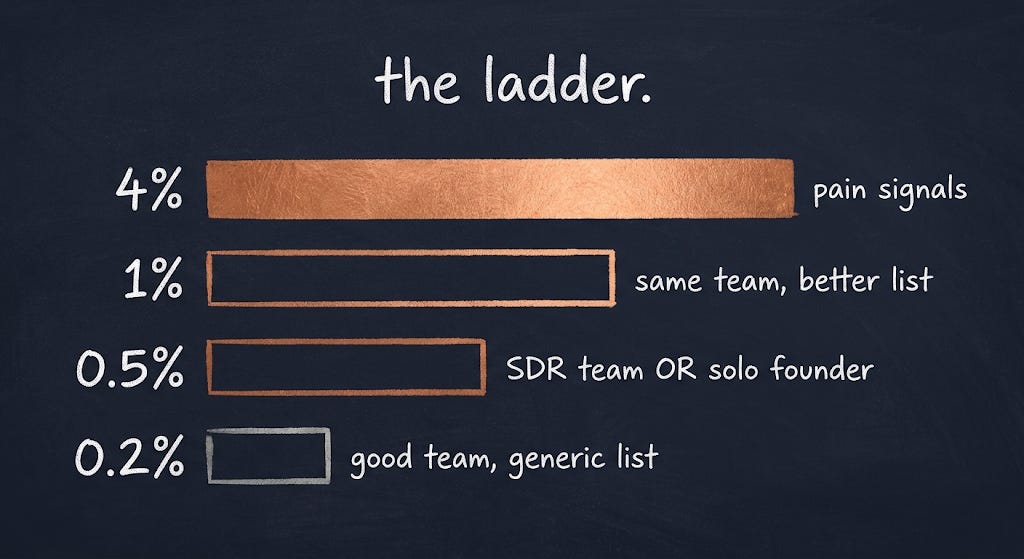
0.2% - the baseline. Good team, real effort, generic list. Where outbound usually lives, and where teams rarely check.
0.5% - shows up in two places that have nothing in common: a well-managed sales team, or a founder working his own network by hand. Hold that thought.
1% - same team, same message, pointed at a better slice of the market.
4% - when the list comes from real pain signals and the message is something the reader would want anyway. That’s Doug’s specialty, and the basis for Jasper’s email framework.

📉 Why it drops as you grow
Go back to that second rung. A founder with nothing and a fully staffed team book at the same rate.
His edge was never talent, but closeness.
His list is people he already knows: Old colleagues, investor intros, people who reply to his texts.
10 customers, all of them by name, so every email starts from a problem he’s watched someone actually have.
Small volume forces sharp aim.
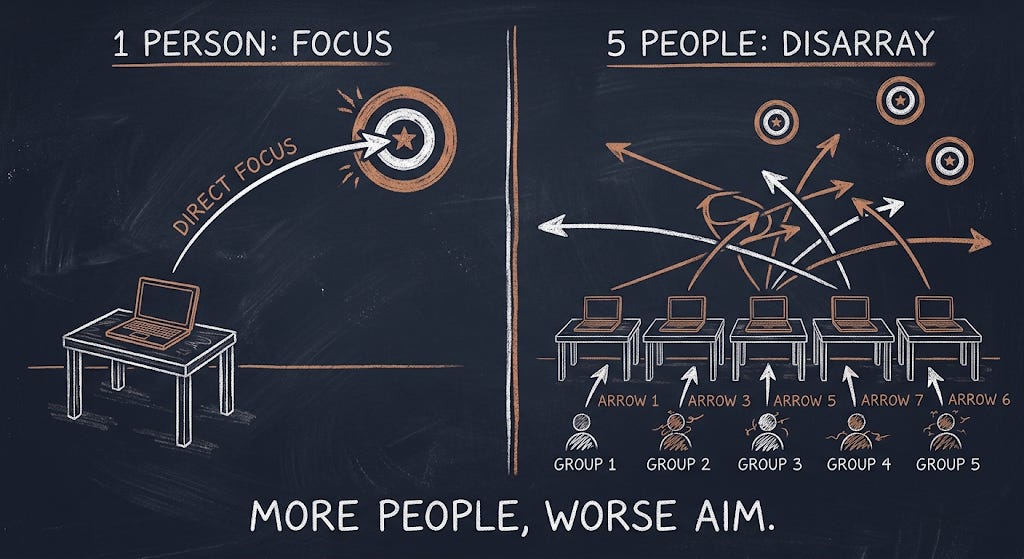
Then the company grows and the aim slips. Nothing breaks all at once:
The network runs out, so someone buys a list
The handwritten email becomes a template
New hires arrive who’ve never met a customer
Volume goes up. Precision leaves quietly.
Neither of us saw the whole curve from where we stood.
Jasper watched the fast start and assumed scale would improve it.
Doug watched teams sat at 0.2% and assumed it had always been that way.
It took both ends of the same companies to see one number falling for the same reason, at every stage.
6 times the meetings, same message
Back to those 15 salespeople from the introduction.
National coverage, calls and emails, one state at a time.
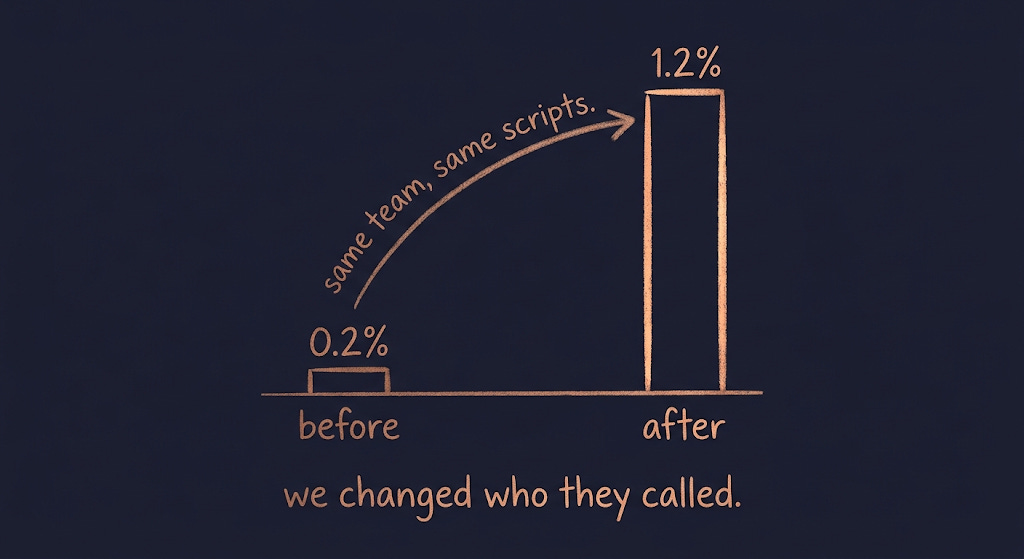
Rate: 0.2%.
Nothing was wrong with them. Good process, good managers, activity right on plan.
One question could fix it:
Which companies need this, right now?
Instead of working the market alphabetically, the team got pointed at companies showing real signs of growth, where the problem was live this quarter rather than possible someday.
—> New rate: 1.2%. 6x the meetings, same payroll.
If you’re a founder: your early rate isn’t luck, but what closeness buys you, and the job as you grow is finding ways to stay close.
If you’re running a sales team: good people stuck at 0.2% don’t have an effort problem. They’re aimed at the wrong companies.
✅ What to do on Monday
If you’re a founder:
Answer one question this week: how many meetings did outbound book last month, any channel?
Can’t answer? That’s your answer.
Start counting before you buy anything. A number you track beats a stack you don’t understand.
If you’re running a team:
Track meetings booked ÷ people contacted, by segment, last 90 days
Compare it to the ladder
Sat at 0.2% with a good team? Leave the message alone and fix the list. It’s free, and it’s the biggest lever you’ve got.
Either way: before you automate anything, know who you’re reaching out to and why now.
Every $ you spend in this category is downstream of that answer.
This article came out of multiple conversations between Jasper Vanu and Doug Bell.
The "fix the list before the message" point is the one most teams invert — they'll burn three weeks A/B-testing subject lines to move reply rate a point, when the 0.2%→1.2% jump in your example came entirely from re-aiming, message untouched. Where I always get stuck is the signal: "companies where the problem is live this quarter" is clean in hindsight, but at list-build time what do you actually trust — headcount deltas, a funding event, something in their own content? Curious where you draw the line between a real "why now" and a plausible-looking one.
I think another reason founders can be better at outbound when the company is small is because they are still learning from every customer. They can get a lot of useful information from those conversations, not just about sales but also the product, customer behaviour and what happens after the sale.
As the company grows, the founder has more things to focus on and it becomes easier to move further away from those direct customer conversations. Hiring someone can help with the workload, but I don’t think it fully replaces that closeness.
Do you think founders should still make some time for direct customer conversations as the company grows?