


Last week, an agency owner told me he’d spent 2 hours tweaking a prompt to get Claude Code to build a better prospect list.
Nothing worked.
I asked him what Claude knew about his business before he typed the prompt. The conclusion:
He was working on the wording of his prompt, which is prompt engineering.
What Claude knows before you type a word is context engineering: who you sell to, and why your best customers bought. Get that in place first, and four lines beat forty.
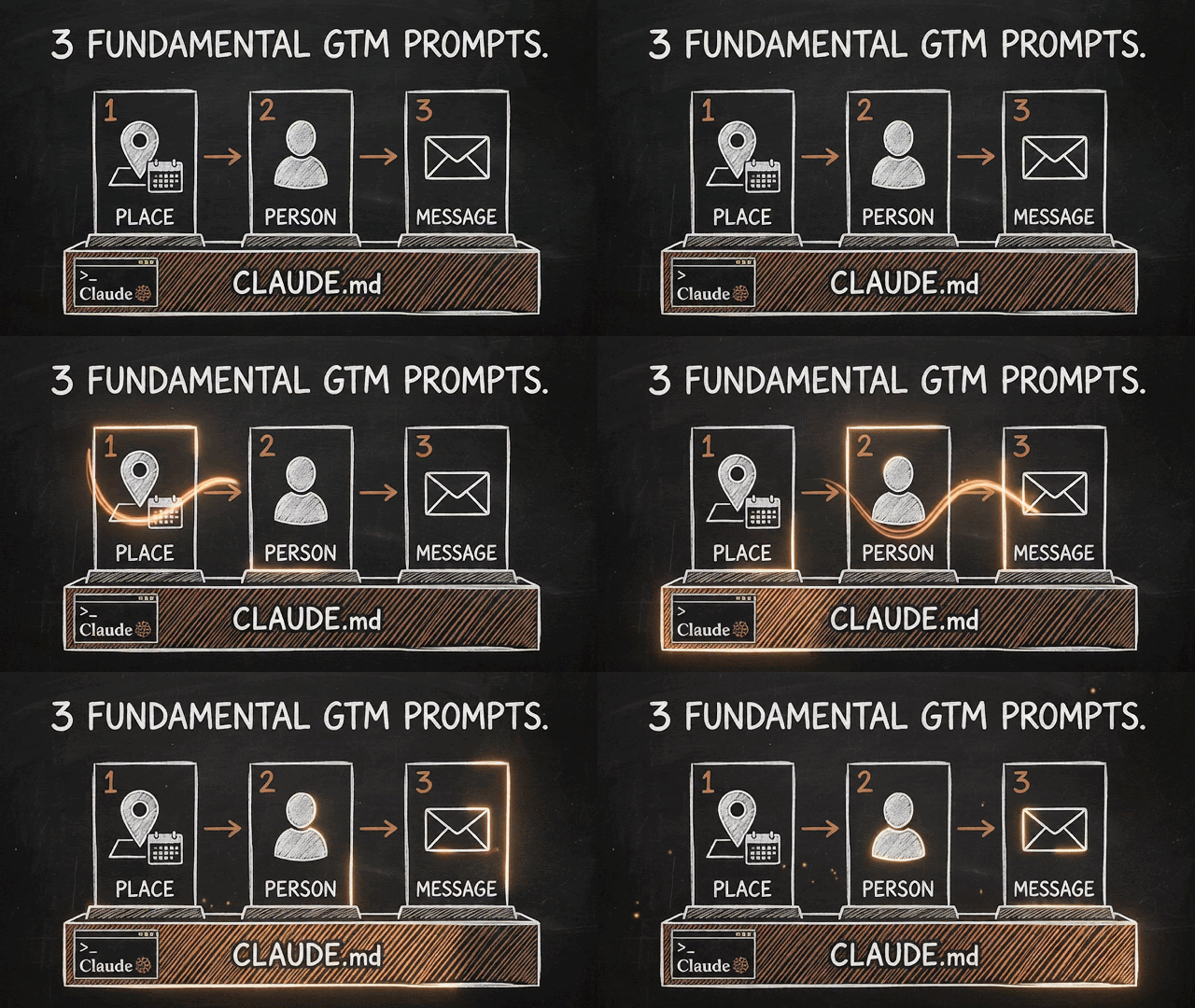
Here are 3 prompts, one per layer of GTM. The brackets inside them are the context, and in a minute you’ll save those answers once, so you never type them twice.
1. The signal check: right place, right time ✨
Your best customers are the benchmark.
The goal is finding companies in the situation they were in when they bought, with proof fresh enough to act on.
You are a GTM researcher. I sell [what you sell] to
[who you sell to]. My product becomes relevant when
[the breaking point, one sentence].

My best customers are: [3-5 domains].

Step 1: Work out what they had in common at the moment
they bought. Their situation, never their industry.
Use web search to check their hiring, funding and news
from that period.

Step 2: Research [Company] (domain: [domain]): job
postings, news from the last 90 days, LinkedIn.

Tell me:
1. Does it look like my best customers from the outside?
2. Which signs of my breaking point are active now?
   Quote each one, with its date and link.
3. Reach out this week, or wait? Pick one, say why.

Rules: a sign older than 90 days doesn't count. Every
claim needs a date and a link I can open. If you find
nothing, say so. Never approximate.
The full system, from closed deals to a scored list of 30 to 50 companies: The Company List Builder.
THE COMPANY LIST BUILDER

How to build a hyper-targeted B2B account list using Claude Code in under an hour.
2. The contact finder: right person 👤
Connect an enrichment tool to Claude Code as an MCP server, like Apollo, LeadMagic or FullEnrich.
And remember that finding an email and trusting it are two different jobs.
In my current client build, strict release rules kept bounces at 0.48%, which is what keeps your domains alive.
[Your enrichment tool] is connected to this session.

For each company below, find the best contact:
Champion title: [e.g. Head of Finance]
Buyer title: [e.g. CEO / CFO]
Prioritise the Champion, else the Buyer.

Return per contact: name, exact title, email with the
tool's verification status, phone and LinkedIn if
available, domain.

Release rules:
- Only release emails marked deliverable or verified.
  Hold the rest, with the reason
- Any catch-all flag means hold
- Never guess an email pattern. Write UNKNOWN instead

Companies: [paste domains]
The release rules behind that 0.48%, in full: The Lead Enricher.
THE LEAD ENRICHER

Verified emails, scored against your ICP, flagged for hiring signals, in one command. Built in Claude Code from about $46 a month, against $446 to $495 for Clay Growth.
3. The YYY email: right message 💬
YYY answers the 3 questions every prospect asks before acting:
why me? why you? why act?
The rule that books meetings is opening with a fact the prospect can check in 10 seconds.
Write a cold email using the YYY Framework.

WHY ME: [the signal]
WHY YOU: [one proof point]
WHY ACT: [the free offer, e.g. "a short video of the
exact setup, no pitch"]

Rules:
- Open with the finding, stated so the prospect can
  check it themselves
- Under 80 words, one sentence per line
- No links, no meeting ask. The goal is a reply
- Subject line: 3 options, lowercase, 2-4 words
- Sign off with a first name only

Then the test: could a person send this to a colleague
without it feeling like a sales email? If not, rewrite
until yes.
Or skip the copy-paste and take it a step further: a Claude skill interviews you once, researches each prospect, and writes 3 drafts in about 2 minutes.
Get the YYY email skill here for free.
THE YYY EMAIL SKILL

A Claude Skill that researches your prospect and gives you 3 email drafts to pick from.
Takeaway
Right situation, right person, right message.
Copy the prompts, but keep the habit behind them: fill in the context before you ask for the output.
The agency owner from the top had it backwards, and 2 hours of tweaking couldn’t fix it.
10 minutes of context beats 2 hours of prompting.