

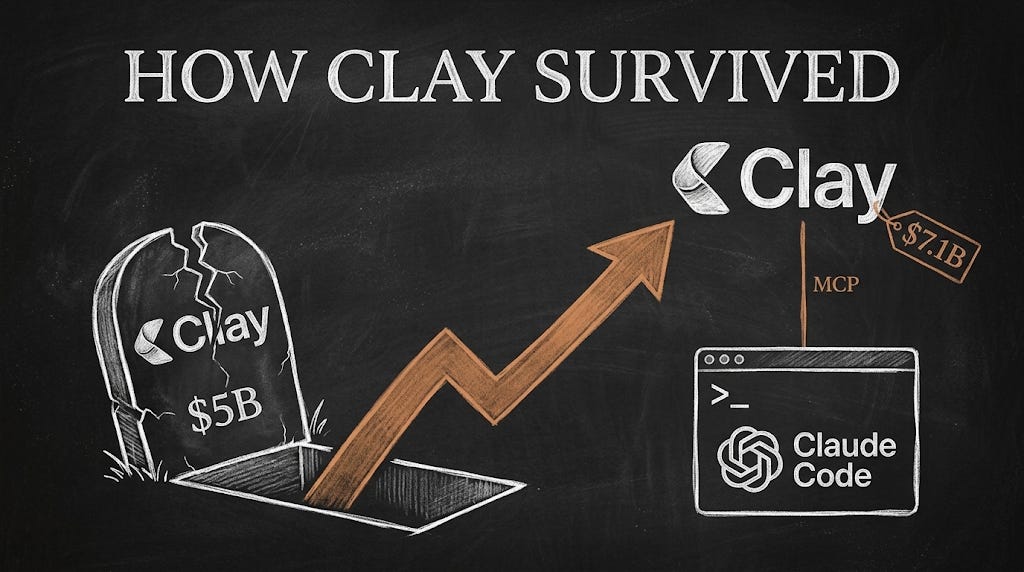
In March, I asked the $5 billion question in this newsletter.
Is Clay worth it when Claude Code can reach the same data?
Two weeks ago, Clay raised $115 million. At $7.1 billion.
So let me own this one.
I framed it as Claude Code versus Clay. That framing was wrong, and Clay is the reason I know.
⚰️ The funeral everyone planned
The argument went like this, and I made a version of it:
Data gets cheaper every month. Anyone can call Apollo or an enrichment API directly.
Orchestration is what AI agents are built for.
So Clay loses both halves of what it sells.
But Clay saw the same thing coming. Then it made three moves:
1. It cuts the price of data
On 11 March, Clay rebuilds its pricing. Billing splits in two:
Data Credits for enrichment
Actions for workflow work.
Then data gets cheaper. Clay’s own pricing page says the most-used enrichments now cost 50% fewer credits on average.
The top self-serve plan drops from $800 a month to $495.
Data was heading that way anyway. Clay gets there first, and moves its price to running the workflow, which stays hard.
2. It lets the agents call it
Clay ships an MCP server. A rep can now use Clay’s tools from inside Claude, without opening Clay at all.
The thing that was supposed to replace Clay now sends it work.
3. It builds its own agents
The new money goes into agents that find customers, research companies and set up outreach.
Clay stops waiting for someone else’s agent to route around it.
The detail I like most
Clay’s own announcement lists its customers: Anthropic, Google, OpenAI, Stripe.
And SpaceXAI. The company behind Grok Bot, the agent everyone says is coming for orchestration.

How to see it now
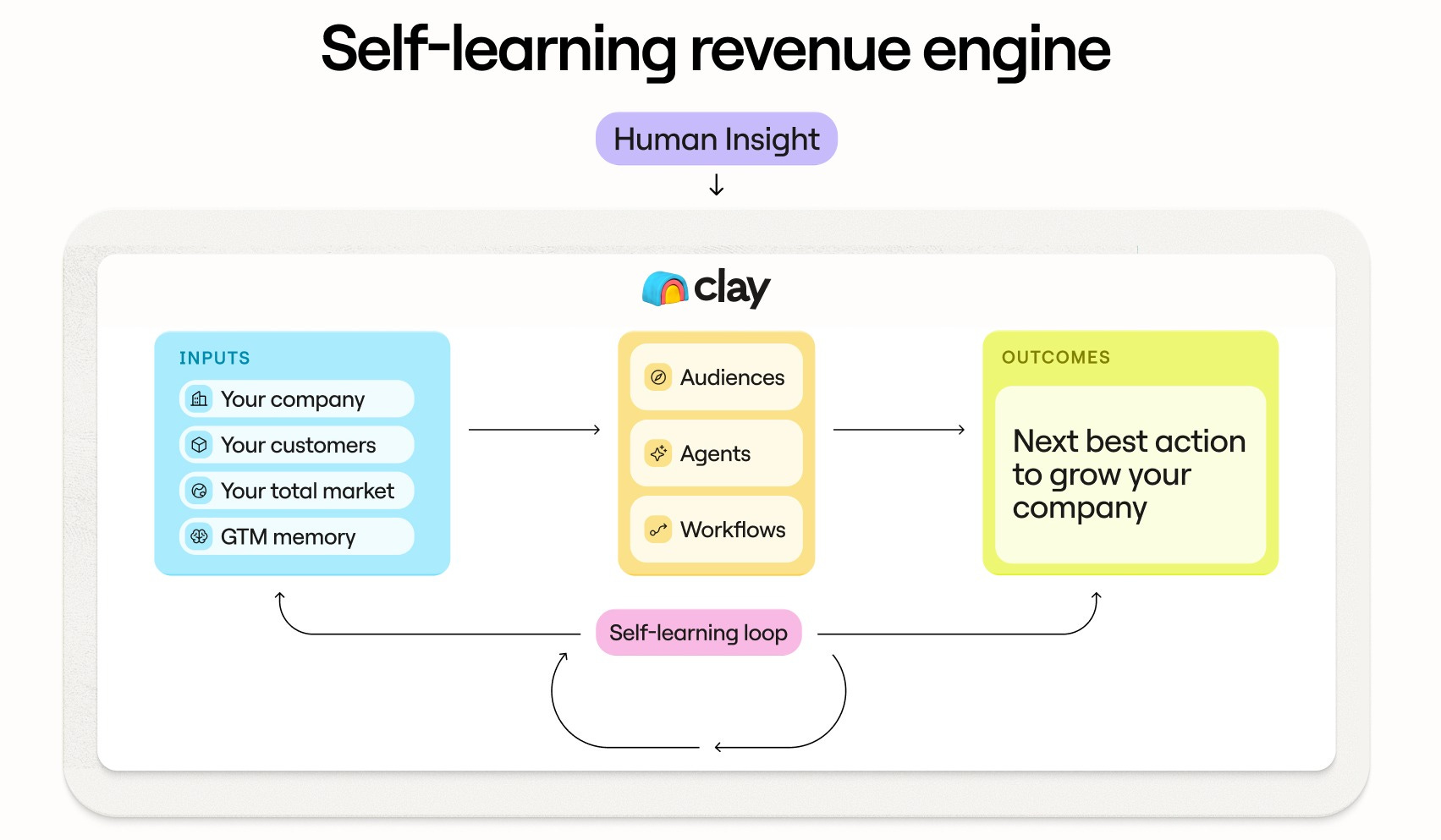
Every GTM stack does three jobs:
1. Data is a commodity. Shop around for it.
2. Workflow is where tools fight, and Clay fights hard for it.
3. Judgment belongs to you: who you target, why now, what you say.

🧩 Where Claude Code fits
For one person, Claude Code covers the last two jobs.
It holds your judgment in a file you own, your CLAUDE.md.
Then it runs the workflow. It researches accounts, decides who fits, and drafts the email.
What it lacks is data of its own. So it calls data tools through MCP:
MoltSets sells contact data on a flat plan from $27 a month, with no per-lookup credits. It comes from the founder of RB2B, and it’s still in closed beta.
Deepline connects Claude Code to dozens of data providers. Bring your own keys and it charges a $0 platform fee and 0% markup.
Apollo, Prospeo and other lead enrichment tools plug in the same way.
Here’s what the “versus” framing missed:
Clay has an MCP server too. So Clay becomes one more tool Claude Code can call, on the day you need it.
You never have to choose on day one.
Do you really need Clay?
Clay is built for big teams. You’re probably not one yet.
So the answer depends less on Clay, and more on how you run outbound today.
Two or three facts about your setup settle it:
Use Claude Code with a direct data source if:
One or two people run your outbound
You want your ICP and rules in a file you own
Research quality matters more to you than volume
You’re happy to connect your sequencer through MCP, like Smartlead or Instantly, so leads go straight in
Add Clay when:
Several sales reps run enrichment, and some of them will never open Claude Code
Your team needs one shared, visual workspace everyone can see and edit
You’d rather manage dozens of data providers under one account and one bill than juggle your own keys
You want ready-made templates your team reuses without writing a skill
Even Deepline, which competes with Clay, says as much:
Clay suits teams that want a visual workflow builder.
Running a founder-led team at $1-10M? You probably don’t need Clay yet.

Start with Claude Code and one direct data source.
Add Clay the day a second person needs to run enrichment without touching Claude Code.
Since Clay speaks MCP, you keep everything you’ve built.
💶 What each setup costs
List prices, September 2026. Ranges run from annual to monthly billing.
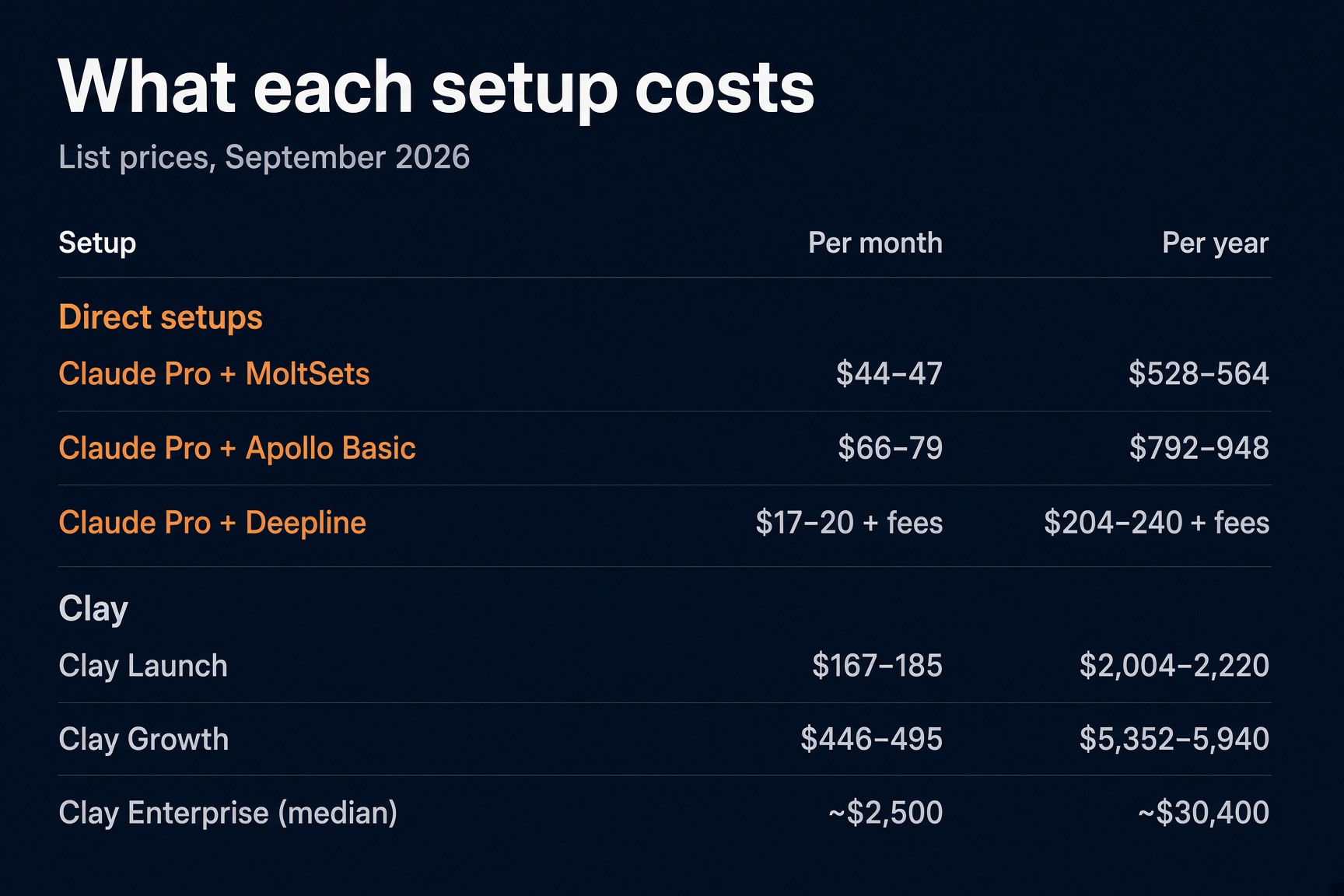
Clay rows exclude Claude. Add $17–20 a month if you still use it for research.
Claude plus MoltSets costs about a tenth of Clay Growth.
Clay Launch alone costs roughly four times as much. Enterprise lands near sixty times.
This isn’t a like-for-like comparison, though. Here’s what the gap buys:
Clay gives you a shared visual workspace and pushes leads into your sequencer
MoltSets charges extra for verified mobile numbers, and it’s still in closed beta
Apollo credits run out, and heavy users pay more
Clay top-ups cost 30% more than your plan rate
For a founding team sending a few hundred emails a month, the extra doesn’t buy much.
For a team of five running enrichment every day, it can.
Takeaway
Data got cheap for everyone.
Clay saw it coming, moved its price to the workflow, opened its doors to agents, and doubled its valuation on the way.
For big teams, that earns its place.
For a founding team running outbound, Claude Code with one direct data source does the job for a tenth of the money.
Either way, the same thing decides whether it works: who you reach out to, and why now.
Keep that in a file you own, and plug Clay in the day you outgrow it.
PS: Want the Claude Code setup built for you step-by-step?
The Lead Enricher gets you a verified email in 15 minutes, then turns your whole list into scored, ready-to-send leads with 1 command. Updated for Q4 2026. For Premium subscribers.

Upgrade here to get full access.