

The hottest trend in GTM right now is outsourcing your brain to an AI.
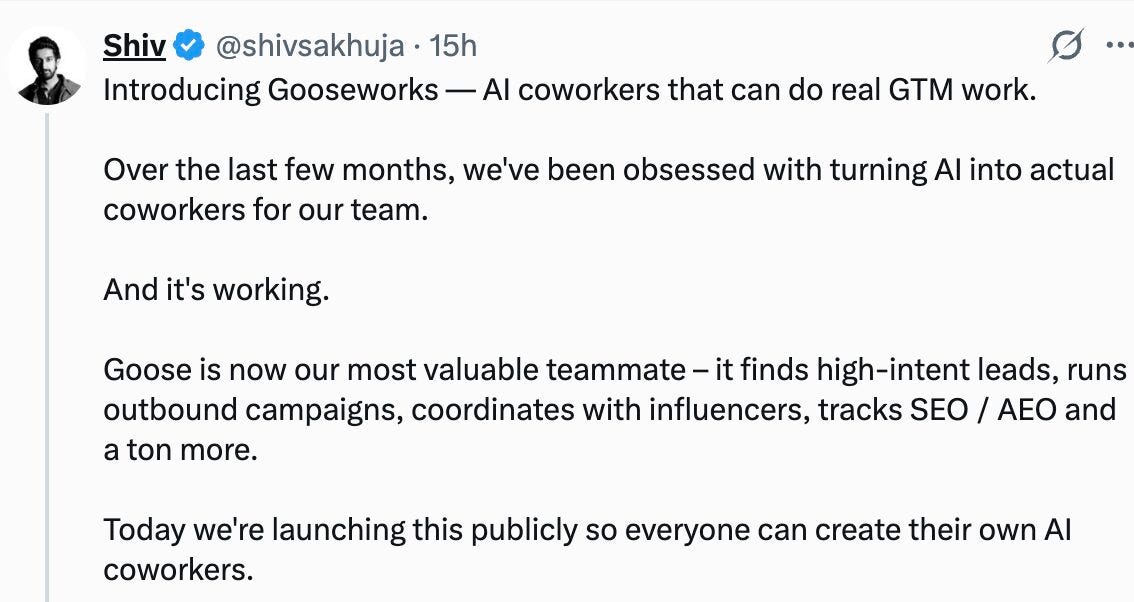
A few months ago, an AI startup (Gooseworks) wanted to run my GTM for me.
YC-backed, an AI coworker with its own computer, email, skills and memory. It would run outbound, manage the CRM, and I’d approve its work from Slack.
A client asked me last month whether he should just pay for one of these instead of learning Claude Code.
“Why would I build it when I can hire it?”
Fair question. Here’s what I told him:
The blind spot in every managed AI
These tools execute fast. What they can’t do is fix what you feed them:
A vague Ideal Customer Profile gets automated into vague outbound
Generic signals become generic campaigns, run faster
Untested messaging gets scaled instead of tested
The strategic thinking still has to come from you. No tool changes that, whichever logo is on the invoice.
Which means the real question was never “AI or no AI.”
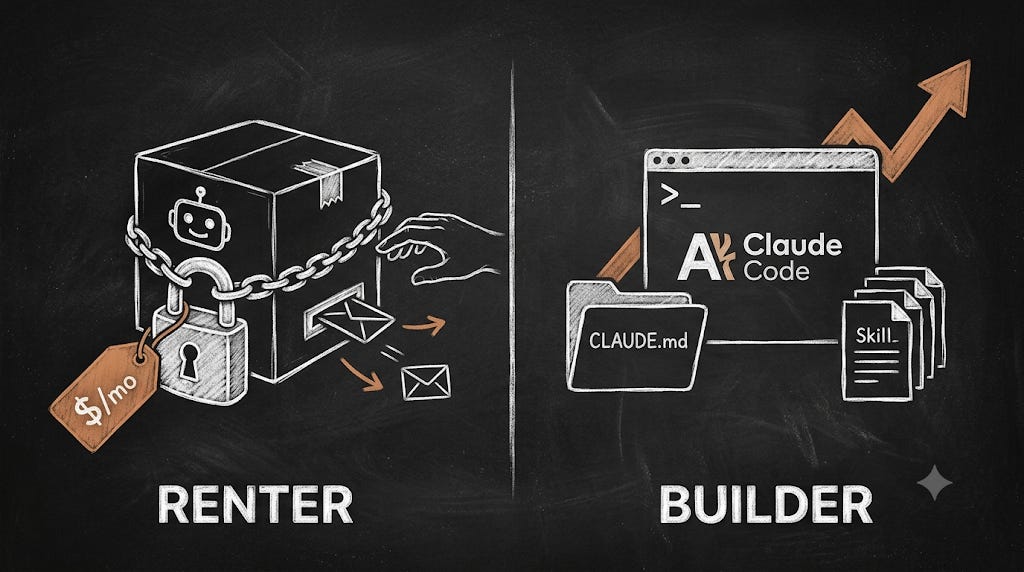
It’s which camp you join:
💳 The Renter
Pays monthly for a managed AI coworker
Fast start, polished interface, someone else’s roadmap
Owns none of it: the prompts, the data, the logic and the off switch all belong to the vendor
The day the pricing changes or the startup pivots, his entire GTM walks out the door with it.
That’s not a hypothetical anymore.
Gooseworks still says “runs your GTM” on its homepage.
But three months on, what it’s actually shipping and pushing hard isn’t an autonomous coworker running your outbound.
Now it’s a tool that remixes ad templates for Meta.
🛠️ The Builder
Creates the same system in Claude Code
Slower first week, then compounding every week after
Owns everything: the CLAUDE.md that encodes his customers, every prompt, every learning, at a fraction of the platform fees
Nobody can raise the rent on his own brain.
Even the AI startups know it
Here’s the detail that gives it away:
Gooseworks open-sourced every skill its AI coworker uses, both before the pivot and after.
That includes the exact skill that now makes the ad creative they charge you a subscription for.
Anyone can install it straight into Claude Code, for free.
Think about what that means. They’re charging monthly for something you could build yourself with the same free parts already handed out.
The subscription is the business, not the product.
The value was always the system underneath it, the one he open-sourced.
And when the big ambitious version of the company got hard to keep running, that free, owned system is the part that survived.
Lay the first brick today
The renter’s advantage is speed to start. So remove it.
The builder’s first brick is a CLAUDE.md, the file that teaches Claude Code who you sell to, and it takes one conversation to draft. Here’s the master pronpt:
You are my GTM system architect. I'm building the foundation
of my outbound system in Claude Code instead of renting a
managed AI tool: two files, CLAUDE.md and BATTLECARD.md, that
every future session will read before doing anything else.

Never smooth over a vague answer into something that sounds
specific. If my answer is soft, tell me it's soft and ask me
to sharpen it before moving on. A file built on vague answers
produces vague outreach, which is the exact failure I'm
building this system to avoid.

## STEP 1: INTERVIEW ME, ONE QUESTION AT A TIME
Wait for each answer before asking the next.

For CLAUDE.md:
- What I sell, in one sentence, and roughly what it costs
- My best customer of the last year: who, what was happening
  in their business right before they bought, what it was
  costing them
- The customer I regret taking: who, and the early warning
  sign I ignored
- Two or three job titles I actually sell to, not job titles
  I wish I sold to
- One phrase or tone I never want to sound like

For BATTLECARD.md:
- My single best proof point: a named customer (or
  anonymised, my choice) and a specific number. If I don't
  have one yet, say so rather than inventing one, and note
  it as a gap to fill before this file is trustworthy
- The one thing that makes a prospect say yes, described the
  way a customer would say it, not the way my website does

## STEP 2: DRAFT BOTH FILES
Write CLAUDE.md with these sections: ROLE, COMMUNICATION STYLE
(3 voice rules from my answers, not generic advice), IDEAL
CUSTOMER PROFILE (written as the condition my best customer
was in, not just firmographics), NO-GO LIST (built from my
regret customer).

Write BATTLECARD.md with: THE PROBLEM WE SOLVE, THE PROOF
POINT (exactly what I gave you, flagged clearly if it's
generic rather than a named result), OBJECTION HANDLING (ask
me for my single most common objection and draft one response
to it).

## STEP 3: STRESS-TEST BOTH FILES
Before finalising, tell me which answer I gave you was the
weakest, the one most likely to produce generic output if I
don't fix it now. Push back on that one specifically. Then
tell me what's still missing that a full system would need,
the proof point, the ICP, or the voice rules, so I know this
is a starting foundation, not the finished system.

Keep both files under a page each. Every future session
inherits them, so nothing generic gets in.
One conversation, and you own the file every managed tool keeps behind its login.
Takeaway
The renter and the builder end up with the same capability on day one.
They end up in different businesses by year one: one holds a subscription, the other holds a system.
Which camp are you in: paying for a managed AI coworker, or building the system yourself?
Reply “builder” and I’ll tell you what I’d add to your CLAUDE.md .
PS: The prompt gets your first file drafted. The Claude Code GTM Starter is the full system: CLAUDE.md, five saved Skills, and the Rules that catch mistakes before they ship.

The "subscription is the business, not the product" line is the whole post. Once a vendor open-sources the skills, you're not paying for capability anymore, you're renting their roadmap and their off switch. What people underestimate is the CLAUDE.md itself: encoding your ICP and your hard-won messaging into a file you own is the compounding asset, and it's exactly the thing a managed coworker never lets you keep. The Gooseworks pivot from "runs your GTM" to remixing Meta ad templates is a pretty clean tell about where that category is actually heading.