

Back in January I wrote that you probably don’t need a GTM Engineer yet.
A lot changed in 9 months, so I thought it was time for an update.
The role exploded, and the tools changed underneath it. And the job itself looks different heading into 2027.
What changed
The hype turned into hiring:
3,000+ open GTM Engineer roles on LinkedIn by January, up 205% in a year (eMarketer.com)
1,837 new postings between April and October, across 1,377 companies (Cargo.ai)
Median US salary: $158,500
Only a third of roles get filled within 90 days
Meanwhile, SDR seats dropped 22.7% over two years (Regie.ai)
So the role is in demand, expensive, and hard to fill. That alone is a reason to think twice.
But the bigger change is what happened to the work.
The 4th era: agent teams
In January I described three eras of GTM engineering:
The Clay era: building better lead lists
The Workflow era: stitching tools together with Zapier, Make or n8n
The Agent era: using AI like Claude Code to do work that used to need a human
Now there’s a fourth: teams of agents.
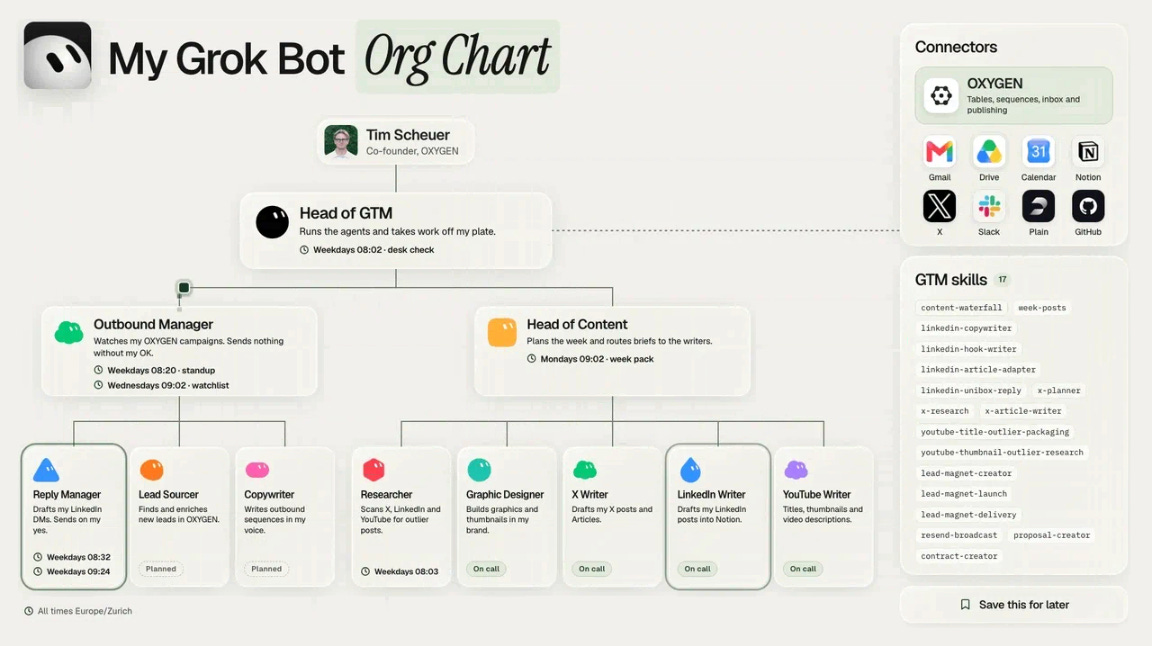
Grok Bot from SpaceXAI is the clearest example.
Each bot gets its own computer in the cloud. It logs into your tools like a person, works while your laptop is shut, and hands work to other bots.
I recently covered what Grok Bot is, and how to test it without burning a market.👇🏼

Richard Purcell, Growth Lead at Builld, just wrote about moving his work over to it.
When he ran his agency, MoxieGTM, he had contractors in Egypt, Germany, India and the Philippines.
He says one team of bots now does that work.
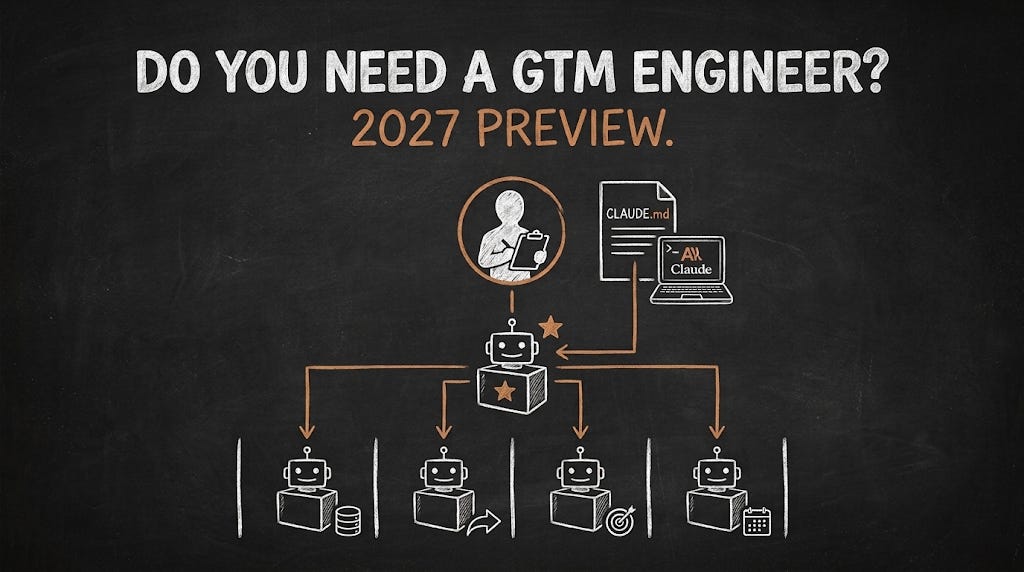
His setup: one “chief of staff” bot, with specialist bots underneath.
One for HubSpot, one for lead handoff, one for ABM, one for events. Each bot owns its lane.
His new rule for building a team:
“Team of agents first, tool second, offshore third, headcount last.”
So what does a GTM Engineer do now?
In January, the GTM Engineer was the person who set up the machine.
Close to RevOps: connecting your data, tools and CRM, and orchestrating how leads flow through them.
A lot of that setup work is moving to agents.
AI connects to your tools directly now, and when there’s no connection, a bot just logs in and clicks.
So the job moves up a level. The GTM Engineer becomes an agent manager:
Writes the docs. Your ideal customer, your voice, your rules.
Assigns the jobs. Which bot does what, and who hands off to whom
Sets the guardrails. Nothing goes out without your approval
Checks the work. And fixes the instructions when a bot gets it wrong

🦊 Where Founder’s GTM lands: Claude-first
In August, my verdict was simple: let Grok Bot handle the mechanical work, and keep the judgment in Claude.
Two months on, I still land there. Grok Bot wins the legwork, and it gets into tools Claude can’t reach.
But the thinking still happens in Claude. That’s where your ICP, your rules and your skills live, in files you own.
And I’m not alone: one GTM builder running eight bots on Grok Bot says that for copy and design, he still goes back to Claude.
Claude does the thinking: research, writing, and the docs your bots learn from
Grok Bot does the legwork: logging in, clicking, and finishing tasks across your tools
Your docs are the asset. Whatever tool runs them, you keep them.
💸 The $200k maths, updated
In January, I shared Richard’s maths for hiring too early:
The hire: $150,000
The software: $30,000
The glue: $20,000
Year one: about $200,000
Heading into 2027:
The hire got pricier. Median salary is $158,500, and two thirds of roles take longer than 90 days to fill
The glue is shrinking. AI connects to your tools, and bots log in where it can’t
The agent stack starts under $50 a month. Claude Pro from $17, and Grok Bot from $30 through SuperGrok, plus usage as you scale
One thing hasn’t changed: Someone still has to manage it.
The 3 phases, rewritten for 2027
The three phases from January still hold. What you do in each one changed.
Phase 1: Product-market fit
You’re still proving someone wants to buy.
Sell by hand, and feel the friction
Write everything down as you go. What worked, who bought, what they said. Those notes become your agents’ training later
Hire nobody
Phase 2: Go-to-market fit
You’ve got a few customers. Now you need a repeatable way to sell.
Agents first. Give one lane to one bot, the one that eats most of your week
You manage it yourself
Rent agents
Phase 3: Scaling
You’ve got a playbook that works. Now you need volume.
Hire the GTM Engineer, as an agent manager
Their job: run the agent team you started, add new bots, and keep the docs sharp
Premium subscribers get the full 2027 hiring plan, and the prompt that builds yours.
Inside:
The four things every GTM task needs, and who should do each one
How it changes in each phase
The signs that tell you it’s time to hire
What to look for in a GTM Engineer in 2027
A prompt that turns your current GTM work into your hiring plan