


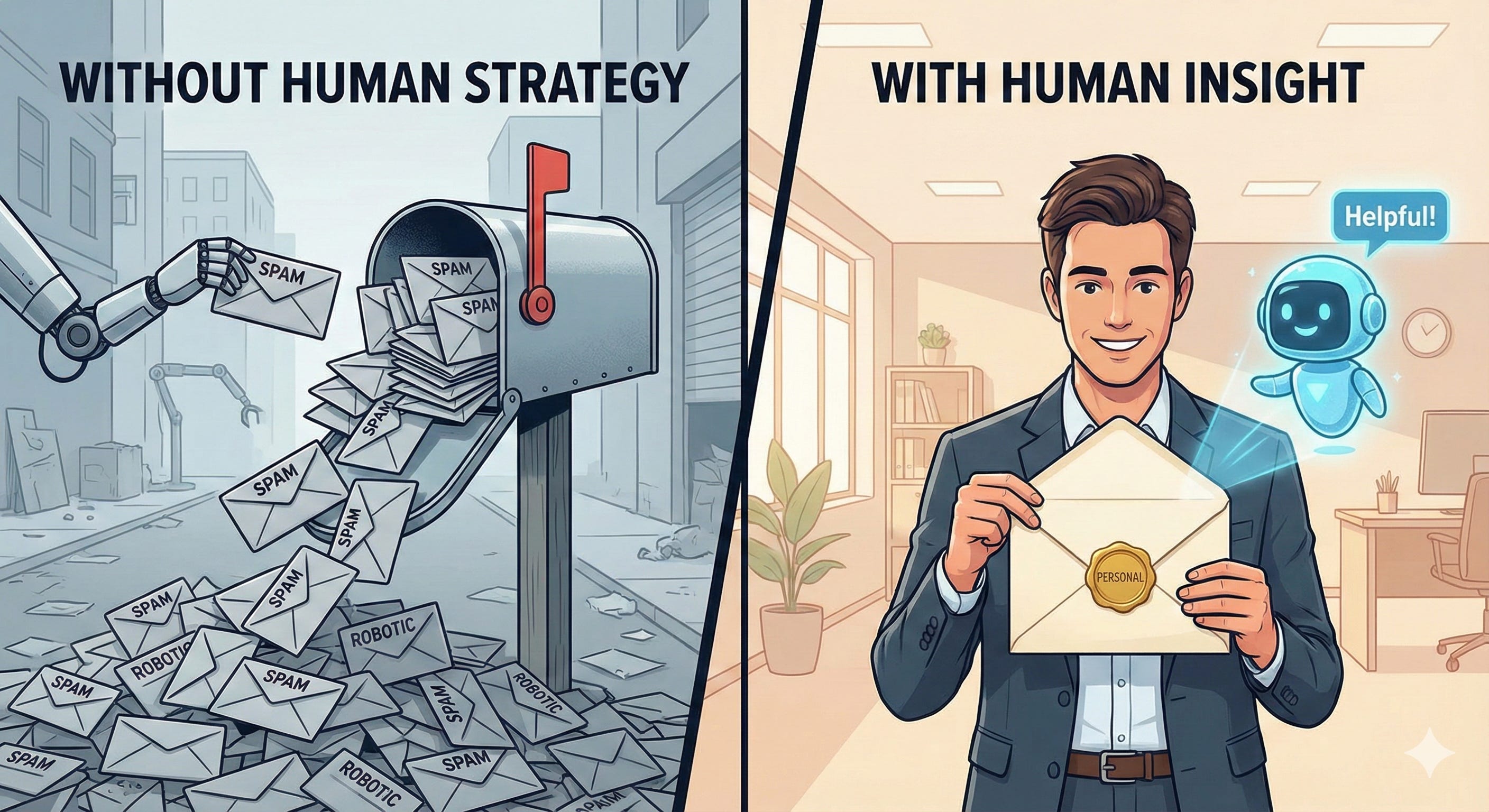
A founder told me last week she was considering an AI SDR.
“Why not automate the whole thing? If AI can do the work of three SDRs for a fraction of the cost, it’s a no-brainer, right?”
I get the fantasy.
You dislike sales, hiring someone is exhausting, and expensive consultants rarely deliver.
So when a vendor promises an “AI Agent” that will automate your entire outbound motion for $300 a month, you buy it.
You imagine a world where you push a button, and the AI does the thinking, writing, and strategy while you just need to close the deal.
Here’s the thing: Outsourcing your thinking to an LLM will simply scale your own mediocrity.
Plenty of teams are currently using the most powerful tech in human history to send average spam at a speed we have never seen before.
Let’s look into why the AI SDR is failing, and how the top 1% of founders are using AI to actually build pipeline.
The Data
Let’s look at the scoreboard.
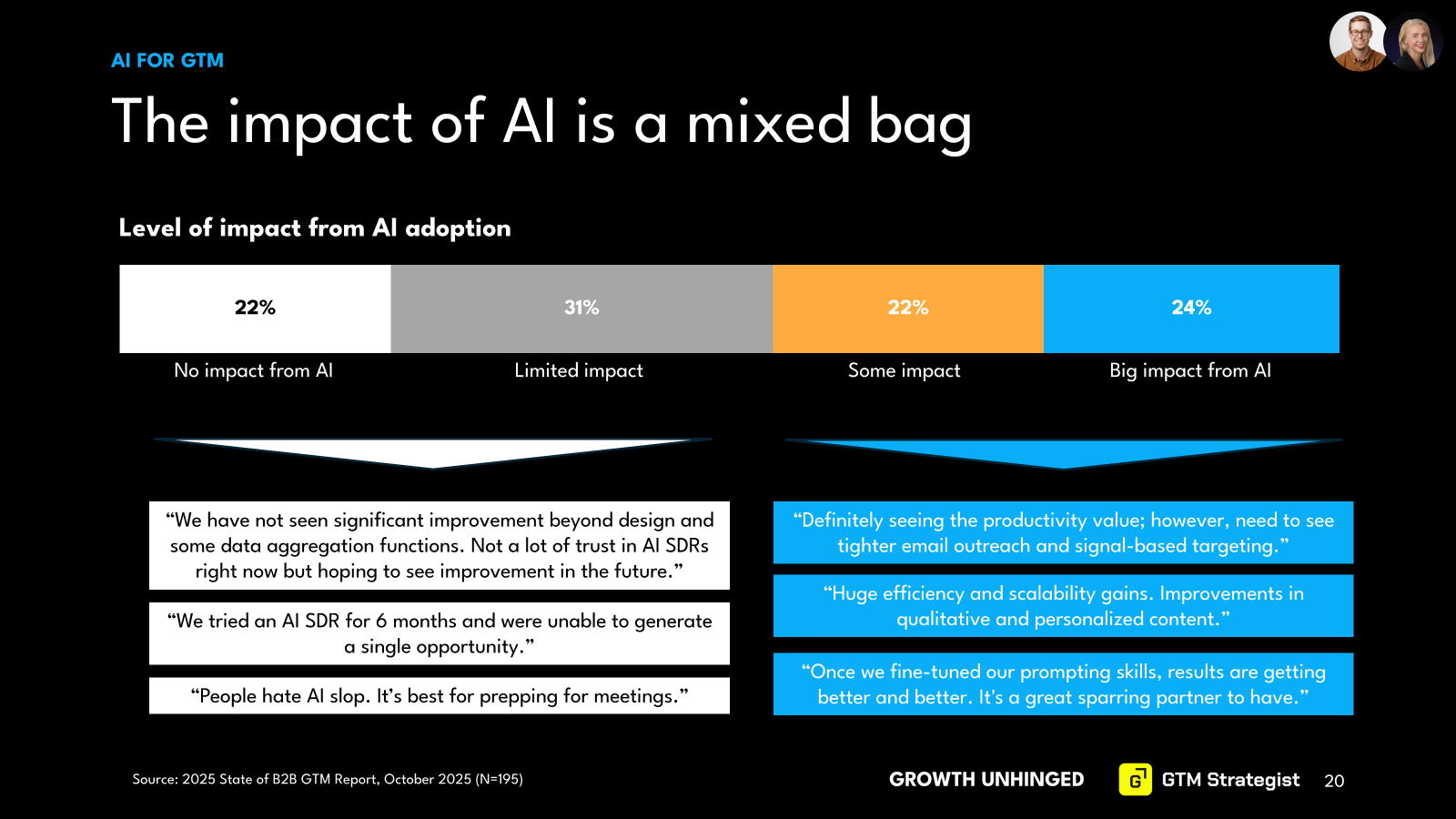
Kyle Poyar’s Growth Unhinged surveyed 195 GTM leaders. The results were brutal:
75% feel top-down pressure to “adopt AI” immediately.
53% see zero or limited impact from it.
The disillusioned outcome is most acute with “AI SDRs.” A founder confessed:
“We tried an AI SDR for six months and were unable to generate a single opportunity.”
Zero.
Founders often rush to plug in every new AI tool, hoping tech will solve the problem.
But without a strategy, three months fly by and the sales pipeline stays empty.
The Psychology
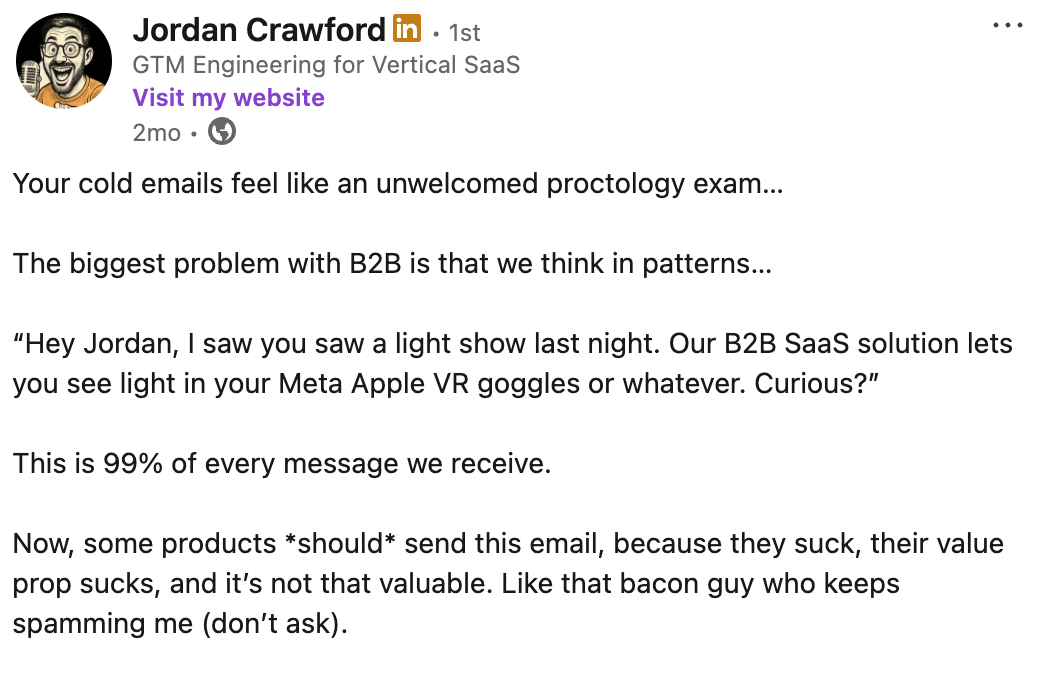
Why is the failure rate so high? Jordan Crawford from Cannonball GTM sees the specific psychological mechanism at play.
Humans are elite pattern recognisers. If we are not interested in one generic email, we are not interested in any of them.
AI models are trained on the “average” of all sales emails ever sent.
When you ask an AI to write a sequence, it reverts to the mean. It produces a perfectly average message.
But humans punish “average.” We subconsciously filter it out.
The “Zero Opportunity” stat isn’t a tech failure but a pattern recognition success.
Your prospects know it is a bot within milliseconds, so they delete it.
The Operations
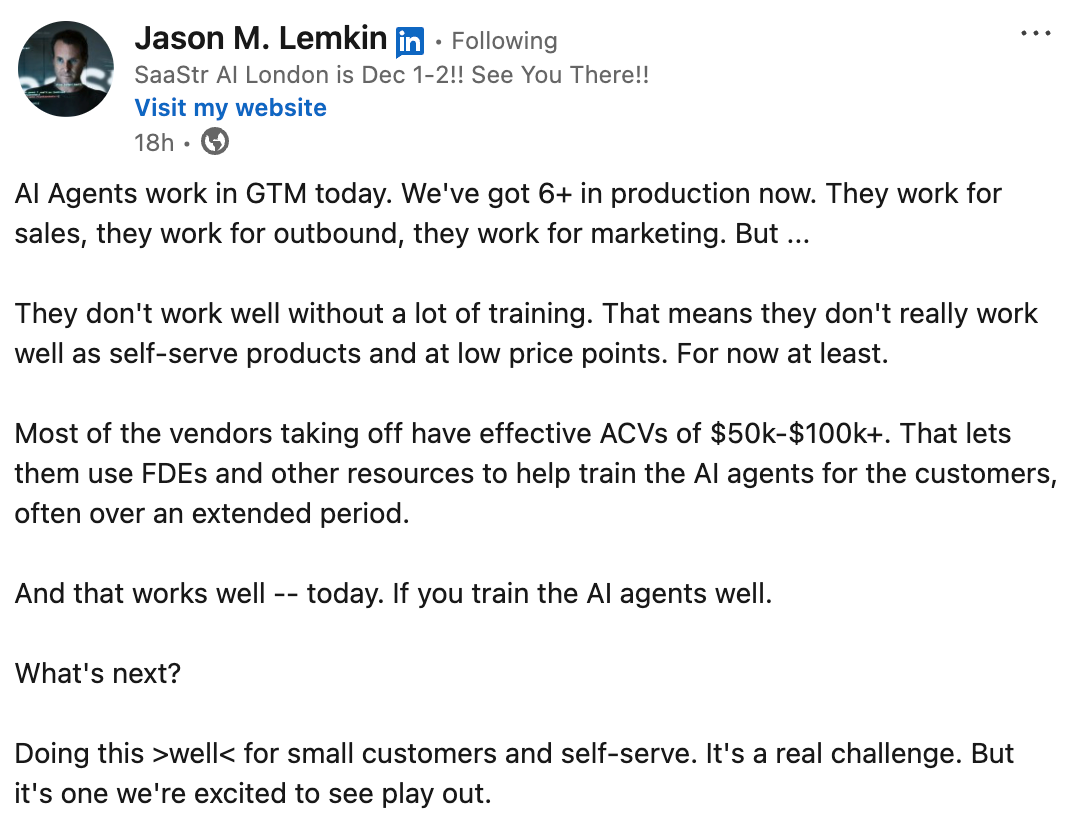
So is AI useless? No. Jason M. Lemkin 🦄 (SaaStr) clarifies the nuance here.
He notes that AI agents do work for them. He has 6+ in production right now.
But there is a catch that most “set it and forget it” founders miss:
The AI vendors actually succeeding right now have ACVs of $50k-$100k.
Why does the expensive stuff work while your cheap tool fails?
Because at $100k, the vendor provides humans to train, fine-tune, and orchestrate the AI for you.
The $300/month self-serve tool fails because it relies on you to train it, and you are treating it like a magic wand instead of a new employee.
You can replace most outbound SDRs with AI, but only if you orchestrate it daily.
You cannot just push a button.
Be the Thinking Partner
So what does “AI orchestration” look like?
It means you provide the ingredients. The AI provides the scale.
Here is an example of a strategy prompt that I use to find high-intent leads without buying expensive intent data.
The Prompt: