

We need to discuss the ‘Magic Hire’ fantasy.
If you’re a founder grinding through the early days of founder-led sales, you have likely looked at the explosion of GTM automation tools (Clay, n8n, Apify, etc.) and thought:
“If I just hire one brilliant engineer to hook all this up, I can stop doing manual sales, and automate everything!”
This is the most seductive narrative in GTM tech right now. It promises that code can replace headcount and that you can replace a team of 10 burning-out sales development reps with one genius writing Python scripts in a dark room.
But before you spend $200,000 trying to build a Ferrari engine, you need to check if you are still driving a go-kart.
Putting a rocket engine on a sinking ship doesn’t make it fly. It just makes it sink faster.
To make the right decision, let’s understand what this role actually is, where it came from, and why you most likely do not need one yet.
What is a GTM Engineer?
The GTM Engineer differs from a rebranded developer. Clay effectively coined and popularised this role, along with the ecosystem that grew around it.
The Pioneers
About five years ago, outbound innovators like Eric Nowoslawski and Jordan Crawford started doing things that traditional Sales Ops could not do.
Rather than just managing Salesforce fields (maintenance), they creatively stitched together lead data to find leverage.
They asked how they could scrape a job board, cross-reference it with a funding announcement, use AI to write a personalised email based on a podcast the CEO appeared on, and send it automatically.
The evolution of the stack
This role evolved in three waves:
The Clay Era: It started with mastering data enrichment tools like Clay to build better lead lists.
The Workflow Era: It moved to orchestration. Connecting tools using n8n, Make, or Zapier to build complex, multi-step “waterfalls” that automate the entire sales development process.
The Agent Era: Now, the cutting edge involves using the Claude Code API and AI agents to execute complex reasoning tasks that previously required human intuition.
How it differs from RevOps
Founders must understand this distinction.
RevOps / Sales Ops: They sit in the Revenue bucket and function as Maintainers. They keep Salesforce clean, contracts signed, and dashboards green. They focus on the bottom of the funnel.
GTM Engineer: They sit in the Growth bucket and function as Builders. They focus solely on Top of Funnel lead generation. Their job is to engineer pipeline out of thin air using code and automation.
Hype vs. Reality
If this role is so powerful, why isn’t everyone hiring one?
You might see OpenAI, Ramp, and Webflow hiring for this role and assume it is the new standard. The data tells a different story.
According to last year’s data analysed in Kyle Poyar’s Growth Unhinged, the market is still hesitant:
SDR Jobs Posted (3 months window): 11,810
GTM Engineer Jobs Posted: 128
So basically, companies hire 92 SDRs for every 1 GTM Engineer.
Hiring a full-time engineer to sit in sales carries significant risk. 45% of the people with this title work for agencies or consultancies rather than startups.
Most founders realise that “renting” this talent is safer than betting their runway on a role they don’t know how to manage.
Manufactured Complexity
The biggest danger for a founder is the hidden cost of complexity rather than just the salary.
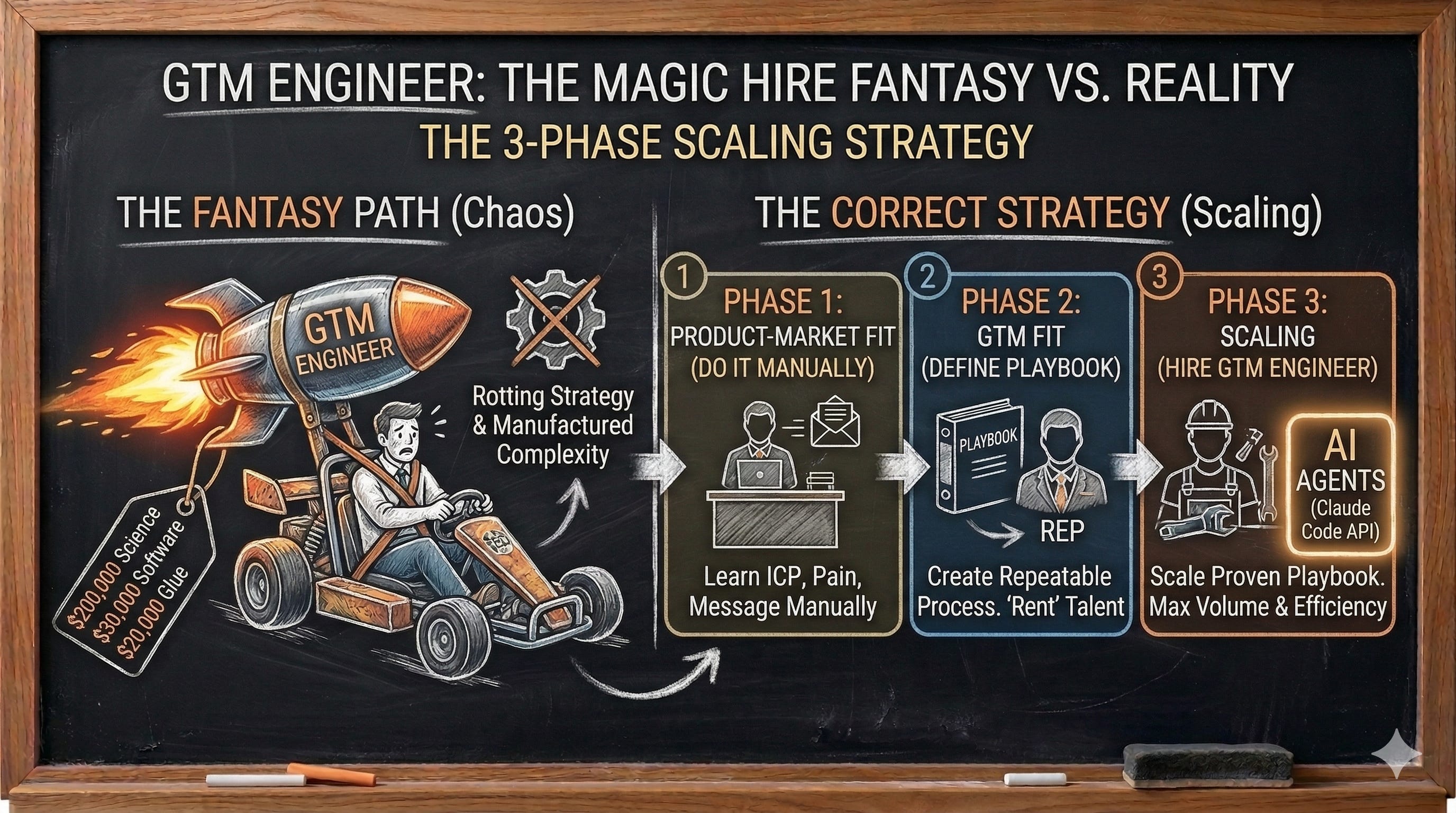
The industry’s leading contrarian voice, Richard F. Purcell, calls this the Math of Manufactured Complexity. If you rush to hire a GTM Engineer to build a custom “AI Stack” before you are ready, here is the bill you are racking up:
The Hire: $150,000 (Salary + Benefits)
The Software: $30,000 (Clay, OpenAI credits, data tools)
The Glue: $20,000 (Middleware to make the tools talk)
—> Total Year 1 Cost: ~$200,000
What do you get for that $200k? Often, you get a workflow that becomes obsolete in 6 months.
Strategies rot. The specific enrichment waterfall that works today might stop working when data providers change their APIs or your Ideal Customer Profile (ICP) shifts.
Hiring a builder before you have a blueprint means you are funding a science project instead of building an asset.
The 3-Phase Strategy (When to Actually Hire)
This is the core takeaway. The question is not if you need automation, but when.
Using the framework from Maja Voje, we can break your journey into three phases. The GTM Engineer only belongs in the final one.
Phase 1: Product-Market Fit (PMF)
Goal: Prove someone wants to buy what you have.
The Reality: You do not know your ICP yet. You do not know your message.
The Move: Do not hire. Do it manually. Send the emails yourself. Feel the friction. If you cannot close a deal manually, an engineer cannot close it with Python. You must be the “engineer” of the logic instead of the code.
Phase 2: Go-To-Market Fit (GTM Fit)
Goal: Prove you have a repeatable way to sell it.
The Reality: You have a few customers. You know the “pain.” Now you need to define the playbook.
The Move: Rent, don’t buy. This is the “Shadow IT” phase. Empower a smart generalist on your team to experiment with Zapier or Clay. Or hire a consultant/agency to build a specific loop for you. Test the channel before you build the infrastructure.
Phase 3: Scaling
Goal: Pour fuel on the fire.
The Reality: You have a playbook that works. You have unit economics that make sense. Now you need volume and efficiency.
The Move: Hire the GTM Engineer. This is the moment the math changes. You bring in the builder to automate the manual playbook you proved in Phase 2. You are asking them to scale a winning strategy, not to find one.
The “No UX” Future
There’s one final reason to wait. The tech is moving so fast that the role itself is changing.
We are moving toward a “No UX” future. As Richard Purcell says, tools like the Claude Code API and MCP (Model Context Protocol) are making it possible to automate without complex “glue code”.
Rather than paying an engineer to write Python scripts connecting Tool A to Tool B, we are entering a phase where you can simply ask an AI agent:
“Find me 20 VPs of Sales who just started a new job and use HubSpot.”
The AI handles the complexity, and the middleman disappears.
Next Step: Build the Foundation
You are not ready for a GTM Engineer until you are AI-Ready.
AI-Ready means you have the strategy, the logic, and the process locked down. It means you know exactly what to build, so you avoid paying $150k for someone to guess.
This is why I started Founder’s GTM 🦊 .
My goal is to help you build that GTM Foundation (the strategy, the logic, and the process) so that when you do turn on the full automation, it actually works.
Let’s get your foundation built. Then we can talk about the robots.
Jasper
Great insights! Seen so many founders make the mistake of hiring GTM before PMF!
Hey, thanks so much for the mention here, definately one of my fauvorite models + beachhead :)) We are definately doubling down on GTM engineering in 2026 - a brand new report soon <3