


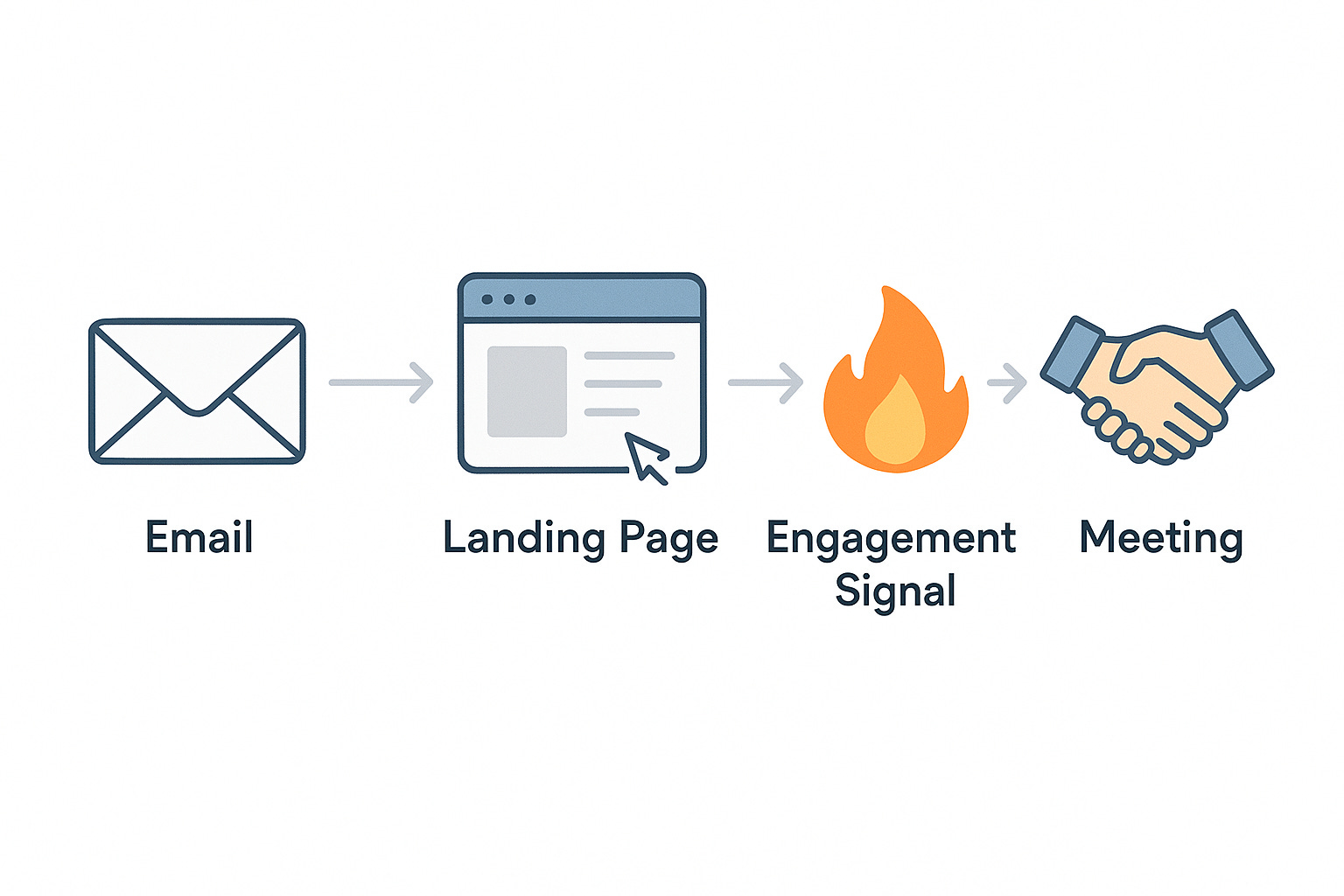
Welcome back to the Founder’s GTM with actionable strategies for business owners to win clients predictably.
Since we’ve touched the topic of creating email campaigns that actually convert, we’ve learned:
✅ How to get your emails seen by landing in the inbox
✅ How to get them opened and read
✅ How to trigger engagement with your emails
☑️ Today we’re looking into how to convert your email leads into warm pipeline by following up strategically.
As a reminder, this is what the 3-step cold email sequence looked like:
An opening email with a compelling offer (YYY framework)
A follow-up reply that delivers the offer
A different angle in a new thread with a new offer
The goal wasn’t just to get replies, but to trigger all kinds of engagement (clicks, views, downloads, etc). Something more meaningful than a “Sure, let’s talk” or a ghosted open.
If you did this right, every message you sent delivered value upfront: something the prospect might actually want if they knew it existed. A short demo, a checklist, a PDF, a Loom. Each one linked to a simple landing page with the resource.
Now, some of those leads replied, and you’re already talking. But most didn’t. This edition is about what you do with the rest. Because in outbound, silence doesn’t always mean no. Sometimes it just means: “I saw it, I was interested, I just didn’t act (yet).”
The best part is that you don’t need to guess. Thanks to modern landing page tools you can track exactly who leaned in to your offer
So this week, we’re covering what happens after the campaign. No endless follow ups, no chasing. Just the smart, subtle follow-up that works.
Here’s what we’ll break down:
• What counts as interest (real signals vs. noise)
• How to track it (simple setup, no heavy stack)
• When/how to follow up (without sounding creepy)
Let’s dive in.
1. What counts as interest?
In your email campaign, you didn’t just ask for time like 99% of sellers do. You are smarter than that. You offered something valuable first: A video demo, a checklist, a template, a Loom, etc. Something tangible that solves a small part of their problem right away.
That offer lived on a simple landing page, linked inside Email 2 or 3 of your campaign. Those landing pages weren’t just passive real estate. They were tracked:
→ You know who clicked
→ You know how long they stayed
→ You know what exactly they interacted with
That’s your warm signal.
Instead of sitting back and waiting for prospects to raise their hand, in this motion you create the signal. That’s the difference between outbound-led inbound and what’s often called inbound-led outbound.
Inbound-led outbound, popularised by Adam Robinson from RB2B when he launched his website visitor deanonymisation tool, takes whoever happens to land on your website, runs them through a funnel, lead-scores them, and fires off an automated touch.
The past few years have seen a rush of SaaS tools selling “buying intent” data: website visitor ID, intent keyword trackers, and other “signal-based” selling add-ons. But most of these signals are just small fragments of research; a single page visit, for example. Scalable, yes. Strong buying intent? Mostly not.
Outbound-led inbound flips it. You send the first touch, deliver a tailored resource and watch what happens. If they click through, spend time, scroll deep, or watch part of your video, you already have all the proof you need that they’re leaning in. No reply needed.
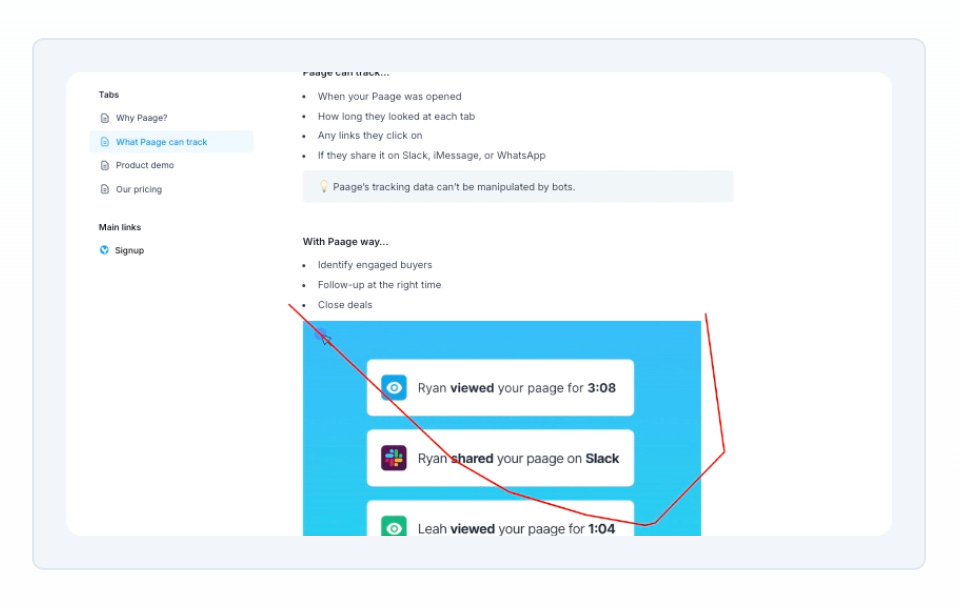
Now, not all signals are created equal. Here’s how you can think about it:
Low interest (≤ 10s bounce): No action, keep in sequence.
Medium (~20–30s + partial scroll): Send a light manual email (no ask), add value.
High (≥ 45s, full scroll, video click): Within 24–48h: manual email / LinkedIn touch / warm call.
These are the prospects you follow up with right away. It’s a simple but powerful shift: instead of chasing everyone, you let the right people reveal themselves and then decide who’s worth showing up for again.
2. How to track engagement (without breaking your stack)
If you’re not tracking engagement, you’re blind to 90% of what’s working.
That one prospect who clicked, spent a minute watching your video, and left without replying? Without tracking, they disappear. With tracking, they become your next opportunity.
Luckily, you don’t need a complex martech stack to set this up. Here are two simple ways to get it done depending on how you’re operating:
Option 1: Paage (the fast, outbound-native option)
Paage is designed exactly for this use case: outbound sequences that link to personalised landing pages for each prospect.
What it gives you:
Unique URL for each prospect (auto-generated with merge tags)
Instant signal when someone clicks or interacts
Native integrations with most cold email tools
Easy to add Loom videos, PDFs, or text
What I like about this tool is that you don’t need to touch your website. Just drop your resource into Paage, and send the link in your Email 2 or 3.
Option 2: Use your existing site with HubSpot or GA
If you already use HubSpot, Webflow, or Notion-backed sites, you can embed simple tracking via tools like:
HubSpot tracking links (tie click + page behavior to known contacts)
Google Tag Manager + events (scroll, video view, time on page)
Segment or Mixpanel if you’re more advanced
This route is great if you’re already tracking site behavior and want your sales touchpoints to feed into that same system.
Just be careful: Don’t overwhelm your prospects with a heavy, salesy landing page. Keep it clean, single-purpose, and focused on delivering the offer.
A good landing page should feel like a helpful resource, not a pitch. You’re warming them up, not closing them yet. Here’s a good example of a resourceful Notion landing page that you can track with a tool like Notionlytics.
3. Following up without killing momentum
Once someone has clicked your link, landed on your page, and actually engaged with your resource… you’re no longer in “cold outreach” territory. They’ve leaned in and that’s your green light.
Now here’s the mistake most sellers make: They blow it by jumping in with, “I saw you checked out X…” or “I noticed you visited our page…”
That’s creepy. It breaks trust. And it shifts the conversation from value to surveillance.
Instead, you must follow up naturally. You already know what they engaged with, so you show up with more of it, without mentioning the tracking.
A few examples:
Manual email (medium interest): “That 3-step workflow could probably save you time this month. Want to run it through together and see if it fits?”
Manual email (high interest): “The reporting workflow I shared works best when it’s mapped to your exact setup. Want to walk through it live and see what it would change?”
LinkedIn DM: “Caught your post on month-end chaos. Want to see how teams cut close time by days?”
Warm call opener: “Quick one. I sent you that email last week on improving reporting workflows. Are you currently handling reporting in-house, or do you have a set process you follow?”
The key here is continuity. Your follow-up should feel like the next logical step in the same conversation you started in your cold sequence, not a brand-new pitch.
You sparked the motion, they responded silently by engaging, and now you’re simply giving them the next thing to lean into.
Done right, this is where you start seeing the real payoff of the sequence you built: you’re not guessing who’s interested but acting on proof.
Client Case: How a bootstrapped founder turned 14 warm leads into 5 qualified meetings
A bootstrapped B2B SaaS founder selling a lightweight analytics tool for ecommerce brands ran the 3-step automated cold email sequence to 180 high-fit leads.
The initial outreach was entirely automated: written using the YYY framework, with Emails 2 and 3 linking to a simple landing page hosting the promised resource (a short demo video + a PDF checklist).
Automated results:
5 direct replies (2.8% reply rate)
1 meeting booked
Nothing spectacular, you might think. Well, by tracking landing page engagement, the founder spotted 14 additional warm leads who had interacted with the content. So what did she do next? Manual follow-ups with just those leads:
Sent personalised emails building on the resource
Connected on LinkedIn with a short note
Made a couple of warm calls
Warm follow-up results:
9 replies from the 14 warm leads
5 additional meetings booked
Final tally:
6 total meetings (1 from automation, 5 from warm follow-up)
42.9% meeting rate from tracked warm leads
Automation opens the door, but it’s rarely the whole win. By zeroing in on the people who actually engaged with the resource, the founder skipped chasing cold leads and spent time where there was already interest. That mix of scale from automation and precision from manual follow-up is what turned a so-so reply rate into a flow of qualified conversations.
Bringing it together
If you followed the 3-step sequence from the last edition, you now have a clear way to warm up cold leads without spamming or chasing endlessly.
But here’s where a lot of sellers overcomplicate things. The whole “signal-based selling” movement has made it feel like you need a massive tech stack to even start: Clay for research, website visitor identification tools, buying intent SaaS subscriptions… all to “know” whether a lead is going to be interested before you even talk to them.
That mindset shrinks your reach and often becomes a reason to put off outreach. In reality, those signals are just public data. Anyone can access them, and they lose their edge over time.
Instead, start by triggering those signals yourself through simple, targeted outreach. Every unopened email, every click, every landing page scroll is a signal. You just need to notice and act on it.
You don’t need a dozen tools to do that. Limit your SaaS stack, use it smart, and focus on personal, manual follow-up when engagement actually happens.
The process is simple:
Automate the first touches with a strong YYY message and a tracked landing page offering something useful.
Monitor engagement without stalking or over-relying on SaaS dashboards.
Follow up smartly with more value on the same topic, through email, LinkedIn, or a warm call.
It’s the difference between throwing bait in every direction and fishing where you know the fish are biting.
Alright, that’s it for email for now. Next time, we’ll dig into the LinkedIn lead generation playbook for founders that can outperform even your best cold email campaigns, so you can build the same predictable system there as well. Stay tuned.
Jasper
PS: Want a free audit of your sequence + follow-up plan? Reply ‘Audit’ and I’ll tell you exactly what to change so more of your leads turn into meetings.
♻️ If you found this helpful, forward this email to a friend.
⚡ Book your free Outbound Optimiser🛠️ to diagnose your GTM and get actionable, tailored advice.