


Welcome back to the Founder’s GTM 💬 with actionable strategies for business owners to land clients predictably.
In the last two issues, we covered the first steps of sending effective cold emails:
✅ How to get your emails seen by landing in the inbox (deliverability)
✅ How to get them opened and read (subject line + preview text)
☑️ Now we’re taking it further: how to trigger engagement with a full email campaign.
Let’s get into it..
The Goal of Your Email Campaign 🥅
If you don’t know what your email campaign is meant to do, you’re just adding to the noise.
Too many sellers treat cold email like a vending machine: send message, get reply, book call. But that mindset leads to a volume-first approach: spammy copy, low engagement, and missed opportunities.
Here’s a better way to look at it: Cold email is about creating triggers. You’re building awareness, momentum and nudges that move people one step closer to action.
That action could be a click, a site visit, a download, a forwarded email. All of these are signs of interest, even if the person doesn’t hit reply right away.
Perspective shift: a 5% reply rate means 95 out of 100 people didn’t respond. Would you call that a win if you were pitching live in a room?
People keep asking: “What’s a good reply rate?” And here’s the reality: that’s the wrong question.
I’ve seen founders obsess over hitting a benchmark reply rate, thinking it’s the magic key to outbound success. But reply rates, even positive ones, don’t pay the bills. Pipeline does.
Let me give you an example.
An agency owner recently shared their data: across all their campaigns, the average is one positive response for every 525 contacts. Two years ago, it was one in 400.
But here’s the nuance:
One customer gets a positive response every 78 contacts. Their LTV is $2,000.
Another customer gets a positive response every 2,000 contacts. Their LTV is $200k.
Both are profitable. Both are happy.
So is a 3% reply rate “good”? Or 12%? Or 0.06%? The answer depends on your deal size, your margins, and your ability to experiment until you find what sticks.
The real question isn’t “What’s the average?” The real question is: “Does the math work for your business?”
That’s why optimizing purely for replies is a trap. Your reply rate isn’t the scoreboard. It’s just a signal. What matters is whether your sequence drives the right people to take meaningful action, and whether one deal makes the whole motion worthwhile.
When you stop optimizing for replies only and start optimizing for action, your campaigns get smarter. You give them time to breathe. And you start paying attention to real signals instead of vanity metrics.
That’s why the new goal is simple: say something they care about, and share something that’s worth their time. Create a reason to act: for their benefit first, not yours.
Once that clicks, your entire strategy starts to shift. And so will your results.
The 3-Step Sequence 🔱
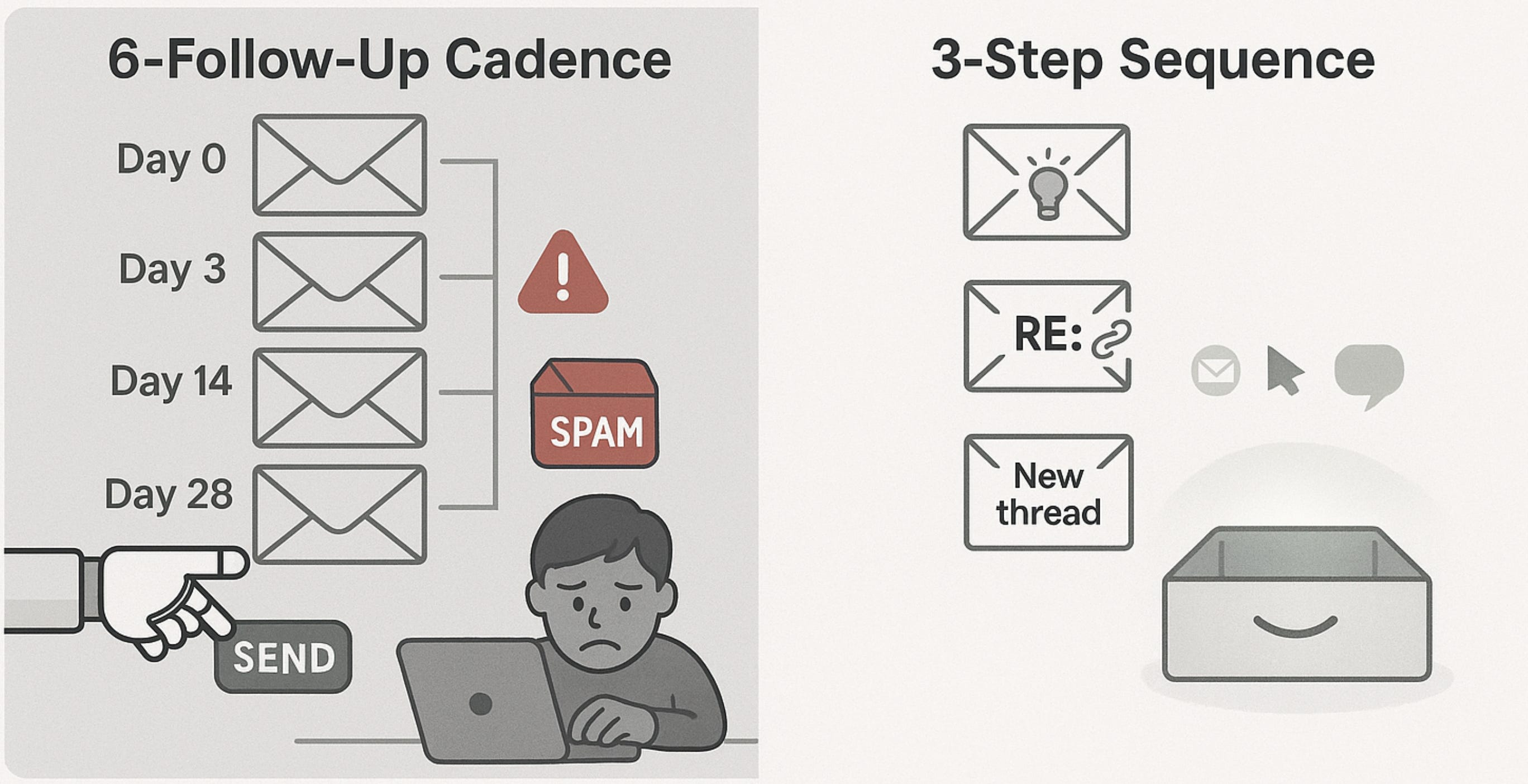
The other day I saw a founder destroy their domain reputation with a perfect prospect.
Not because of pricing. Not because of competitors. But because of the “Just checking in” fallacy.
Her sent folder was filled with the same, valueless messages:
⤷ “Just following up...”
⤷ “Wanted to circle back...”
⤷ “Hope you had a chance to review...”
That kind of follow-up might’ve worked in 2018. Today? It triggers spam filters. You aren’t just losing one lead, but burning the bridge to all future ones.
Here is the smarter way:
Last month, a bootstrapped founder launched a lean, three-step email sequence using the same framework we’re covering today. Here’s what happened:
350 high-fit leads reached
8 replies (2.5%) —> Many would call this a failure.
$55k in Pipeline Generated —> We called this a massive win.
We didn’t nag them for a meeting, not did we use salesy gimmicks.”
Instead, we offered a specific asset through a landing page and tracked who visited it.
The leads didn’t reply, but they navigated. And because we tracked that behavior, we knew exactly who was interested, even if they were too busy to write back.
We won’t go deep into the technical setup, but here is the foundation of the 3-Step Behavioral Sequence:
Instead of a 12-step “nudge” campaign, your sequence should be built on 3 purposeful value drops:
✅ Email 1: The Hook (Permission). Ask if they want the asset (e.g., The Configuration Map) to solve a specific pain.
✅ Email 2: The Delivery (Behavior). Send the asset. Track the visit. This is your “Silent Handraise.”
✅ Email 3: The Pivot (New Angle). Offer a different asset for a different pain.
Then stop. If they don’t click after three value-heavy emails, they aren’t interested.
Move on.
Let’s break each email down step by step.
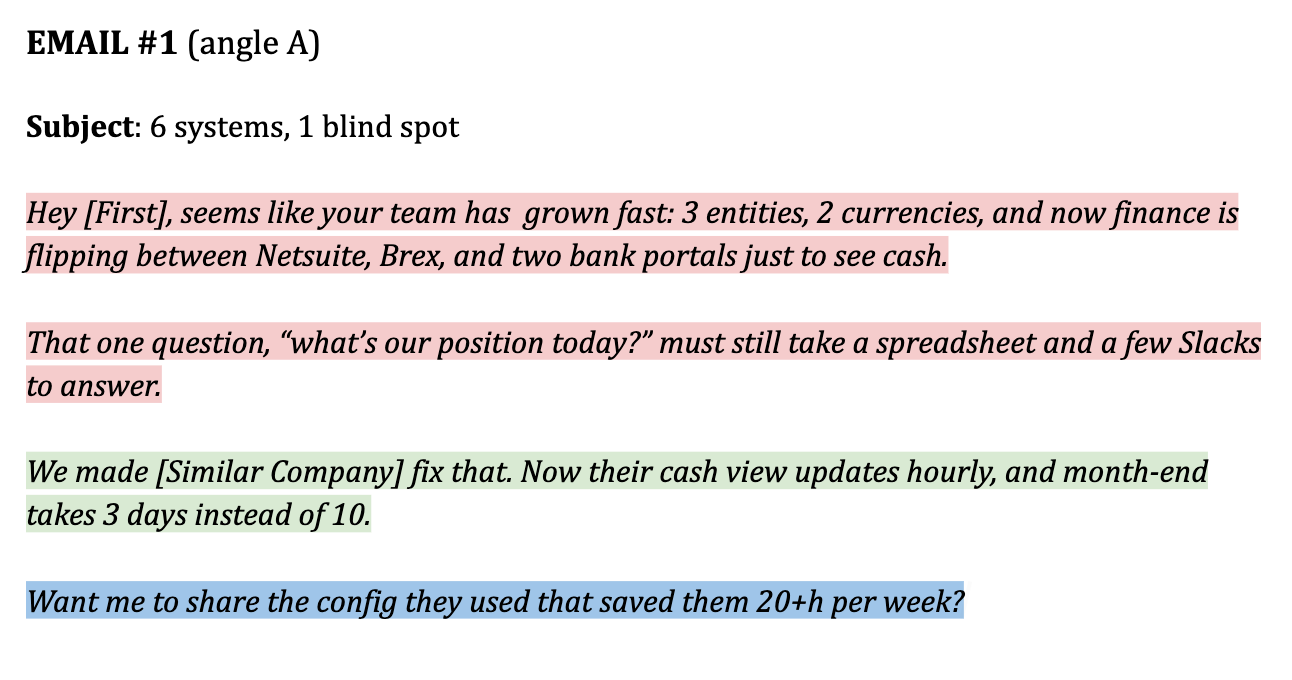
Email 1: Trigger + offer (YYY)
This is your core value prop. A YYY-style message that explains:
Why you’re reaching out: relevance
Why you’re credible: proof
What they can get: compelling offer
It’s a clean, text-only message with no tracking links or images yet for the best deliverability. The goal: spark curiosity, open the loop, and - ideally - get a reply.
This is what it looks like: relevance (marked in red), proof (green), offer (blue):
Email 2: Clarify + deliver (2 days later)
If there’s no engagement within 48 hours, it’s time to follow up, without starting over. Stay in the same thread and send it as a reply (RE:), so it feels like part of the same conversation.
This one’s simple:
✅ Clarify the value
✅ Deliver the offer directly
Instead of asking if they’re interested, you just give them something worth checking out.
No pressure, no hard ask. Just making the value easier to act on.
Example:
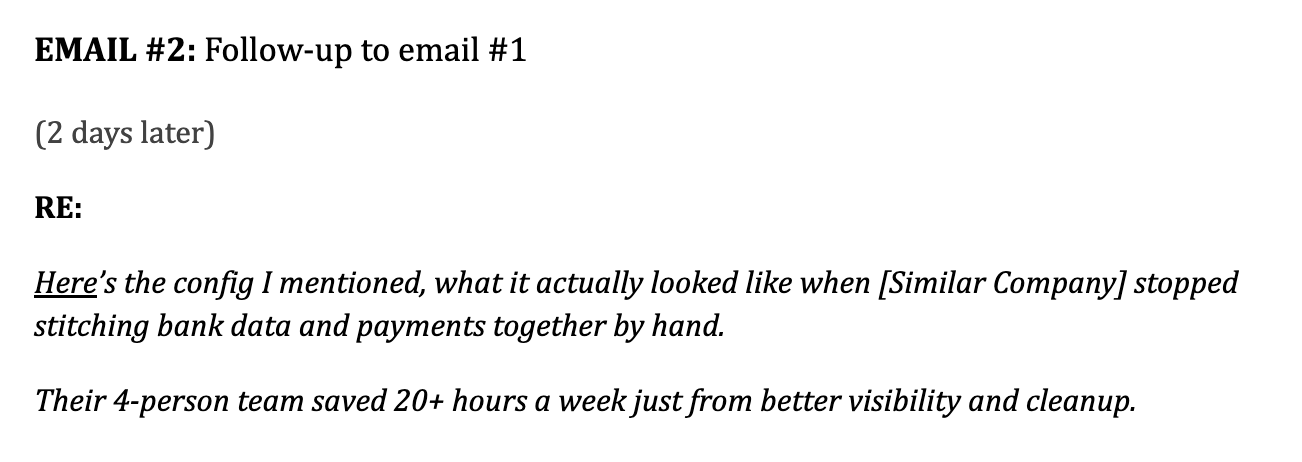
Optional pro move: include a screenshot or thumbnail of the resource with the link. It makes the offer more tangible and increases the chance they’ll actually click on it.
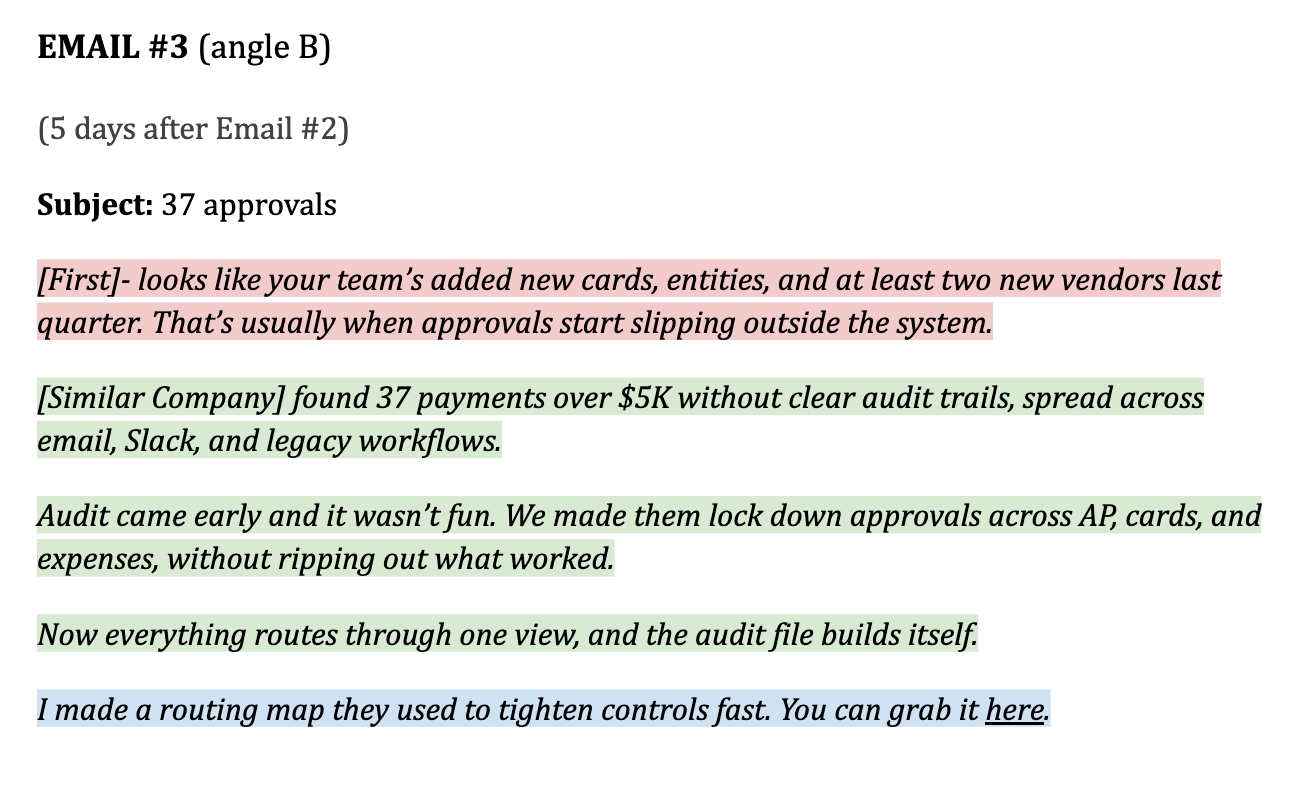
Email 3: New thread, different angle (YYY) (5 days later)
If there’s still no sign of life 5 days after your follow up, it’s time to change the angle and see if third time’s a charm.
Start a new thread and treat it like a fresh cold email. Similar structure to Email 1, but with a slightly different value prop. Keep it short. No ask. Just drop the resource.
This is where you blend elements of the first two emails. Example:
That’s it.
Now you might be wondering: does this all scale? Especially that first part, writing tailored, relevant intros that require proper research.
And the answer is yes. AI handles the heavy lifting. Tools like Clay let you research prospects at scale, and with the right framework (YYY), you can generate strong first drafts automatically.
And of course, sending can be handled by email automation tools like Instantly, Apollo, or Smartlead.
Converting Warm Leads 🔥
If you’ve been following this newsletter seriously, after today you should know how to build targeted lead lists, write messaging that converts, and run your first effective email campaign.
Next time, we’ll dive into how to follow up strategically on your campaign leads, by using landing page tracking, monitoring engagement, and turning warm leads into calls or signups.
That’s how you identify who to follow up with in phase 2, and let your warmest leads reveal themselves before they ever reply.
More on that next time!
Jasper
📚 Find more resources on my landing page.
🩺 Get a free Outbound Health Check to diagnose your founder-led sales and get actionable advice.
💬 Follow me on LinkedIn or X for daily tactics.