
The only GTM tools you need in 2026
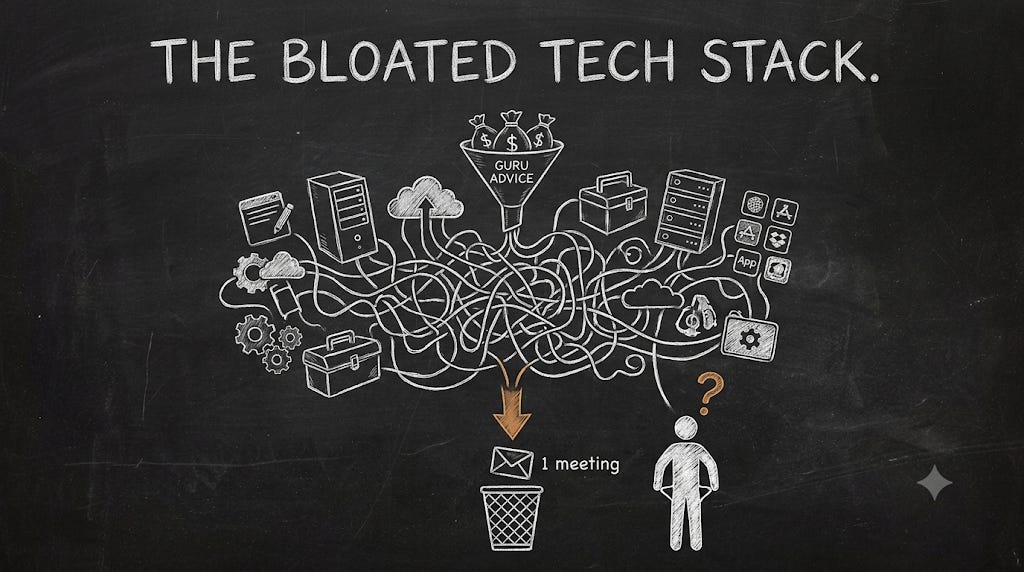
2025 GTM stack advice on LinkedIn has turned into engineering cosplay: complex workflows that look impressive but ignore business reality.
These 12-step diagrams cost $3,000 a month and require a full-time GTM engineer to maintain.
Complexity is profitable for the sellers. SaaS platforms get paid per seat and workflows grow longer every month, but you are the one left carrying the burden of the maintenance.
Before you buy a single tool, map your workflow to the 3 Core Categories below.
If a tool doesn’t fit cleanly into one of these buckets, cut it.
Category 1: Data Sourcing
1. The Accounts (Who fits?)
Founders often default to LinkedIn. But before you buy a new SaaS, ask yourself where your target accounts actually live.
Standard B2B: If you sell to standard tech or service companies, they live on LinkedIn.
—> You need LinkedIn Sales Navigator. (The gold standard).
Specialised markets: If you sell to industries like construction, manufacturing, or healthcare, they often aren’t active on LinkedIn. A trade show exhibitor lists or industry directories is often more useful.
—> Use Apify or Phantombuster to scrape an exhibitor page or local directories.
The lookalikes. If you have a list of your best clients and want more of them.
—> Go with Ocean.io. It finds companies that match your best clients contextually, not just by industry tag.
2. The Signals (Why now?)
Static lists are cold. You need data that triggers timing. To find the Why now, you need to track two types of signals:
Account-based signals: These tell you a company is entering a growth phase or has fresh budget.
Website intent: Snitcher tells you which companies are browsing your pricing page (~$50/mo) so you can reach out while they are actively researching.
Funding & news: Crunchbase (~$30/mo) tracks “big events” like new funding, acquisitions, or IPO filings that signal an immediate need for new infrastructure.
Operational shifts: Use Sales Navigator or BuiltWith to track hiring spikes or new tech installs (e.g., they just installed your competitor or a tool you integrate with).
Persona-based signals: These tell you a specific decision-maker is active and likely to engage.
Social intent: Trigify.io is a “social listening” engine. It monitors platforms like X and LinkedIn, and automatically grabs the specific people who like or comment on posts related to your niche. It turns likes into lead lists instantly.
Job changes: Use the Sales Navigator “Spotlight” filter to track past customers who just moved to new companies. When a fan of your product starts a new role, they are 3x more likely to buy from you again to get an early win.
Category 2: Data Enrichment
This is usually where budgets balloon. Enrichment has three jobs that move a lead from a name on a list to a qualified opportunity:
Identify the person: Finding the specific decision-makers within your target accounts.
Verify contact info: Get a valid email or mobile number using “waterfall” logic (if Provider A fails, try Provider B).
Find context: Collecting the specific data points needed for the “Why Them” section of your message. This is where you plug in an LLM to automate research at scale.
Clay
Clay is the industry standard because it connects 100+ data providers into one spreadsheet, using AI agents to research every prospect for you.
It is incredibly powerful, but the learning curve is steep and the credit-based pricing can get expensive fast. If you use it, don’t guess your way through and start with Clay University.
If Clay feels like overkill, look at Freckle. It offers similar waterfall enrichment and AI research but with a simpler interface and predictable, flat-fee pricing. It gets 80% of the job done with 20% of the headache.
Category 3: Distribution
Before you pick a sending tool, ask yourself “Where do my leads actually engage?”
Don’t force a channel on a market that ignores it.
Email First
Corporate B2B targets live in Outlook. To stay out of the spam folder, you need tools built for high-volume deliverability and domain warm-up.
Instantly / Smartlead allow you to scale your outreach across dozens of “burner” domains without the per-seat pricing that kills SMB margins.
Social First
Tech founders and Gen Z leaders often ignore their inbox but live in their LinkedIn or X DMs.
HeyReach / LGM are safe, cloud-based automation engines. They mimic human behavior, (viewing profiles and liking posts) before sending a DM, so your account stays safe while you book meetings on autopilot.
Phone First
Traditional markets often ignore cold emails but still value a conversation. If your prospects are “offline,” the phone is your primary channel.
Aircall is a reliable cloud phone system for manual or power-dialing with deep CRM logging.
TitanX/SureConnect have an AI layer that scores your list to identify “Phone Intent,” allowing you to call only the people most likely to answer and skipping the voicemail grind.
The $1K Lean Stack
Here is what a scalable engine looks like for a lean team.
This setup covers your data, signals, enrichment, and multichannel outreach. All while staying well under budget:
Account Data & Signals: Sales Nav / Trigify.io / Snitcher (~$200/mo)
Lead Enrichment: Freckle / Clay (~$200/mo)
Phone Engine: SureConnect / Aircall (~$150/mo)
Email Engine: Instantly / Smartlead (~$100/mo)
Social Engine: HeyReach / LGM (~$150/mo)
Total: ~$800/mo.
You still have $200 left over for extra data credits or a coffee budget for your sales hire.
If you are spending more than $1k/month and haven’t booked your first 50 meetings, your problem isn’t the software but your strategy.
Before adding more tools, start with your Why Them.
Last but not least: Whatever tool you choose, it must integrate with your CRM. If data doesn’t flow back to the CRM, it doesn’t exist.
The Takeaway
Tools do not fix a broken strategy.
You can have the most expensive stack in the world, but if you are scraping LinkedIn when your customers are on a trade show list, or emailing people who only use the phone, you will fail.
Start with the customer, pick the right category. Then buy the leanest tool that does the job.
Complexity is a cost. Simplicity is a competitive advantage.


Love the article. I agree with the bucket categories but how do you see these tools supporting the sales process after the first meeting and prospect is sales qualified?