

A bootstrapped fintech founder I spoke to recently has closed deals most companies never see in a decade.
No outside money and no sales team.
He sells through a few senior people with thirty years of relationships each, himself included.
On paper, sales is handled. Then he said the line that gave it away:
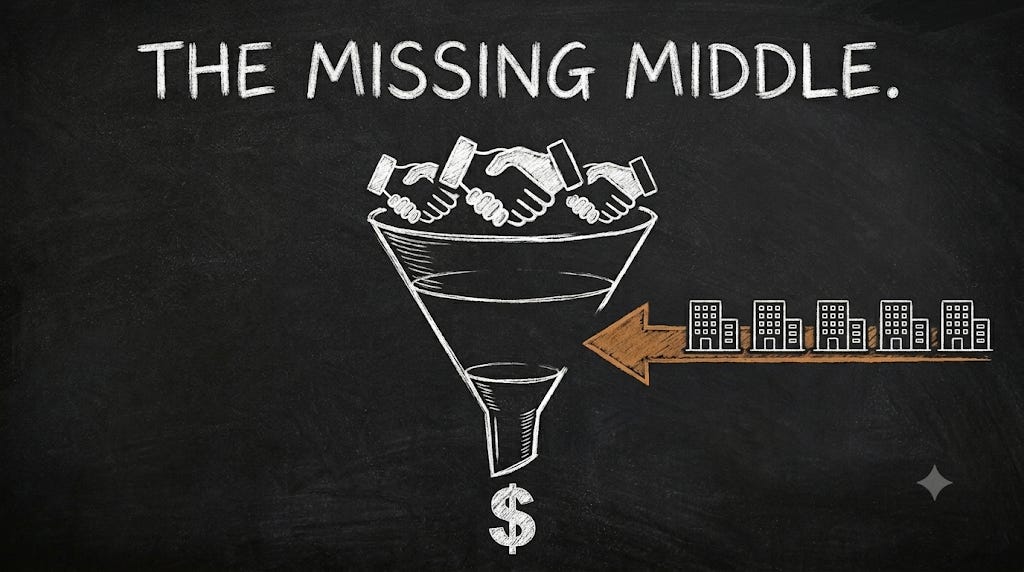
“We have either no business outreach, or a very senior business outreach. Nothing scalable in the middle.”
A brilliant top end, an empty bottom, and nothing in between.
The missing middle 🕳️
When a senior relationship closes, it’s enormous. When it doesn’t, there’s nothing underneath to catch the quarter.
His product works. But the whole middle of his market has never heard of it, because reaching them was nobody’s job.
A strong network feels like a sales engine, right up until the month it goes quiet.
That’s when you see what it is: a few brilliant people and their address books. Those go further than you’d think, but they still run out eventually.
Another senior hire won’t fix it. That just adds one more address book.
What fixes it is a repeatable layer underneath the relationships, so the pipeline stops depending on whether this quarter’s introduction came through.

Your best wins already hold the answer 🔍
Every deal your network closed had a reason behind it. Something was happening inside that company at the moment it said yes:
A new leader who needed a quick win
An expansion that broke the old process
A funding round that came with pressure to grow
The introduction got you in the room. The situation made them buy.
And that situation isn’t private. Other companies are in it right now, and plenty of them leave a public trace: a job ad, a launch, a new hire, a funding announcement.
So here’s the move:
Work out what made your best network win a buyer.
Then find more companies in the same spot.
The prompt 🛠️
Give Claude one deal you won through your network. A warm intro, a relationship, anything that didn’t come from cold outreach.
It works out what made that company a buyer, then finds ten more in the same situation that you can reach directly, no introduction needed.
You are my lookalike account finder.

I'll describe one customer I won through a relationship or
a warm introduction. Find ten more companies in the same
situation that I can reach directly.

## STEP 1: UNDERSTAND THE WIN
Ask me, one question at a time:
- What they do, and roughly how big they are
- What was going on in their business when they bought
- The problem my product solved for them
- Why they were a good fit, in one sentence

Then ask:
- The size and geography of company I sell to
- Who to exclude: competitors, industries that never buy,
  anyone already in my pipeline

Wait for my answers before going further.

## STEP 2: FIND THE TRIGGER
Work out the situation that made this company a buyer:
a stage, a recent change, or a pressure that created the
need. Look past the industry label.

Write it as one sentence, in this shape:
"A company that has just [specific event], which usually
means [the problem it creates]."

Ask me to confirm or correct it. Don't search until I
confirm. Every company on the list must share this
trigger. Industry and size come second.

## STEP 3: FIND TEN LOOKALIKES
Search public sources for companies showing that exact
trigger right now.

Rules:
- The trigger must be visible and dated within the last
  90 days: a hire, a launch, a funding round, an
  expansion, a public post, a job ad
- The company must fit my size and geography
- Skip my exclude list, my original customer, and my
  competitors
- Include a company only if you can link to the dated
  evidence. No guesses

A perfect trigger at the wrong-size company is a wasted
row. Leave it out.

## STEP 4: OUTPUT
A table, strongest trigger first:
- company and domain
- the dated evidence, with the link
- the role I should reach
- an opening line I could send, naming the evidence and
  what it likely means for them

Below the table:
- which one to reach first, and why
- any company you weren't sure about, and what would
  confirm it
- where you found the best evidence, so I can search
  there again next month

Only companies you can verify. If you can confirm seven,
give me seven and say why.
3 tips to get more out of it 📌
Start with your best win, then run it again with your second best. If both triggers match, you’ve found a pattern. If they differ, you’ve found two segments
Push back in step 2. If the trigger sounds like “growing companies”, it’s too vague. Ask Claude to name the event
Run it monthly. Triggers expire. The last line of the output tells you where to look next time
What to do with the 10 ➡️
You’ve got 10 companies with a dated reason to talk. Next:
Find the right person. The Lead Enricher pulls verified emails for the role Claude named.
Write the first email around the trigger. The YYY email Skill builds it from the evidence.
Want a bigger list? Build Your List With Claude Code scales the same idea to 30 to 50 accounts.


Before you go cold, check how far your network reaches 🤝
Lookalikes cover the companies nobody’s introduced you to yet. But your warm network is probably bigger than you think.
When I mapped my own LinkedIn, 7,186 connections turned into 1,382 ICP-fit founders I could reach warm, through just 6 people.
The Network Referral Maker walks you through it: find your top connectors, map who they know, check how strong each relationship is, and know exactly what to send.

Takeaway
A great network hides an empty pipeline, the same way a great close rate hides a thin one.
Both feel like winning, until the source dries up.
You don’t need more relationships to fix it.
You need to understand why your best relationships turned into deals, then go find that situation everywhere else.
Your next ten customers are already in it. They just haven’t been introduced.