


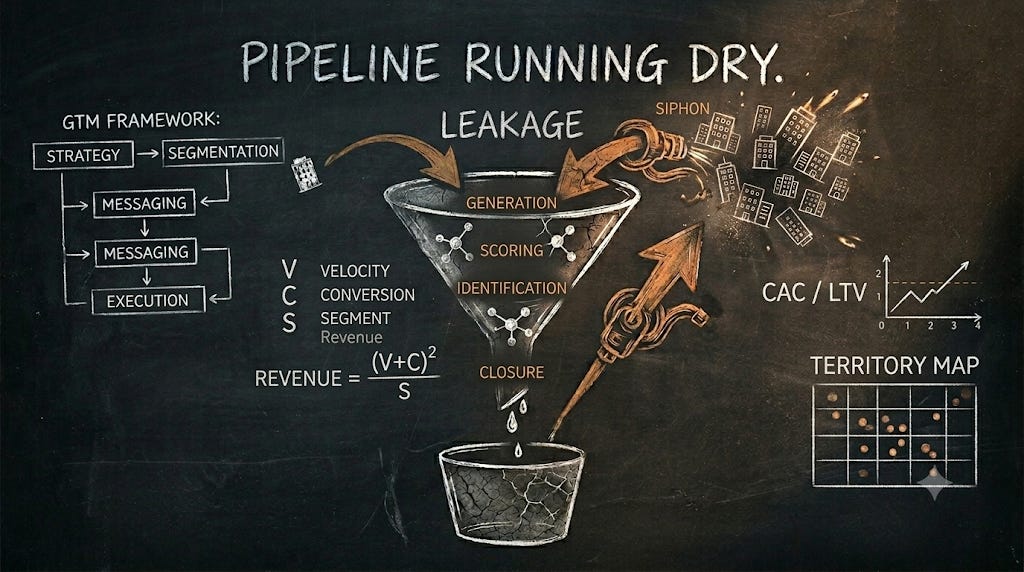
A few years ago I almost ran my business into the ground, on a good week.
I was drowning in client work and got complacent. Booked solid, delivering, busy in the best way. And because the pipeline was full, I did the laziest thing a founder can do.
I stopped feeding it.
No outbound, no prospecting. Why would I, with more work than I could handle?
For months, nothing happened. Then the market shifted.
A few projects wrapped, a couple didn’t renew, and I looked up to find the top of my funnel gone empty.
I’d been so sure of the work that I’d let the one thing that brings in more work go quiet.
So I rebuilt outbound from zero. Building pipeline when you’re calm is work. Building it when you can feel your cash running out is a different kind of pressure.
I got out of it. But I never forgot how avoidable it was.
You might be making the same mistake
Right now, I see a whole market of teams making this exact mistake. Trusting a channel because it feels safe, while it slowly stops working.
Inbound is changing underneath everyone, and AI is the reason.
People used to search, scroll a page of links, and click yours. Now they ask an AI, get one answer, and never see the list your SEO fought for years to climb.
Your ranking holds. The clicks it used to earn quietly go elsewhere.
And the founders best at the old game are the most exposed. They trust the channel that built them, and keep waiting for it to recover.
The dip you can always explain away
I watched this land on another founder that sells to retailers, names you’d recognise. A business built entirely on his network and inbound, deals that turn into five-year clients.
He’d message me every few months and agree it was time to start outbound. But every time, nothing moved. The channel still felt warm enough to wait on, and starting felt big.
So he waited. Another quarter, another dip he could explain away.
The founders who get out of this have one thing in common
I take on a handful of founding teams at a time, by choice, and the ones I say yes to share one thing: They’ve stopped waiting.
I can’t make that call for anyone, and I’ve stopped trying. Nobody changes someone who isn’t ready.
The most I can do is say it plainly: every month you wait, someone who started is reaching the clients you assumed were yours.
The way out is the thing I stopped doing
The way out? Reach the right companies directly, before they go looking for what you sell. The ones showing in public, right now, that they have the exact problem you fix.
Most teams never start, because the internet handed them ten tools and a hundred tactics and they froze.
So here’s the first step, small enough that you can’t talk yourself out of it. Point this at your best customer, and it builds a starting list of companies in the same situation right now.
You are my outbound starter. I've leaned on inbound and my
network for too long, and it's drying up. I need to start
reaching the right companies directly. Don't hand me a system
to master. Hand me one sharp list I can act on this week.

## STEP 1: LEARN FROM MY BEST CUSTOMER
Ask me to name the single customer I most wish I had ten more
of, and tell you in plain words:
- What they do and roughly how big they are
- What was happening in their business when they bought
- The specific problem I solved, and what it was costing them
- How they found me, or how I found them
Wait for my answers before doing anything else.

## STEP 2: FIND THE REAL TRIGGER
Work out the underlying situation that made them a buyer. Not
the industry. The condition: a recent change, a pressure, a
moment. Write it back to me in this exact shape:
"A company that has just [specific event], which usually means
[the problem it creates that I solve]."
Ask me to confirm or fix it. Do not search until I confirm.

## STEP 3: BUILD THE LIST, SIGNAL-FIRST
Search public sources for ten companies showing that trigger
right now. Rules:
- The trigger must be visible from something real and dated in
  the last 90 days: a hire, a launch, a funding round, an
  expansion, a public post, a job ad.
- The company must plausibly fit the size and type of my best
  customer.
- No guesses. If you can't point to dated evidence, leave it out.
- If you can only verify seven, give me seven and say why.

## STEP 4: NAME THE BUYER, NOT THE OBVIOUS NAME
For each company, the person to reach owns the problem the
trigger points to, not always the most senior name. Small
company: the founder. Bigger one: the function head one level
above the pain, not the CEO who'll never reply. Give me the
exact role at each.

## STEP 5: HAND ME THE STARTING BATCH
Return a table, strongest first:
- company
- domain
- the dated evidence they share my customer's trigger
- the person and role to reach
- one line on the angle I'd open with, naming the evidence
Then tell me the single company to email first, and why it's
the best use of my first hour. Keep it to ten.
Ten companies, one afternoon. That’s all the first step is.
I had my good week years ago. It’s the most expensive thing I never noticed.
Don’t wait for yours to end before you feed the funnel again.
Best,
PS: That prompt gets you one list. The full system, every Claude Code Skill, the Systems Library, and every guide, is what turns one list into pipeline you build every week, without waiting for inbound to save you.