

I admitted a hard truth to Chris Hines on his Next Round Ready podcast recently.
Two years ago, if a founder asked me, “How do I fix my sales pipeline?” I would have sold them a GTM Strategy sprint.
You would pay a consultant $15,000. They would interview your team, audit your stack, and three weeks later, they would hand you a beautiful Roadmap.
And back then, it was often worth every penny.
Today, paying for such a Roadmap seems like burning cash. You no longer need to hire a human to answer that question, because you just ask your LLM.
You upload your website to Claude or o1-preview, paste in your value prop, and ask for the ideal GTM strategy.
And honestly? The answer is usually 80% correct. Plus, it does in 30 seconds what used to take us 30 days.
The market value of information has fallen to zero.
The Canary in the Coal Mine
Richard F. Purcell from Moxie GTM shared an honest update last week about the collapse of his agency.
In January 2025, he was doing $30,000 MRR. By April, he was at $0.
He pivoted, then executed perfectly. He closed new deals, but ultimately realised he was fighting an un-winnable war.
“I was competing against AI tools that were getting better every month... GTM Engineers charge $6k-$12k per month for what can now be done with a few prompts in Claude for $20.”
Richard is not a low-level operator. But he did the math that most agencies are terrified to admit.
We are watching the death of the Middleman.
For the last decade, the GTM industry was built on arbitrage. Consultants knew secrets founders didn’t. Technicians knew buttons founders didn’t.
Powerful LLMs exposed those secrets. The Agents are pushing the buttons.
The Happy Path Trap
If AI gives you the strategy for free, and AI builds the tech stack for free... why do startups still fail?
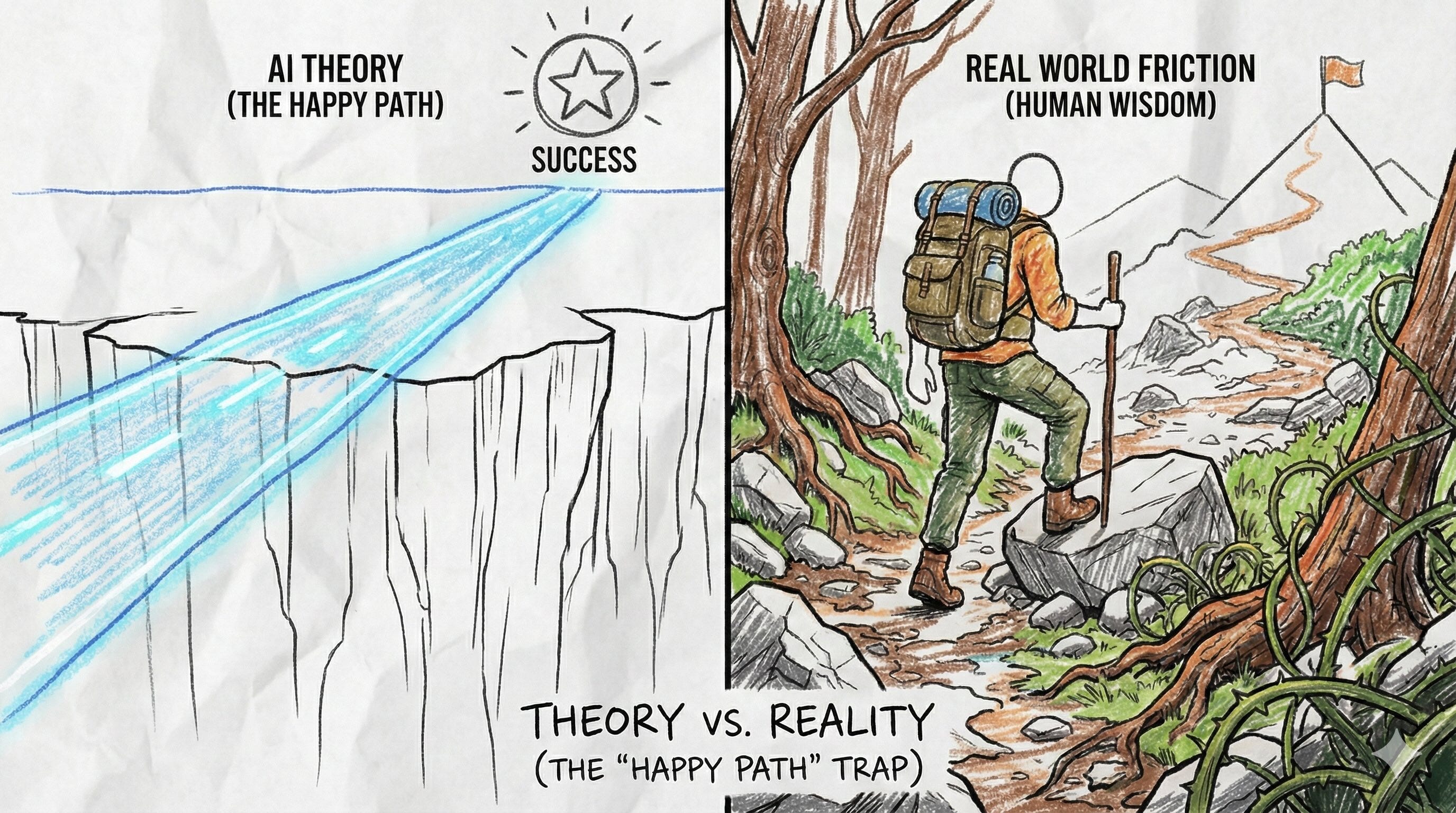
Because AI is excellent at Theory.
In the LLM’s world, the market responds rationally. If you write a good value proposition, the prospect replies. If you set up DMARC, you land in the inbox.
But in the real world, Friction is the default.
Budgets get frozen because it’s Q4.
The Champion gets fired mid-sequence.
Your “perfect” email lands in spam because Google updated its filters on a Tuesday.
“But, can’t the AI fix that?”
Sure, it can give you the textbook fix. If you ask, “My reply rates dropped,” the AI will say: “Shorten the subject line and personalise the intro.”
That is solid advice. It is also exactly what everyone else is doing.
Because AI is trained on the average of the internet, it gives you the average solution. It doesn’t know that “Quick Question” subject lines are currently triggering spam filters because spammers overused them.
I discussed this exact dynamic with Chris on the podcast:
The Theory (AI Approach): A fintech client had a 1% reply rate. The AI analysed the copy and said: “Optimise the call to action to be clearer.”
The Reality (Human Wisdom): The market was tired of “Calls to Action.” They didn’t want a meeting but value upfront.
We didn’t need better theory. We simply had to manage reality.
We scrapped the 12-step sequence for a 3-Step Sequence.
Instead of optimising for replies (which people hate giving), we optimised for visiting a landing page on a specific asset for their finance stack.
The Result:
Only 8 replies (2.5% rate).
But $55k in pipeline.
How? By tracking the people who visited but didn’t reply, and then calling them.
Whereas an AI builds a strategy based on the ideal outcome (a reply), a Human builds a system based on the likely outcome (silence), and finds a way to win anyway.
The Two Deaths in GTM
This shifts the value equation for everyone in the industry. There are two roles that are effectively dying, but one is being reborn.
Death 1: The Strategist
Old World: You paid $20k for the “Plan.” You paid for someone to tell you who to target and what to say.
New World: The Plan is a commodity. You can get a B+ strategy from o1-preview for free. If you are selling information, you are selling ice in the Arctic.
Death 2: The Clay Expert
Old World: You paid an agency or a specialist $8k/month to configure your stack, connecting Apify to Make, Make to Clay, and Clay to HubSpot.
New World: Claude Code handles the configuration. The Button Clicker (the person whose primary skill is knowing how to set up the tool) is now a bug instead of a feature. And AI just patched it.
However, this does not mean the GTM Engineer is dead. It simply means the bar has been raised.
As we’ve seen in When to hire a GTM Engineer?, putting a rocket engine on a go-kart won’t make it fly.
You don’t hire a GTM Engineer to find your strategy (Phase 1).
You also don’t hire them to test your channel (Phase 2).
You DO hire them to scale a working motion. (Phase 3)
The Clay Expert/Claygency who charges you a tax to manage your software subscription will disappear.
The GTM Engineer who builds proprietary infrastructure to scale a winning playbook is more valuable than ever.
The Only Survivor
So, if the Plan is a commodity, and the Build is automated... what’s left?
Richard Purcell is a Professional. He built a real agency doing $30k/month. He sold execution: building the actual engines.
When he realised that AI had commoditised his execution (bringing the cost of “building” to zero), he didn’t lie about it.
He admitted it, shut down the obsolete model, and pivoted.
That is Wisdom.
AI has infinite Knowledge (Theory). AI also has zero Wisdom (Experience).
Theory is knowing that a cold email should be under 100 words. (The AI knows this).
Wisdom is knowing that this specific prospect will ignore a short email but will read a longer, technical one because they are an engineer. (Only a human who has sold to engineers for 10 years knows this).
Replaced by AI
LinkedIn has been flooded with “GTM Experts” who read a few blog posts and repackaged them as advice.
These folks are now commodities. They sell generic theory. And because AI can now generate that same theory for free, their business model has collapsed.
If you hire them, you are paying a premium for a Spotify playlist when you could just listen to the radio.
Worse, they are dangerous.
When growing a business, burning six months on a strategy that looks good on paper but fails in reality is a death sentence.
Extreme Due Diligence
The only experts who survive this shift are the ones who have battle scars.
These are the people with 10+ years in the field. They don’t just show you a strategy, but can back it up with testimonials. They show you cases where things went wrong, and how they fixed it.
The AI can tell you what to do.
The Expert can tell you what happens when you do it.
If someone cannot prove they have solved your specific problem for a specific client in your specific industry, they are not an expert.
So if you are a founder hiring looking for help with GTM, whether from a consultant, a Head of Sales, or a GTM Engineer: you need to review your filters.
Do not look at their LinkedIn follower count or their perfect strategy deck. Look at their receipts.
Ask for specific case studies: “Show me a client in my industry where you achieved this specific result.”
Ask for the Before and After: “What was the reply rate before? What was the pipeline value after?”
Check the references: Call the founder they worked with. Ask them: “When things broke, did they fix it, or did they blame the market?”
If they can’t provide this, they are a commodity. And commodities are being replaced by code.
Takeaway
The death of the Strategist does not mean strategy itself is useless. It simply means selling generic strategy is dead.
In the past, you paid experts for Access.
Access to data (ZoomInfo).
Access to workflows (Clay).
Access to playbooks (Consultants).
Today, AI gives you access to all of this for $20/month. The barrier to entry has collapsed to zero. This means the noise will be deafening.
Your competitive advantage is knowing how fast you can filter what matters.
Don’t pay for the map. (AI draws it for free).
Don’t pay for the car. (AI builds it for free).
Pay for the Driver. (The human who knows how to handle the curve at 100mph when it’s raining).
The cost of knowing is now zero, but the value of deciding is infinite.
Jasper
Somehow I think it's good to replace the middle man. It should have a positive impact on revenues an margins.
Thanks for this article ! 🙏