


I’ve reviewed hundreds of AI-written cold emails this year.
Almost all of them fail for the same two reasons.
Take a client of mine. He spent three weeks fixing his cold emails.
They ended up sounding exactly like him. Specific. Human. The kind of email you’d actually reply to.
But his reply rate was stuck at 0.4%. He’d just fixed the first reason perfectly.
The 50% everyone fixes
Shiv Sakhuja (Gooseworks AI founder) noticed that AI cold emails suck because the AI has no context about you.
Give it your voice, your proof points, your product story, and the output gets much better.
He’s right. That’s real, and it works.
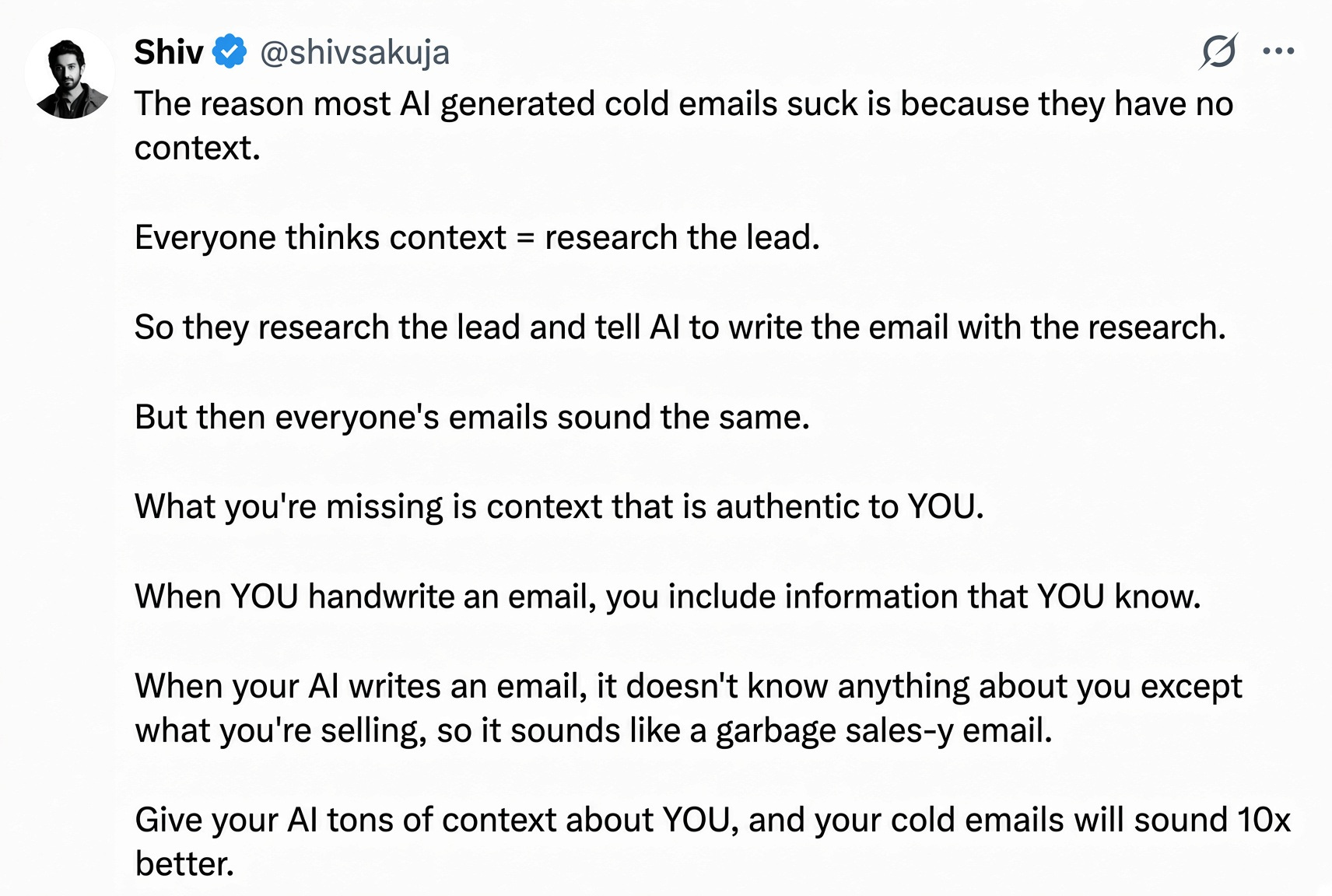
My client loaded his CLAUDE.md with product details, case studies, voice rules, proof points.
And it did exactly what it should: The generic template voice disappeared. Every email sounded like it came from him and nobody else.
But better-sounding emails to the wrong people is just higher-quality spam.
The 50% almost nobody fixes
The problem was that his emails were landing with people who didn’t have the problem he solves.
This part is getting harder, because every GTM team now calls itself “data-driven,” which mostly means everyone looks identical.
Same dashboards, with the same filters.
Same recycled intent data, hitting the same prospects, in the same week.
If your list comes from a filter anyone can run, you’re competing with everyone who ran it.
So we threw out the filters and asked a different question: what was actually happening inside a company right before he closed them?
Where his signals came from
Not “B2B SaaS, 50-500 employees, currently hiring.”
We went through his closed-won customers and looked for what they had in common in the 90 days before they bought.
Three things came up:
→ a tech stack combination that breaks at a certain scale
→ a leadership gap in the exact function his product serves
→ a job posting open 60+ days, signalling an understaffed team
Yes, every one of those is public. Anyone can see a job posting and check a tech stack.
What nobody else has is your closed-won list. That’s where you learn which combination actually means someone is about to buy.
Your lead data tool has no filter for it because nobody built one. It only matters for your buyer.
Claude finds them because you tell it what to look for.
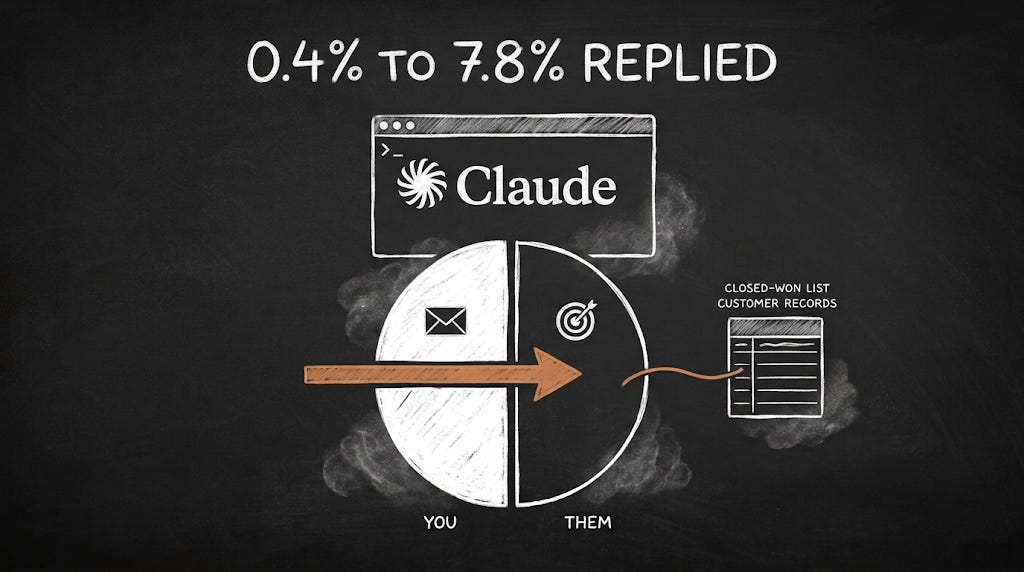
Reply rate went from 0.4% to 7.8%. Same product, same voice rules, same model writing the emails.
The only thing that changed was who received them.
The short version
→ Context about YOU just fixes the tone.
→ Context about THEM fixes the targeting.
→ Signals pulled from your own closed deals fix the competition problem.
People stop after the first one, wonder why nothing lands, and rewrite the copy again.
Your next three signals are sitting in your last five customers.
Go look at what was happening to them right before they said yes.
PS: If you’re still a free subscriber, consider upgrading. Premium subscribers get:
