


A few months ago I cancelled my Clay subscription. When I wrote about it, the pushback came fast.
“Sure, fine. But what about the email enrichment waterfall?”
“What about running thousands of rows?”
“What about the table view?”
Fair points, and here’s what they have in common: None of them are about enrichment.
All of them are about the same thing: workflow orchestration.
The last thing Clay still does well that nothing else does cleanly.
In the past week, two people on LinkedIn made the same argument from two different angles.
A bootstrapped GTM consultant.
A founder running $10M+ ARR.
So let me name what is in it, and why I think it has twelve months left, maybe fewer.
Complex workflow orchestration
When you run a lead enrichment job, you are not just looking up an email, but running a chain of decisions:
Check Apollo. If it returns a verified email, stop.
If not, try Prospeo. Then another email finding tool.
If you find an email, validate it through NeverBounce.
If the company has a HubSpot record, update it. If not, create one.
If anything fails, log it and flag it for manual review.
…
Do that across 2,000 rows, with fifty parallel columns of enrichment, and you get a workflow that needs orchestration.
A table, a queue, logs, retries, visibility, etc.
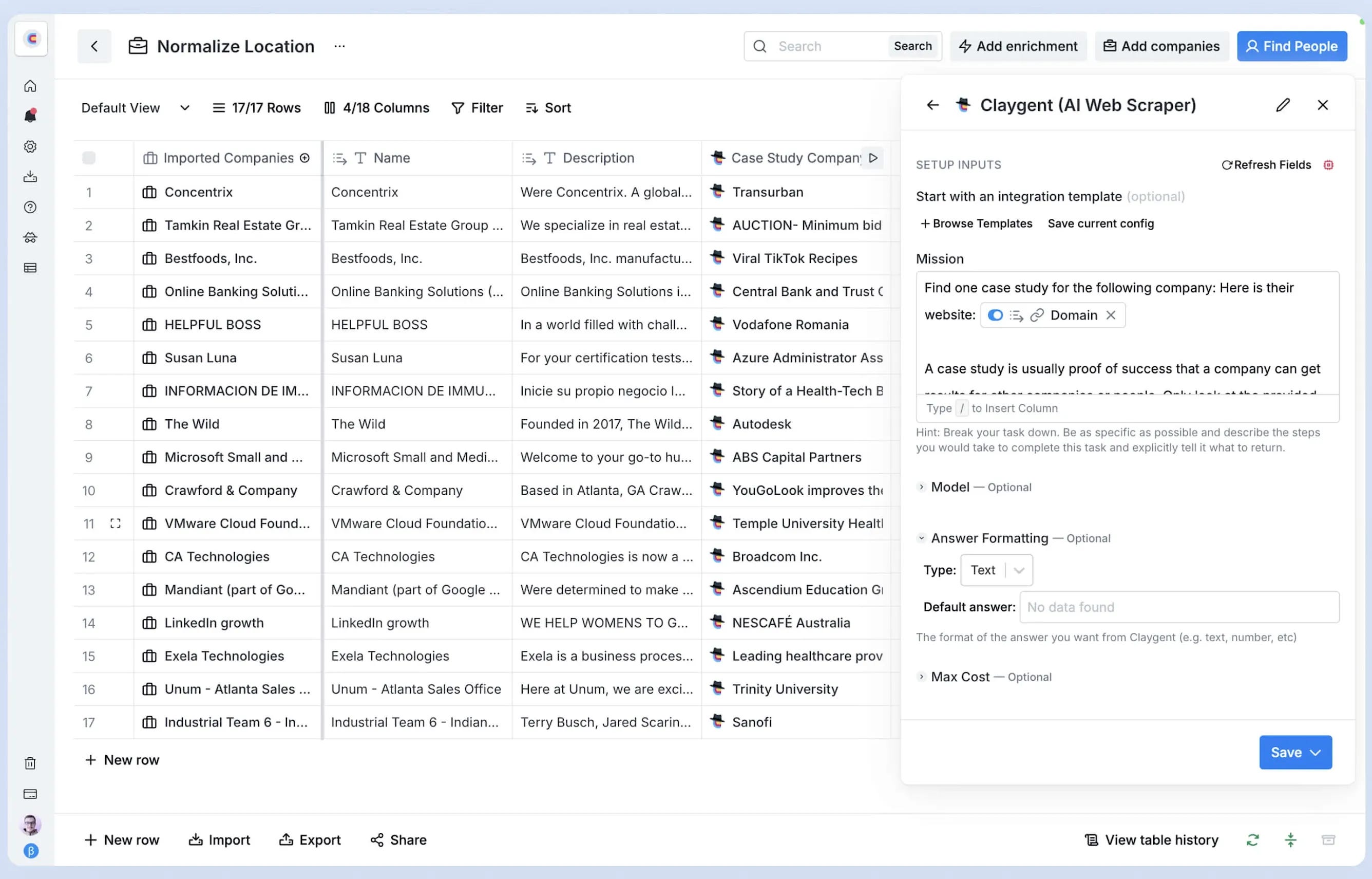
That’s what teams have been paying Clay for. Not the enrichment itself, but the orchestration around the enrichment.
Two founders, same argument
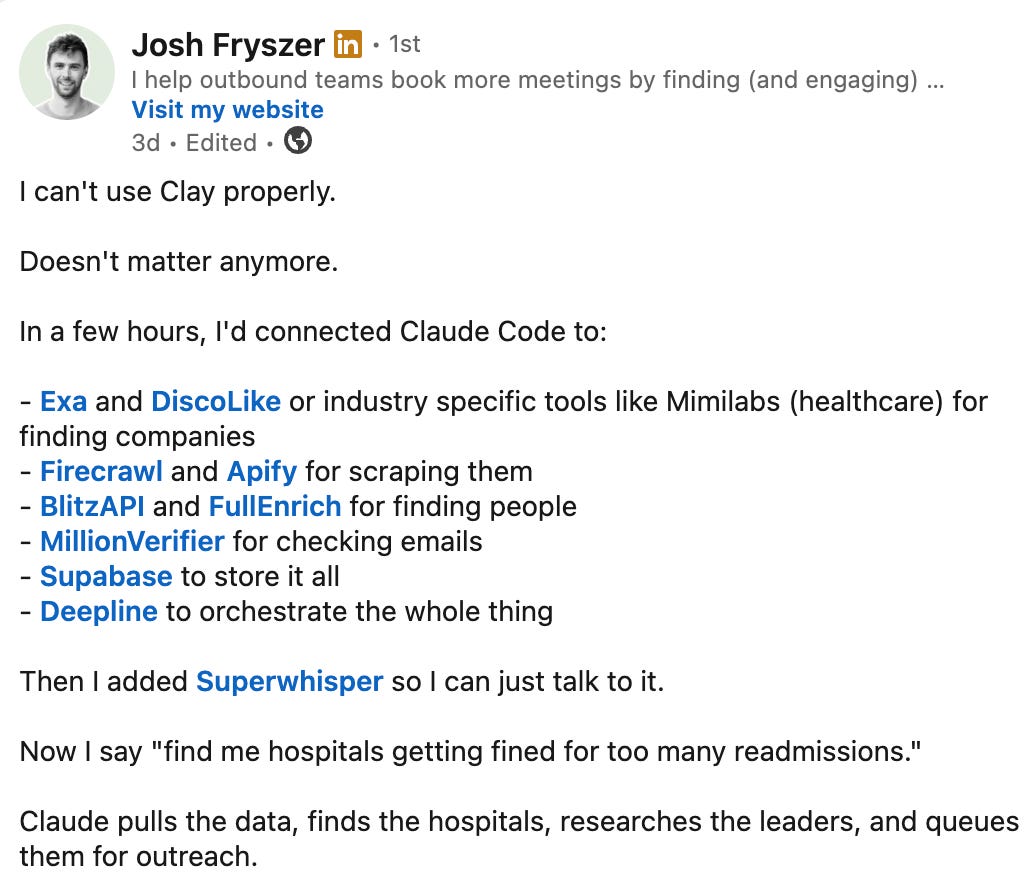
A GTM agency owner, Josh Fryszer, wired Claude Code up to his stack (Exa, Firecrawl, BlitzAPI, FullEnrich, MillionVerifier and Supabase) in a few hours instead of weeks.
He is not a developer. His conclusion:
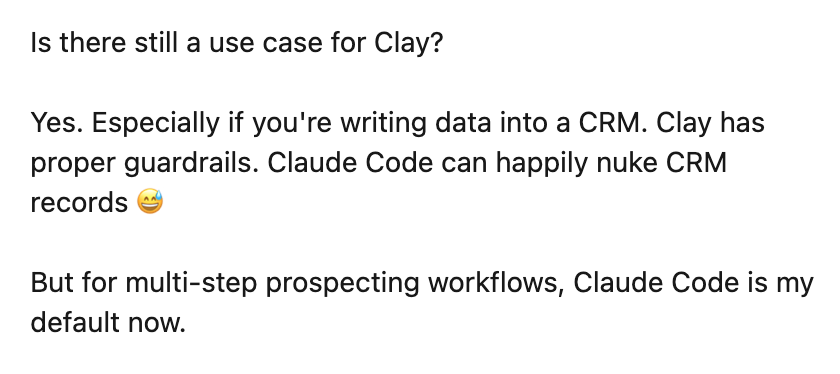
“Is there still a use case for Clay? Yes. Especially if you’re writing data into a CRM. Clay has proper guardrails. Claude Code can happily nuke CRM records.”
That is one slice of the moat. Safety when you write into HubSpot or Salesforce. Claude Code can delete the wrong list. Clay has the brakes built in.
Adam Robinson runs a $10M+ ARR SaaS. He showed the full stack his agency built for him:
Claude Code reads 569 demo call transcripts and pulls out competitor signals.
Apify pulls 9,000 contacts through MCP.
Then a webhook drops everything into Clay. Clay enriches, validates, segments.
Look at where Clay sits in that stack. Middle layer. Between the smart upstream work (call transcripts, signal extraction) and the execution at the bottom (sending).
That middle layer is structured enrichment at volume, with audit trails, across thousands of rows. That is the moat in production.

Two founders, two setups. Same moat, two angles: safety and structured volume.