Clay vs. Claude Code: what nobody's telling you
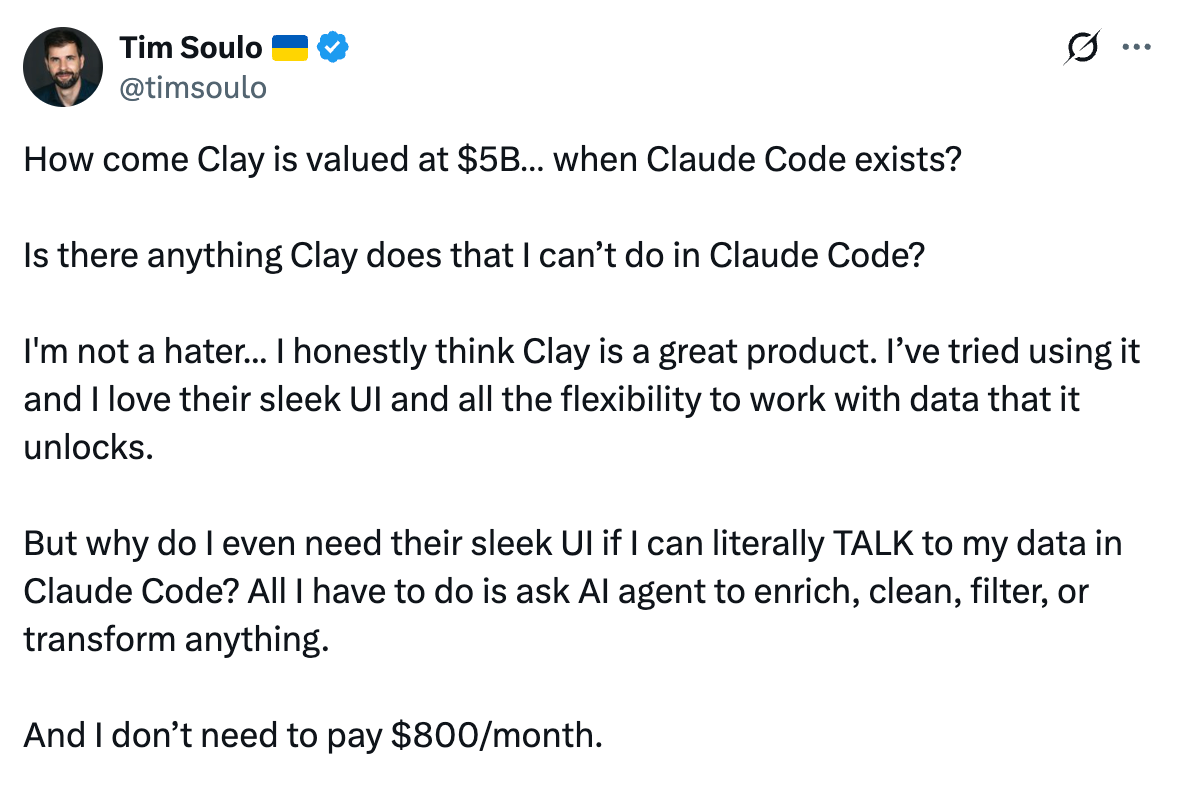
How come Clay is valued at $5B... when Claude Code exists?
Tim Soulo did not ask that question by accident.
When the CMO of Ahrefs publicly wonders, he is not making a product comparison, but pointing at something structural: a company whose entire value proposition sits between you and data you could access directly.
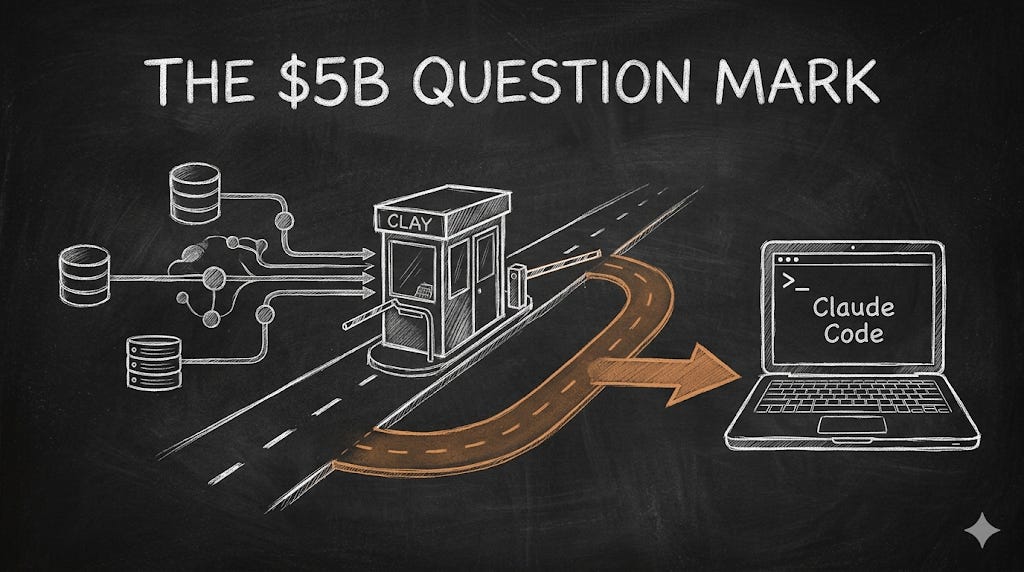
Rather than a $5B moat, that is a $5B question mark.
And last week, about 100 people had something to say about it on LinkedIn.
The debate in the comments was fascinating: founders, GTM engineers, and operators all weighing in on Clay vs Claude Code.
But underneath all of it, one comment from Alex Bojovich (Ramp) said it all:
“Clay helped train an entire market to value enrichment data. That market is now about to buy it without Clay in the middle.”
What Clay Actually Built
Clay is not a data company. It never was.
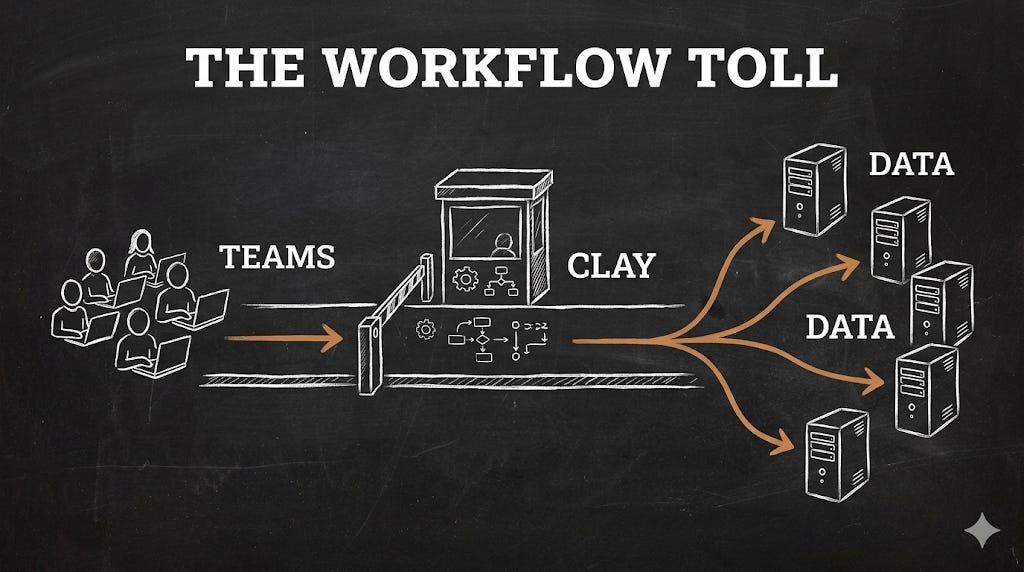
What Clay built is a toll road. You pay to pass through it, and on the other side sits data that belongs to someone else entirely. Clearbit, Apollo, Hunter, ZoomInfo, and a dozen other providers own the actual information.
Clay owns the infrastructure that connects them and makes them usable together.
Infrastructure that is genuinely useful:
Waterfall enrichment: query multiple providers in sequence until you get a verified result
Deduplication: clean and merge data from different sources automatically
Workflow logic: trigger actions based on enrichment results without writing code
Routing: push enriched contacts directly into your outreach tools
For teams who needed all of that without an engineering team, Clay has been the answer. It turned a complex multi-vendor data problem into a visual interface anyone could learn in a week.
But here is the distinction that changes everything:
Clay owns the workflow. The data vendors own the data. You pay for both, bundled together into one credit system that obscures exactly how much each part actually costs.
The moment those two things separate, Clay’s position in your stack becomes a choice rather than a necessity.
And MCP is what separates them.
The Tell Hiding in Plain Sight
Clay made three moves last quarter that most people noticed separately. Put them together and they tell a clearer story.
Cut data costs by 60%
Removed AI markup
Launched MCP support
Each one on its own looks like a product update. Together, they look like a company that can see a threat coming and is repositioning before it arrives.
Think about what each move actually signals:
The price cut tells you Clay knows their credit margin is vulnerable. If teams can access enrichment data directly through MCP, paying a markup to Clay becomes optional. Getting ahead of that by cutting prices first is smart. It is also defensive.
Removing the AI markup tells you the same thing from a different angle. Charging a premium for AI features only works as long as the AI layer is hard to replicate. Claude Code running inside your own terminal, connected to the same data sources, removes that premium entirely.
MCP support is the most interesting move of the three. Clay is essentially building the bridge that makes it easier to route around them. That is either visionary or desperate, depending on how well they execute.
Scott Martinis called it: "Plan for a world where no one ever logs into your app."
Clay is not ignoring the shift. The question is whether they can move fast enough to stay relevant on the other side of it.
Companies that are confident in their moat do not make three defensive moves in the same quarter.
How the Middleman Gets Cut Out
This is not a prediction, but a sequence of events that is already in motion.
Step 1: MCP turns every data vendor into a direct connection
Apollo just launched their MCP server. Crunchbase has one. Brave Search, Serper, Hunter, and a growing list of providers are either live or building.
Inside Claude Code, you connect to them with a single terminal command and query them directly in plain English. No Clay table or credit system. Neither a UI to log into.
Step 2: Data vendors do the maths
Every time a founder queries Apollo through Clay, Clay takes a cut. The vendor gets less, the user pays more, and Clay sits in the middle collecting the margin.
The moment vendors can sell directly to the agent through MCP, that margin disappears and goes back to both sides. Higher revenue for the vendor. Lower cost for the user. The only loser is the orchestration layer.
Step 3: The “add a new vendor” advantage evaporates
One of Clay’s strongest arguments is convenience. Adding a new enrichment provider takes minutes inside their interface. But connecting a new MCP server inside Claude Code also takes minutes.
When the ease-of-use gap closes, the only remaining argument for Clay is the credit system itself. Which is not much of an argument.
Step 4: The Claybros become a liability
Clay’s creator ecosystem is one of its most valuable assets. Consultants and agencies built entire businesses teaching people how to use Clay. But that ecosystem also means Clay’s complexity became a feature rather than a bug.
A tool that requires specialists to run is a tool with an expiration date. When the alternative is plain English instructions in a terminal, the specialist tax disappears.
The irony is almost perfect: Clay spent years training an entire market to value enrichment data. That market is now about to buy it without Clay in the middle.
What This Means for Your Stack Today
This is not a “Clay is dead” take. It is a “know what you are actually paying for” take.
Clay still makes sense in specific situations:
Large teams that need a UI anyone can pick up when people leave
Enterprise environments where getting a new MCP integration past a security review takes months
High-volume operations running scheduled enrichment across tens of thousands of records
Non-technical teams where the visual workflow builder is the difference between using the system and not using it at all
For everyone else, the honest stack looks like this:
Claude Code for research and targeting: finding companies that match your ICP, identifying buying signals, pulling structured data from public sources. Faster, cheaper, and more precise than Clay for this specific job.
Direct MCP connections for enrichment: Apollo MCP is already live. Brave Search and Serper handle web research. You connect once, query directly, skip the credit markup.
Clay only where it is genuinely irreplaceable: waterfall enrichment at scale, complex routing logic, or anywhere your team needs a visual interface to function.
The stack that made sense 18 months ago was Clay for everything.
The stack that makes sense today is Claude Code for research, direct MCP for enrichment, and Clay only where nothing else fits.
Six months from now, that split will look even more pronounced.
The window to build your muscle in Claude Code before your competition does is right now. Not next quarter.
Takeaway
The GTM infrastructure era is ending. Not with a crash, but with a quiet series of API connections that route around the tools that used to be necessary.
Clay is not the villain in this story. They built something genuinely useful and they are smart enough to see what is coming. The three moves they made last quarter prove that.
But useful is not the same as irreplaceable. And the window between those two things is closing faster than most people realise.
A few things worth remembering:
The data vendors have no loyalty to the orchestration layer. They will go direct the moment it is economically rational to do so.
The moat that compounds is the playbook, not the tool. Knowing which signal predicts a deal in your specific market is earned knowledge. It cannot be bought from a data vendor or copied from a GitHub repo.
The early movers have a real window. Founding teams building their Claude Code muscle now will have systems compounding by the time the rest of the market catches up.
The question is not whether this shift happens, but whether you build before or after your competition does.
PS: Want to skip Clay for lead enrichment?
The Claude Code Lead Enrichment Guide shows you exactly how to connect any enrichment provider to Claude Code via MCP and enrich your account list with verified contact data, without Clay as the middleman.
What is inside:
MCP setup for common enrichment providers: Apollo, Hunter, Findymail, and Clearbit
The
/enrichSkill file: drop it into your project and run it on any account listThe exact prompt structure that enriched 80 accounts in 20 minutes on a live client call
A decision guide: when the direct MCP stack is enough and when Clay is still worth keeping
Get immediate access here.


I somewhat agree with this post, but for me, the real beauty of Clay is that I get immediate access to a heap of data providers without having to sign up for multiple accounts. In the Claude Code scenario I need to manage tons of providers and accounts. Add on to that workflows and tables that I can share across users vs. isolated enrichments running in the command line and there's still very much a case for Clay's "middleware" layer. That said, I do love me some Claude Code for enrichment 😂