

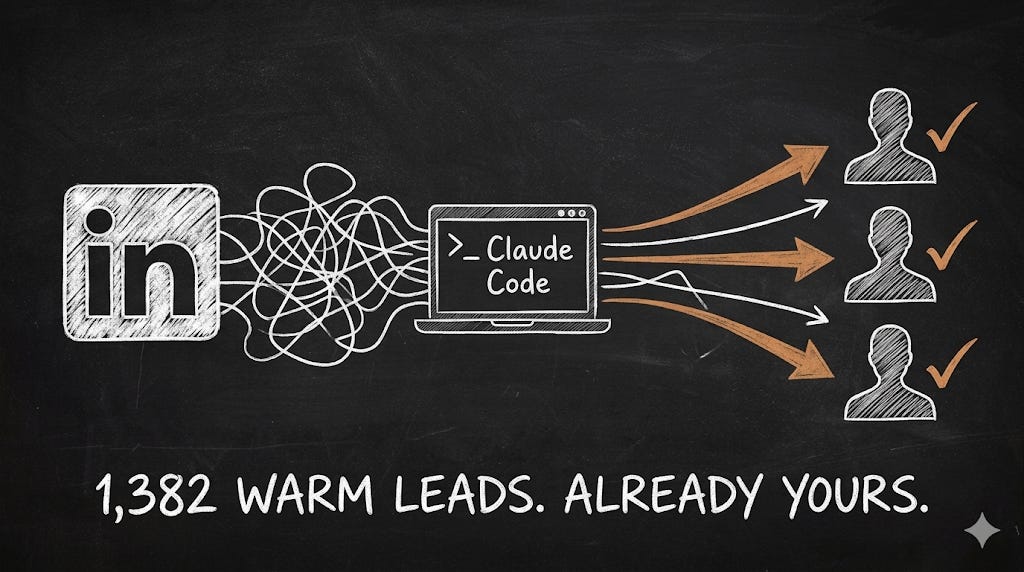
Last week, I sat down with Claude and my full LinkedIn data export, just to finally see what my network actually looked like.
One hour later I had an entire map of every warm path to every ICP-fit prospect I could reach through just six people I already trusted.
The data baffled me:
1,382 founders and CEOs I had never spoken to, one introduction away from someone I know well.
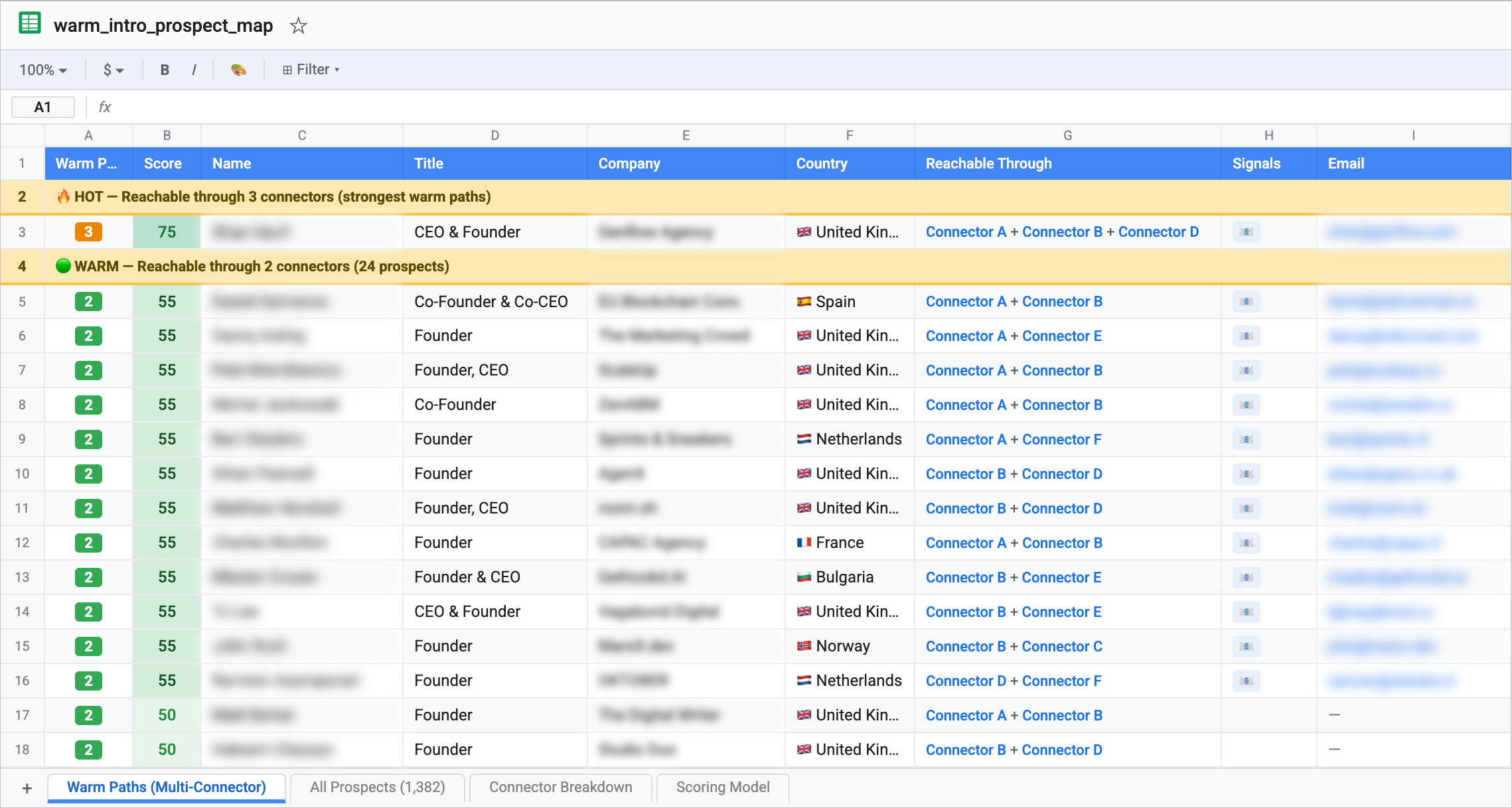
25 prospects connected to two or more of those six people, meaning multiple independent warm paths into the same conversation.
5 past clients who had publicly endorsed me on LinkedIn and who I had not contacted in months.
The network was never small. The problem was that I could not hold it in my head.
Why this matters more now than ever
Commsor surveyed 1,305 sales leaders in 2025. The numbers are hard to argue with:
Only 23.6% hit their revenue goals
It now takes roughly 1,400 outbound touch points on average to book a single meeting, up 5x in five years.
82.4% say warm intro deals close faster than cold-sourced ones
Warm intros show a 3% no-show rate compared to 25% for cold outreach
Warm closes at 2 to 4x higher rates compared to cold
The problem has never been awareness, since every founding team knows warm intros work.
But, only 18% have a reliable system to generate them consistently. The other 82% default to cold because it feels scalable, even though it is the harder path by almost every metric.
What has changed is that the infrastructure to build that system now exists and does not require an ops team or a CRM budget. It requires your LinkedIn export, Sales Navigator, a Claude account, and a few hours.
How the system works: 4 layers
Layer 1: The network audit
You cannot use what you cannot see.
The first step is getting an clear picture of who you actually know and how strong each relationship really is, based on data rather than memory.
Your brain cannot hold a relationship graph for 5,000 people, but AI can. The audit cross-references every signal you have: LinkedIn connections, DM history, calendar meetings, email threads, CRM records, newsletter subscribers, recommendations received, etc.
It produces a ranked list of your top connectors by composite signal score, instead of perceived closeness.
Here is what my own audit returned:
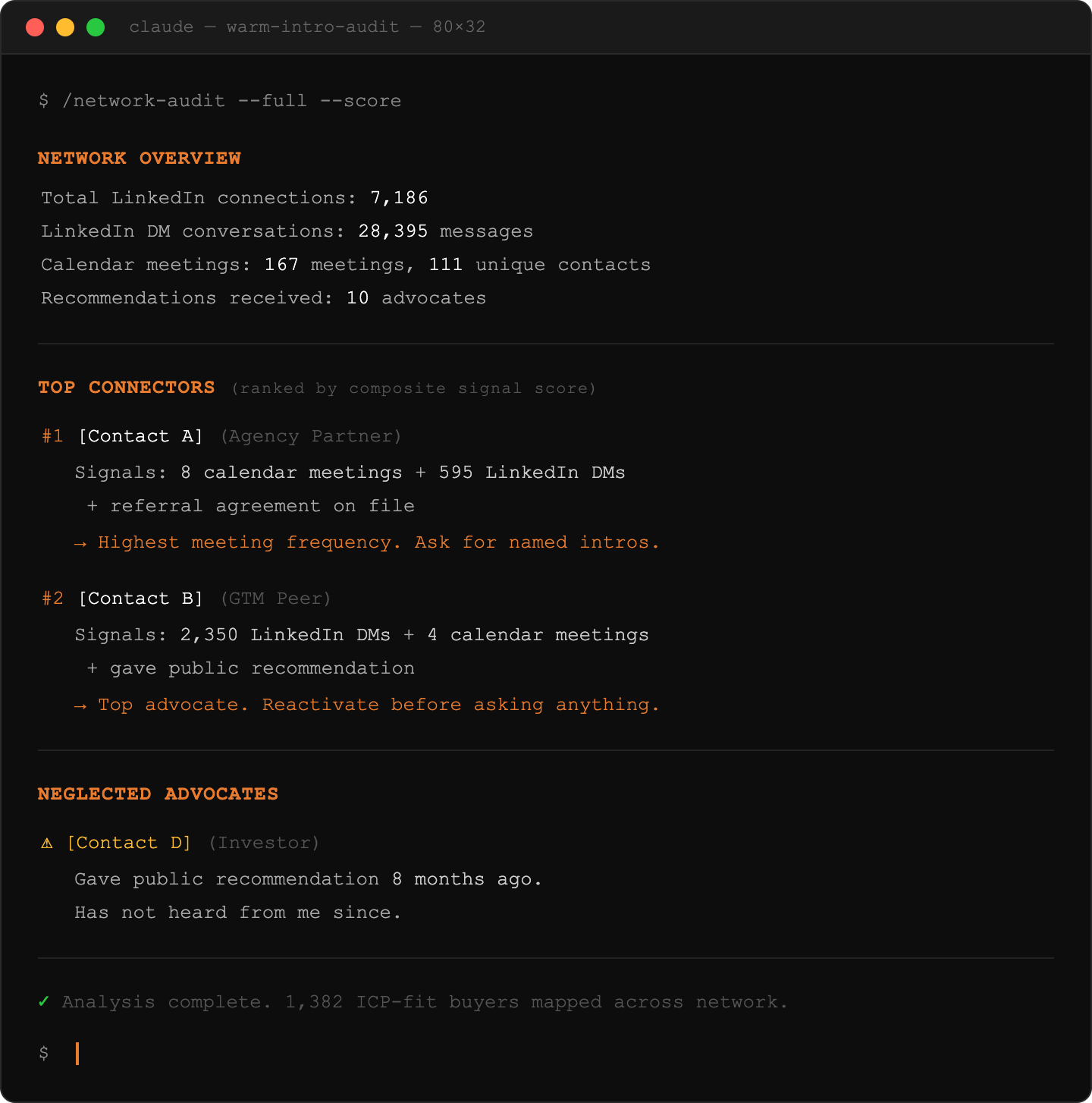
The audit also told me something most teams completely miss: people who publicly endorsed them and have since gone un-contacted. These are the warmest possible starting points. They already spent social capital on you.
One thing worth absorbing before you start. Peter O'Donoghue at Nynch has researched relationship decay and found that when the gap between conversations exceeds roughly 8 times the natural conversation cadence, the probability of the relationship surviving drops below 50%.
Before you ask any connector for anything, check when you last spoke to them properly. If the answer is too long, that is where you start.
What you need:
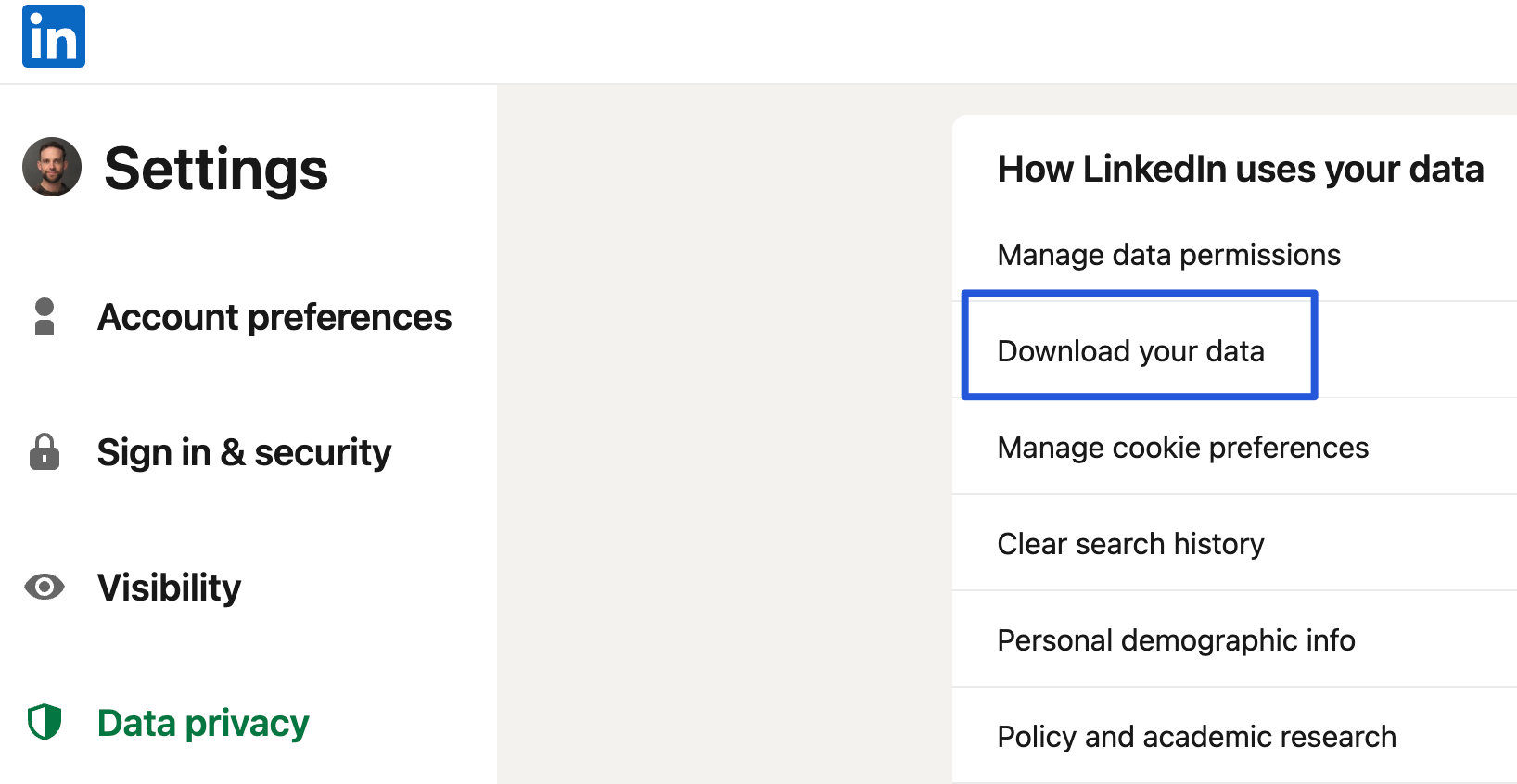
LinkedIn data export: connections and messages CSV (Settings, Data Privacy, Get a copy. 24 hours to arrive)
LinkedIn Sales Navigator: essential for Layer 2. Without it you cannot export a connector’s network filtered by your ICP criteria, which is the core mechanism of the whole system
CRM export or a basic spreadsheet: contact, company, deal stage, last touch date
Calendar and Email client connected via MCP so Claude pulls data directly without manual exports
Any other rich source like a newsletter subscriber list
Minimum viable starting point: LinkedIn connections, messages, and a Sales Navigator account. Add the rest as you go.
Layer 2: Mapping warm paths to your target accounts
Once you know who your strongest connectors are, the question becomes: who do they know that you actually want to meet?
Richard F. Purcell at MoxieGTM makes a point worth taking seriously: start with your Ideal Customer Profile (ICP) and work inward toward your network, never the other way around.
If you start from who your connectors know and then decide whether those people are worth talking to, you end up chasing whoever is easiest to reach rather than whoever you actually want as a client.
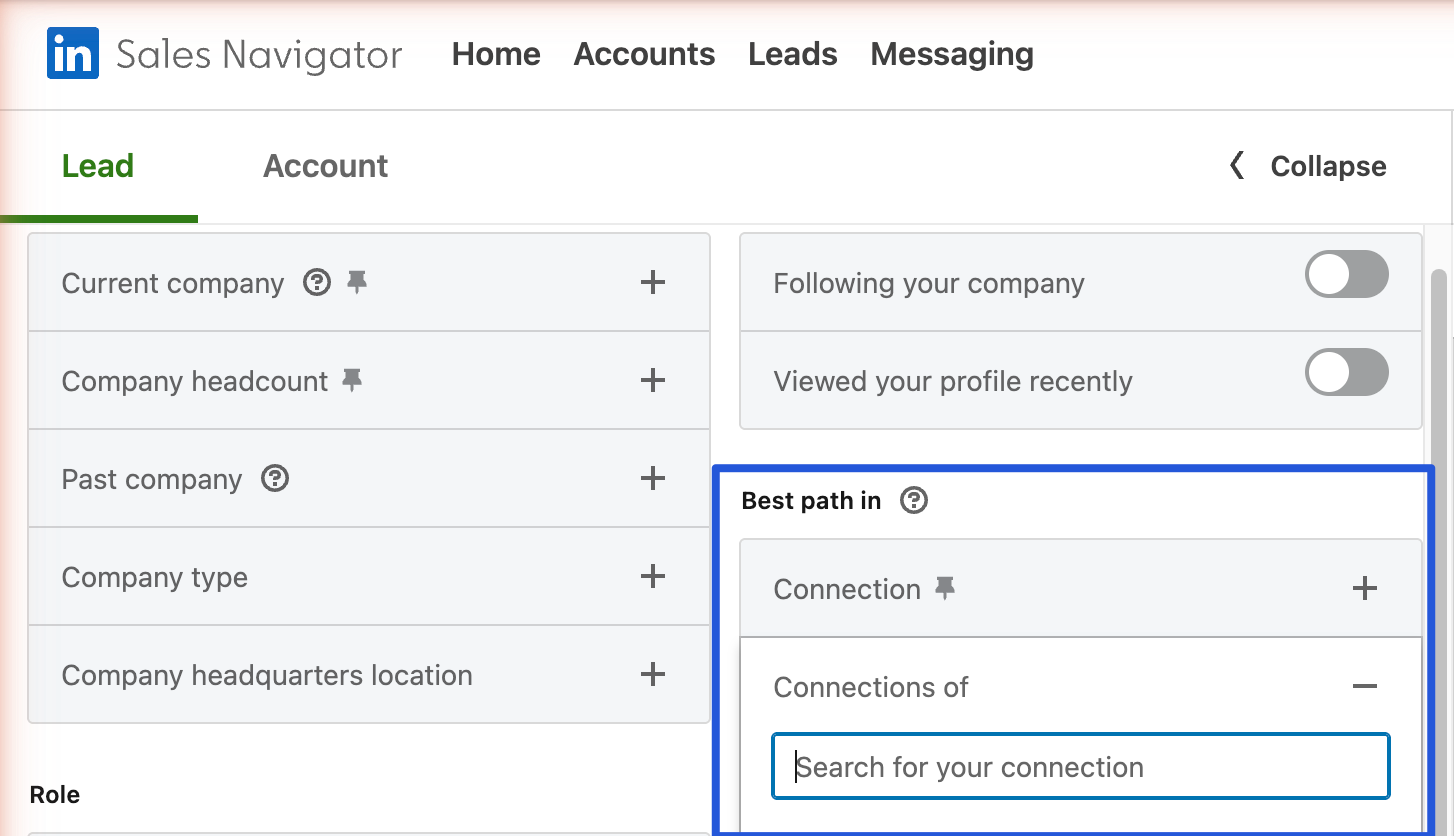
The process: for each of your top connectors, run a Sales Navigator search using the “Connections of” filter stacked with your ICP criteria, export the results as CSV with a LinkedIn scraper extension like Apollo or Prospeo, and upload everything to Claude.
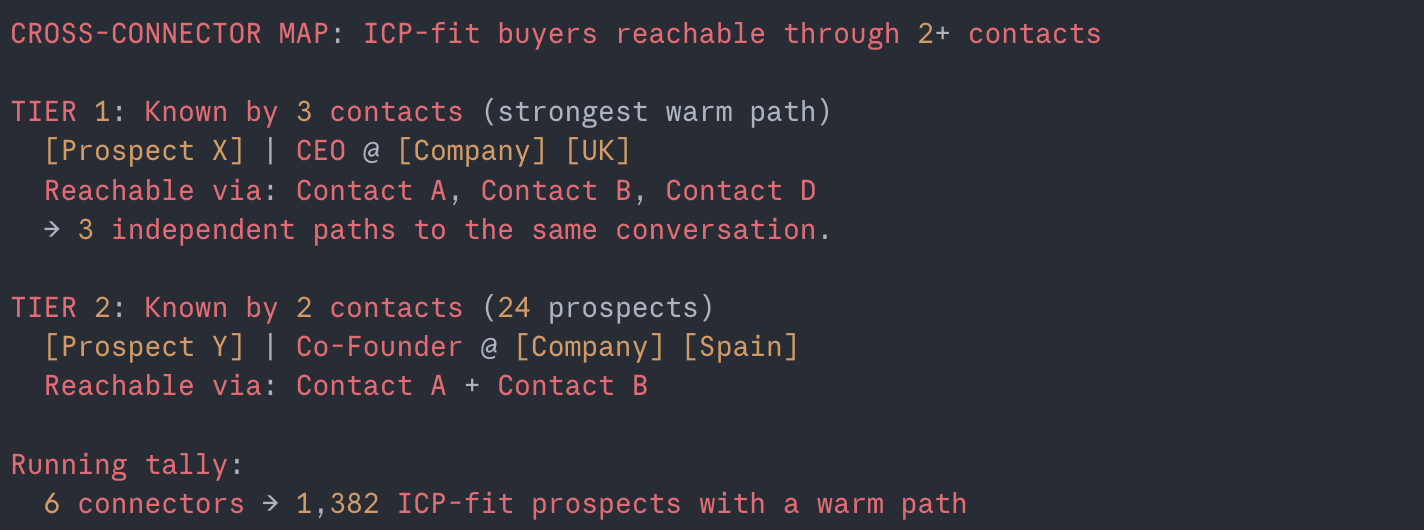
The cross-matching prompt produces a ranked map of every ICP-fit prospect reachable through your network, prioritised by how many independent paths exist.
Here is what that looked like after processing six of my connectors:
Before you ask anyone for an introduction, check the actual strength of their relationship with the prospect, because a LinkedIn connection is not a relationship.
Richard Purcell developed a simple framework for this called S/W/X:
S (Strong): They talk regularly. Ask for a formal introduction.
W (Warm): They have interacted a few times. Use their name in your own direct outreach instead.
X (Weak): Just a connection. Go direct with no reference to them at all.
The name-reference approach in a direct DM, where you mention the mutual connection yourself rather than asking them to broker anything, delivered 4x higher reply rates in Purcell’s testing and scales without spending anyone else’s social capital.
Layer 3: Turning past clients into active connectors
A connector says “you should meet this person.” A past client says “I worked with them and here is what changed.” The second converts at a different level entirely.
Angel Gambino, who has facilitated over a thousand founder introductions, ranks referral conviction by source. Customers who received a real outcome sit at the top of the list, above investors, advisors, and partners.
Many founders have three to five past clients who could make one referral each and fill a meaningful pipeline. The reason it does not happen is the ask is too vague. “Do you know anyone who could use my help?” is essentially unanswerable.
Tie the ask to the exact pain your client experienced before working with you: “Do you know two or three founders dealing with [specific problem you solved for them]?”
That triggers a specific memory and a specific name instead of a general search.
If you have not spoken to a past client in six months, reopen the relationship before the ask.
A quick check-in on how the outcome you delivered is holding up costs nothing and reopens the conversation naturally. Peter O’Donoghue calls this ‘closing the loop’. Only ask for referrals once you are talking again.
Layer 4: The playbook
The map tells you who is reachable. The composite scoring tells you how warm each path actually is.
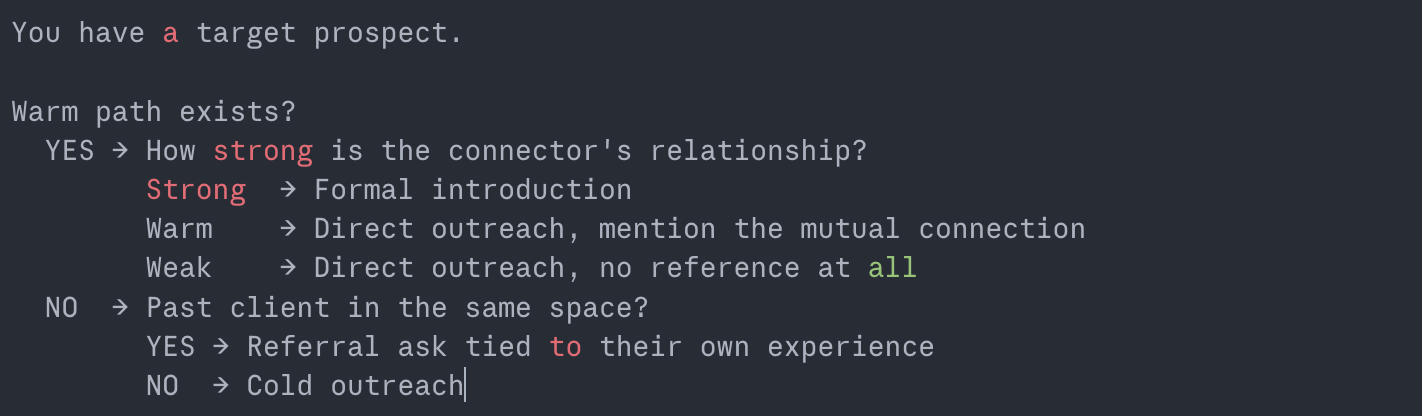
What you do with that information depends on one question: how strong is the relationship between your connector and the prospect?
That is precisely what the system is designed to answer before you ever open a message window. By the time you are deciding what to say, you already know whether you have a strong path, a warm path, or no path at all.
Founders often make that call from memory and get it wrong. The audit makes it from data.
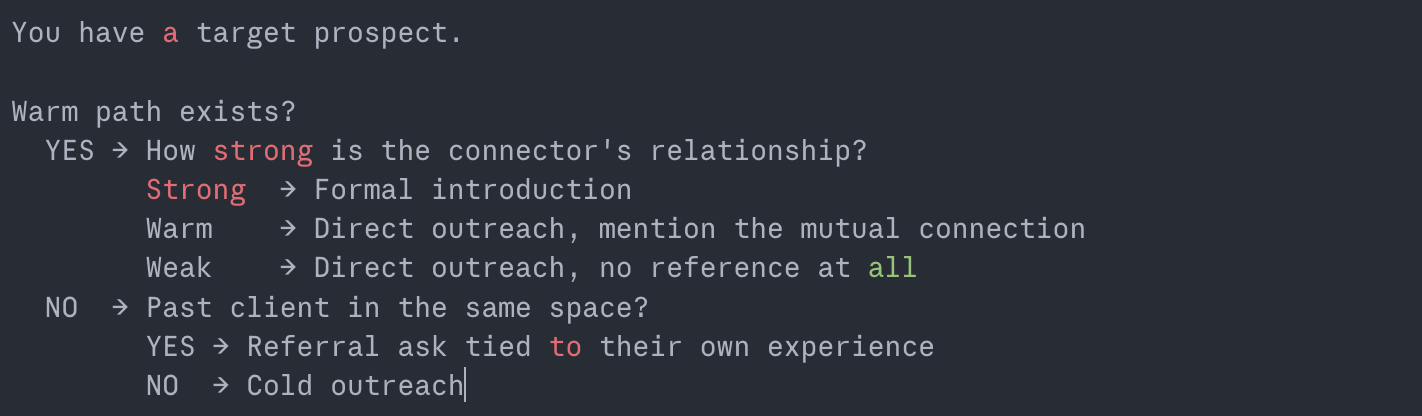
Here are the four plays, in order of relationship strength:
When the connector has a strong relationship with the prospect
—> ask them to make a formal introduction. Write the forwardable message for them so the ask on their end is one click, not a conversation.When the connector knows the prospect, but not closely:
—> reference the mutual connection in your own direct message. No ask on the connector’s end. You are using the relationship as context, not as a favour.When there is no strong connector path but a past client operates in the same space:
—> ask the past client for a specific referral tied to the exact pain they experienced before working with you.When no warm path exists:
—> direct outreach using the YYY approach covered in the cold email guide.
Takeaway
Cold outreach is mostly broken because volume alone cannot compensate for the lack of relevance.
Warm intros sidestep most of that problem. The trust is pre-built, and the relevance is assumed. The no-show rate drops from 25% to 3%.
But, warm intros at scale require infrastructure. What this system does is turn your existing network into a structured, queryable asset.
The connections are already there. The warm paths are already there. The neglected advocates who publicly endorsed you are already there.
Claude does not create any of that. It just makes it visible in a way that your memory never could.
Three things to do before this article disappears from your inbox.
Export your LinkedIn data today, it takes 24 hours to arrive.
Write down every past client from the last two years while you wait.
And check when you last spoke properly to your five strongest connectors.
The answers to those three questions will tell you more about the state of your pipeline than any campaign dashboard.
PS: Want the complete warm intro system that keeps the whole thing automatically updated as your network grows?
The Warm GTM System Guide walks through every layer in full:
The full network audit prompt with multi-source composite scoring
The cross-connector matching prompt and the exact output structure
The referral activation brief builder and two re-engagement plays for cold relationships
The Claude Code setup: folder structure, CLAUDE.md, and single-command workflows for audit, match, referral, and score
The decision tree and complete four-play playbook
Get instant access here.