
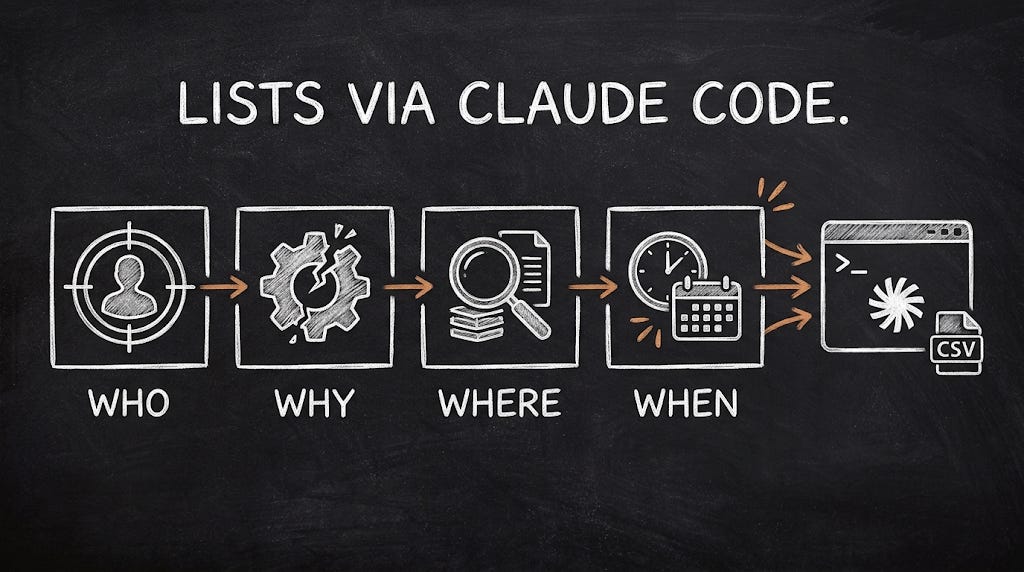
Your best ICP list built with Claude Code
When outbound stops working, the copy often gets the blame.
Founding teams rewrite subject lines, test new frameworks, switch tools, and eventually conclude that cold outreach is dead.
The list never comes up, even though the list is almost always where the problem started.
Before anything else works, three things have to come together:
Targeting: the right message to the right person. WHO is dealing with the problem you solve, right now.
Credibility: making it obvious you can actually fix that problem. Why should they trust YOU over anyone else.
Your Offer: something worth acting on. Why NOW, not next quarter.
Today we are covering number one, because without it, the other two are a waste of good copy.
Get targeting right and everything downstream gets easier.
Your emails write themselves because you know exactly what pain you are addressing.
Your reply rate starts reflecting the quality of your thinking rather than the luck of your timing.
By the end of this edition you will have a framework for building a hyper-targeted account list and a Claude Code prompt you can run today to pull your first raw list in under an hour.
1: WHO and WHY: How To Define Your Ideal Prospect
Founders usually know their WHO: The title, the industry, the company size. That is a starting point, but not a list. Thousands of companies fit that description right now, and most of them will never buy from you.
The missing piece is the WHY: The specific business context that makes someone a real buyer rather than a profile that looks right on paper.
Think about the last two or three clients you won. Ask yourself what was true about those companies at the moment you reached them. Not their industry, but their situation. What was breaking, shifting, or about to become urgent?
That context is your WHY. Write it down before you open any tool.
Bad WHY: “Companies that need better reporting.”
Good WHY: “Finance teams at startups with three to five entities doing month-end close in spreadsheets across multiple currencies. The CFO is reconciling manually. It takes eight to ten days. They have outgrown the process but have not yet hired a Controller to fix it.”
The second version tells you exactly what to search for and what signals confirm a fit. The first tells you nothing.
Three things worth getting specific on:
The breaking point. What has to be happening for your product to feel urgent, not just interesting?
Who feels the pain daily? Not always the person who signs. Your WHY needs to resonate with the first one to reach the second.
What your best customers had in common. Their situation at the moment they said yes, not their industry.
2: WHERE: Unique Prospect Data
Once your WHO and WHY are precise, the right data source becomes obvious. Different buyers leave different digital footprints, and Claude pulls from whichever source fits your ICP.
A practical map:
Funded startups: Crunchbase, TechCrunch, Sifted, EU-Startups. Funding announcements come with company context, headcount signals, and investor names already baked in.
B2B SaaS founders and early-stage teams: The YC company directory is underused and filterable by batch, industry, and stage. Product Hunt and Indie Hackers are worth checking if your buyer is earlier stage or bootstrapped.
Companies using specific tools: G2 and Capterra surface companies actively reviewing tools in your category, which is a strong intent signal on its own. Job postings that mention specific software tell you exactly what a company runs without you having to guess.
Professional services and SMBs: Companies House and equivalent local registries give you incorporation date, filed accounts, and director names. Industry directories and conference sponsor lists are underrated sources for niche verticals.
These are all key signals that you need include when collecting data.
The principle is straightforward: Go where your buyer already has a digital footprint that reflects their business reality, not just their job title.
3: WHEN: Trigger Events: When Prospects Are Ready To Buy
This part is separate from the WHY and comes after your core list criteria are defined.
Trigger events do not determine whether a company belongs on your list. Your WHO and WHY already do that.
What trigger events tell you is which companies on your already well-targeted list are worth contacting this week rather than next quarter.
A company that fits your WHO and WHY with no recent trigger event is still a valid prospect, just with lower urgency.
A company that fits your WHO and WHY and just hired a new CFO, raised a Series B, or posted three SDR roles at once has a concrete reason to act now. That difference matters when you are deciding where to spend your outreach energy first.
One thing worth being careful about: building a list entirely around trigger events without validating fit first produces companies that are active but wrong. Active and wrong burns your reputation faster than anything else.
Trigger events worth tracking:
New funding round: growth mode, new budget, new pressure to show results fast
New C-suite hire in your target function: new leader, new priorities, short window to influence
First sales leader hire: founder transitioning out of founder-led sales, systems do not exist yet
Multiple open roles in one function at once: scaling pain is already visible
Job posting mentions a tool you replace or integrate with: live evaluation happening right now
Think of trigger events as a prioritisation layer. They sit on top of a list that is already well-targeted. Without strong WHO and WHY underneath them, they are just noise.
4: Building the List with Claude Code
You no longer need Apollo or Sales Navigator to build a targeted account list. Claude Code with Brave Search pulls structured prospect data from public sources based on your exact criteria. No exports, no manual tabs or spreadsheet wrangling.
Here is a prompt you can run today inside your project folder. Adapt the criteria to your ICP:
Search for B2B SaaS companies in the UK that:
- Have raised a Series A or B in the last 18 months
- Have between 30 and 150 employees
- Operate across multiple entities or geographies
(look for clues in their website, job postings,
or news coverage)
- Are currently hiring in their finance function
(CFO, Controller, FP&A Analyst, or similar)
Search these sources in order:
1. Crunchbase for funding data and headcount
2. TechCrunch and Sifted for recent announcements
3. LinkedIn for hiring signals and team structure
4. Company websites and careers pages to confirm
multi-entity structure
For each company found, record:
- Company name
- Domain
- Funding stage and amount if available
- Employee count estimate
- Evidence of multi-entity structure
(quote the specific source and what it says)
- Finance roles currently posted
- Buying signal: HOT, WARM, or COLD
HOT = multi-entity confirmed + active finance hire
WARM = multi-entity likely + no active hire
COLD = fits WHO criteria but WHY unconfirmed
- Source URL
Save to companies.csv. Aim for 30 to 50 companies.
Skip any company where you cannot find evidence
of the multi-entity structure from a public source.
Do not guess. Write UNKNOWN rather than assume.
After every 10 companies, save the file.A few things that make this prompt stronger than a generic search:
The source order matters. Telling Claude where to look first reduces the chance of it pulling thin results from low-quality pages.
The evidence requirement is explicit. Asking Claude to quote the specific source means every row in your CSV has a documented reason for being there, not just a name that looks right.
The scoring criteria are defined inline. Without this, HOT and WARM mean something different every session. With it, the ratings are consistent.
The save frequency is locked. Saving after every 10 companies protects against session timeouts on larger lists.
The result is not a list of 500 names. It is 30 to 50 companies where every row has a documented reason for being there.
The Takeaway
A target account list is not a database of names that match a job title filter, but a collection of companies where you have documented evidence that the business context is right, the fit is there, and the timing makes sense.
The WHO tells you which door to knock on.
The WHY tells you whether anyone is home.
The WHERE tells you where to find them.
The WHEN tells you whether now is the right moment to knock.
Get all four right before you touch enrichment and everything downstream gets sharper.
Your research produces useful briefings. Your emails land harder.
Your reply rate reflects the precision of your list, not just the quality of your copy.
In the next edition, we take this companies.csv and run it through lead enrichment APIs to fill in contact data, validate signals, and get it ready for the sequence.
Until then,
PS: Want the full list building system?
The Claude Code GTM Account List Builder takes you from blank folder to scored companies.csv in under an hour.
What is inside:
A WHO and WHY worksheet to translate your customer base into precise, filterable criteria
A pre-written CLAUDE.md template with every block ready to fill in
Full project folder setup with exact folder structure and terminal commands
A ready-to-run
/list-builderSkill file for your.claude/commands/folderA
companies.csvtemplate pre-structured and ready for the enrichment guideA buying signal scoring guide with real examples across four common ICP types
Serper and OpenWeb Ninja setup walkthrough with a decision tree for your ICP type
A validation checklist to confirm every row is ready before enrichment
A troubleshooting guide covering the six most common problems with exact fixes
A list maintenance system with weekly, monthly, and quarterly habits
Get immediate access here.


